


Defending a territory already on its way out
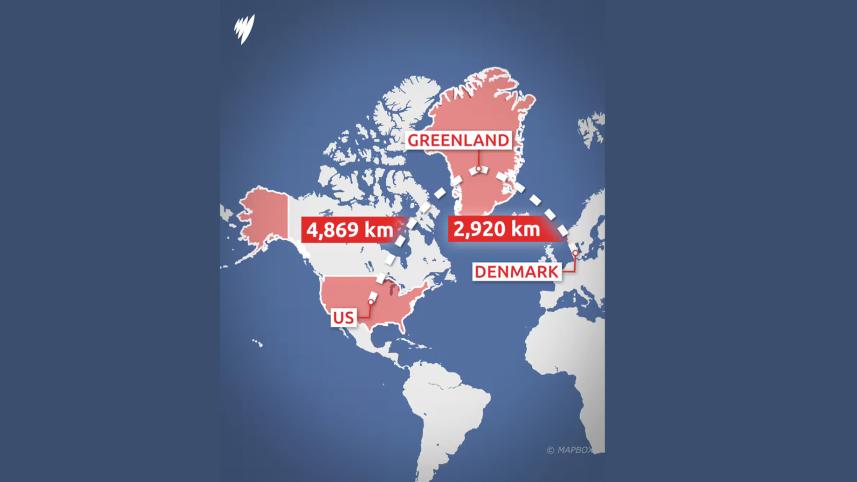
When US Secretary of State Marco Rubio meets his Danish and Greenlandic counterparts next week, Denmark will be defending a territory that has been moving steadily away from it and towards independence since 1979.
President Donald Trump’s threats to seize Greenland have triggered a wave of European solidarity with Denmark. But the crisis has exposed an uncomfortable reality - Denmark is rallying support to protect a territory whose population wants independence, and whose largest opposition party now wants to bypass Copenhagen and negotiate directly with Washington.

“Denmark risks exhausting its foreign policy capital to secure Greenland, only to watch it walk away afterwards,” said Mikkel Vedby Rasmussen, a political science professor at University of Copenhagen.
Denmark cannot let Greenland go without losing its geopolitical relevance in the Arctic territory, strategically located between Europe and North America and a critical site for the US ballistic missile defence system.
Yet it may ultimately have nothing to show for its efforts if Greenlanders choose independence -- or strike their own deal with Washington.
The stakes extend beyond Denmark’s national interests. European allies have rallied behind Denmark not just out of solidarity, but because giving up Greenland would set a dangerous precedent that could embolden other powers to pursue territorial claims against smaller nations, upending the post-1945 world order.
Denmark’s foreign ministry declined to comment, but referred to joint remarks by Danish Prime Minister Mette Frederiksen and Greenlandic Prime Minister Jens-Frederik Nielsen on December 22.
“National borders and the sovereignty of states are rooted in international law,” the two leaders said. “They are fundamental principles. You cannot annex another country ... Greenland belongs to the Greenlanders.”
For now, the Trump administration says all options are on the table, including buying the territory or taking it by force.
Copenhagen professor Rasmussen said any discussion of whether holding on to Greenland is worth the cost has been drowned out by outrage at Trump’s threats.
“It is not part of the political debate in Denmark. I fear we have gone into patriotic overdrive,” he said.
During the Cold War, Greenland’s strategic location gave Denmark outsized influence in Washington and allowed it to maintain lower defence spending than would otherwise be expected of a Nato ally.
This became known as “the Greenland Card”, according to a 2017 report by the University of Copenhagen’s Centre for Military Studies.
But Greenland’s aspirations for self-determination have been brewing since the former colony got greater autonomy and its own parliament in 1979. A 2009 agreement explicitly recognised Greenlanders’ right to independence if they choose.
Copenhagen provides an annual block grant of roughly 4.3 billion Danish crowns ($610 million) to Greenland’s economy, which is near stagnation with GDP growth of just 0.2 percent in 2025.
Prime Minister Frederiksen faces a difficult balancing act, said Serafima Andreeva, researcher at Oslo-based Fridtjof Nansen Institute.
For now, Denmark has little choice but to stand firm to maintain its diplomatic credibility, but in doing so risks the relationship with the United States at a time “when Russia is an accelerating threat and being on the US’s bad side is no good for anyone in the West”.
 For all latest news, follow The Daily Star's Google News channel.
Comments