


State enterprises bleed Tk 88,200cr every year: WB study

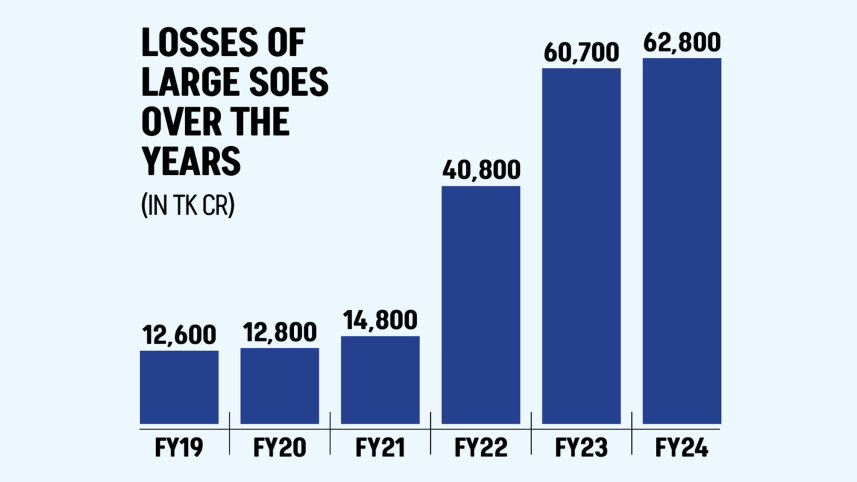
Bangladesh’s state-owned enterprises (SOEs) drained about Tk 88,200 crore from the national exchequer in a single year, emerging as one of the country’s biggest fiscal risks, according to a World Bank study.
The study recommended closing down the Trading Corporation of Bangladesh (TCB), which is a budget guzzler and its effectiveness in reaching out to the poorest of the poor is debatable.

The TCB was created in 1972 to provide essential food items owing to the war-ravaged economy, inadequacy of domestic production and weakness of private sector-based supply chains.
“After 53 years of independence and a flourishing private sector, the need for a TCB is not obvious -- the TCB cannot be a substitute for a strong and vibrant social protection programme,” said the study, which was prepared with the support of the Policy Research Institute.
Social protection to the poor should be provided through a large number of social protection programmes, including food distribution, income transfers and employment guarantee schemes.
Several SOEs like the Bangladesh Petroleum Corporation (BPC), the Chittagong Port Authority (CPA), the Bangladesh Telecom Regulatory Commission (BTRC) and the Civil Aviation Authority of Bangladesh (CAAB) earn modest profits, but most other enterprises either make very small profits or incur losses.
The energy sector is the biggest source of financial losses, with the Bangladesh Power Development Board (PDB), Petrobangla and the Bangladesh Rural Electrification Board (BREB) accounting for more than 90 percent of the losses.
Most of the manufacturing enterprises also make losses, even though they operate in a competitive market structure where a flourishing private sector prevails.
As of fiscal 2023-24, the SOEs showed a substantial negative rate of return on assets of -5.2 percent, found the study, which was unveiled yesterday at a workshop titled “Financial Performance and Fiscal Risk of SoEs in Bangladesh”.
In comparison, India obtained a ROA of 9.7 percent in 2024 while Vietnam secured an ROA of 11.9 percent in 2020.
Owing to this poor financial performance, the treasury had to provide a subsidy in an amount of Tk 44,100 crore (0.9 percent of GDP) in fiscal 2023-24 just to keep the SOEs afloat.
Total net fiscal transfers, including capital transfers, amounted to Tk 120,000 crore (1.7 percent of GDP).
Although the treasury provides investment funds to SOEs as loans, owing to a weak financial situation, most SOEs do not service the debts, making them effectively transfers to SOEs.
“The opportunity cost of this poor financial performance of SOEs is large.”
To put things into perspective, Bangladesh spends 1.6 percent of GDP on healthcare and social protection and 1.8 percent of GDP on education.
The deteriorating financial condition of public enterprises has become “unsustainable” at a time when Bangladesh is already facing falling revenue collection, slower economic growth and mounting pressure on public finances, the report said.
Subsequently, the study called for an overhaul of the SOE sector.
“The situation calls for a systematic approach to reforms.”
The diagnosis of the report suggests that the SOEs as a group suffer from severe operational and efficiency constraints imposed by the underlying corporate governance environment. Price controls further add to the poor financial performance.
 For all latest news, follow The Daily Star's Google News channel.
 The report also highlighted deep corporate governance weaknesses within Bangladesh’s SOE structure. It identified fragmented laws, bureaucratic control, weak oversight and lack of financial transparency as key reasons behind poor performance.
The first step is to classify SOEs by market structure and functions to determine what types of reform are needed.
SOEs that operate in a competitive market structure should be restructured with proper corporate governance to prepare them for eventual privatisation.
These include the Bangladesh Textile Mills Corporation, the Bangladesh Steel and Engineering Corporation, the Bangladesh Sugar and Food Industries Corporation, the Bangladesh Chemical Industries Corporation, the Bangladesh Forest Industries Development Corporation and the Bangladesh Jute Mills Corporation.
SOEs that function as a monopoly due to regulatory constraints should be put under competitive pressure through deregulation to allow for private participation and restructured with proper corporate governance.
These include the four SOEs in the energy sector (BPC, Petrobangla, REB and PDB) and the water utilities in Dhaka, Chattogram, Rajshahi and Khulna.
SOEs that provide essential services that are commercial in nature but are either natural monopolies or where government ownership is considered necessary for strategic reasons -- should be restructured through proper corporate governance.
These include the Bangladesh Shipping Corporation, the Bangladesh Inland Water Transport Corporation, the Bangladesh Road Transport Corporation, CPA, the Mongla Port Authority, the Bangladesh Land Port Authority, the Bangladesh Bridge Authority, the Payra Port Authority, BTRC, CAAB and the National Housing Authority.
SOEs that mostly perform non-commercial functions should be redefined to take away any limited commercial role and merged with respective line ministries that manage them. Their commercial roles should be reassigned to the private sector.
This includes the five construction-related SOEs Rajdhani Unnayan Kartripakkha (RAJUK), Chattagram Development Authority, Rajshahi Development Authority, Khulna Development Authority and Cox’s Bazar Development Authority.
Under this category are 19 service-related enterprises, most of which are tiny to start with: BJC, BADC, BFDC, BEZA, BSTI, BFDC (Film), BFFWT, BPRC, BIWTA, BSCIC, BEPZA, BTB, BSB, BERC, EPB, BITAC, Novo Theatre, BSRTI, BHB.
SOEs that are purely regulatory in nature -- like the BTRC and the Bangladesh Energy Regulatory -- should be converted to fully autonomous regulatory bodies with full autonomy as a regulatory entity, with no government interference.
“While the nation as a whole will benefit from SOE reforms, the suggested reforms are likely to face bureaucratic resistance, especially from groups who benefit from the existing inefficiencies or malpractices.”
Comments