


Uprisings failed to deliver lasting change: speakers
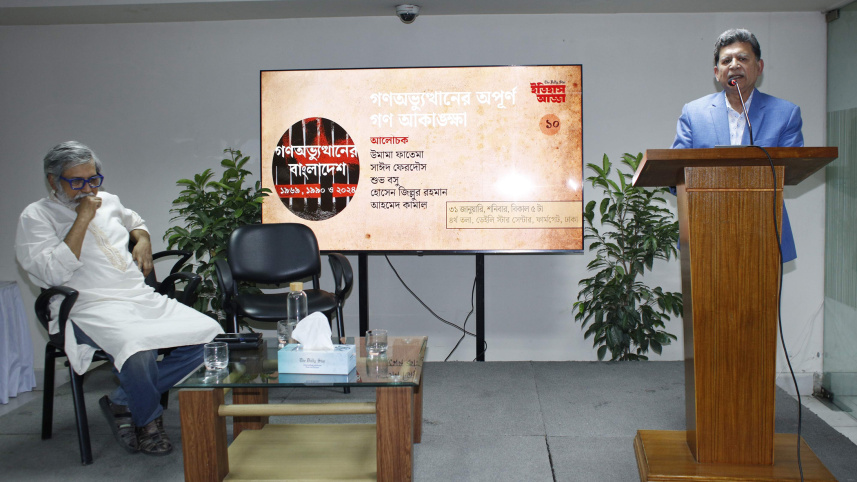
Bangladesh has repeatedly risen against authoritarian rule but has failed to turn popular uprisings into lasting structural change, said speakers yesterday, drawing parallels between the 1969 mass uprising and the July 2024 uprising.
The observations were made at the 10th session of The Daily Star Itihas Adda, titled “The Unfulfilled Mass Aspirations of Mass Uprisings,” held at The Daily Star Centre yesterday.

Former caretaker government adviser and economist Hossain Zillur Rahman said the main challenge of mass uprisings lies not in the moment of revolt but in what follows, which he described as the unresolved “day after”.
Referring to 1969, 1990 and 2024, he said all three movements challenged authoritarian rule, though in different forms. While 1969 and 1990 were movements against military regimes, July 2024 was a struggle against authoritarianism under civilian rule.
“When we talk about authoritarianism, we usually mean military rule. But it can also exist under civilian governments. If we forget that, our criticism becomes one-dimensional,” he said.
He warned that phrases such as “it will take time” or “some gains were made, some were not” can become a form of self-deception.
“After so much bloodshed, avoiding hard self-criticism is not just an analytical failure, it is an injustice to those who lost their lives,” he said.
He also said the bureaucracy has strong “staying power” and can “diffuse, delay and nullify” reform, partly due to a lack of political literacy about how the state functions.
Academician Subho Basu said the 1969 uprising took place in a global context, as the 1960s saw student, youth and worker movements worldwide amid Cold War politics.
He said Ayub Khan’s so-called “decade of development” came with a form of “military capitalism”, where wealth was concentrated among a few families, while unemployment, inflation and declining real incomes burdened workers and the middle class.
These pressures helped drive the 1969 movement, he said.
Drawing a parallel with the period before July 2024, he said claims of economic progress under Sheikh Hasina concealed structural problems such as youth unemployment, insecure work and rising living costs.
Prof Syeed Ferdous of Jahangirnagar University cautioned against viewing mass uprisings as events with clear beginnings and endings, questioning whether July 2024 was being assessed too early.
“We are still sitting inside the event,” he said.
Referring to 1969 and 1952, he said baton charges, tear gas and shootings occurred, but casualties were limited and protesters were not subjected to enforced disappearances.
He contrasted this with 2024, saying the scale of bloodshed raises serious questions about why political change today appears to require so many deaths.
Umama Fatema, former spokesperson of Students Against Discrimination, said lived experiences are often erased when uprisings are later written into official history.
She said people join movements because of daily realities such as inflation, job insecurity and authoritarian control, not abstract ideas.
However, she expressed concern that July was already being claimed by partisan interests and reduced to a referendum.
“Why should the entire July uprising be reduced to a referendum’s yes or no?” she asked.
 For all latest news, follow The Daily Star's Google News channel.
 She urged journalists and researchers to document the “real history” of 2024 without delay.
The Daily Star Editor and Publisher Mahfuz Anam said he participated in the 1969 movement as a Dhaka University student and described it as an unforgettable experience.
He said major student organisations united around a programme addressing labourers, peasants, the economy and, in particular, regional autonomy.
Through a non-violent struggle, students and people showed they had the capacity to remove Ayub Khan’s military rule, he said.
However, he added that unity forged during uprisings often fades after the fall of a ruler, and Bangladesh has repeatedly failed in the constructive phase that follows.
Referring to the July charter, he said it includes many positive recommendations from different commissions and expressed hope that at least the major proposals would be implemented, noting the persistent gap between decision-making and execution.
At the event, Laisa Binte Kamal sang a song, while Mashrur Shakil recited a poem.
The discussion was moderated by The Daily Starjournalist Emran Mahfuz.
Comments