


Shrinking WASH funds may threaten SDG targets: experts
Bangladesh’s water, sanitation and hygiene sector is facing shrinking development allocations, weak implementation and growing climate risks despite the country’s commitments under the SDGs, experts said at a pre-budget policy briefing in Dhaka yesterday.
The discussion, held at the Dhaka Reporters Unity, reviewed the state of the WASH sector, budget trends and future priorities ahead of the National Budget for FY2026-27.

Presenting the keynote paper, Hossain Zillur Rahman, executive chairman of the Power and Participation Research Centre, said the sector is directly linked to several SDGs, including safe water and sanitation, climate action, reducing inequality, and partnerships.
According to the presentation, only 55 percent of the population currently has access to improved and easily accessible drinking water facilities, with major disparities between urban and rural areas. Coverage stands at 71 percent in urban areas compared to 48 percent in rural regions.
Citing data from the 2025 Multiple Indicator Cluster Survey, the paper said 58.2 percent of households have improved unshared sanitation facilities. However, only two percent of the population is connected to sewerage systems, while nearly 70 percent rely on septic tanks, most of which are managed unsafely.
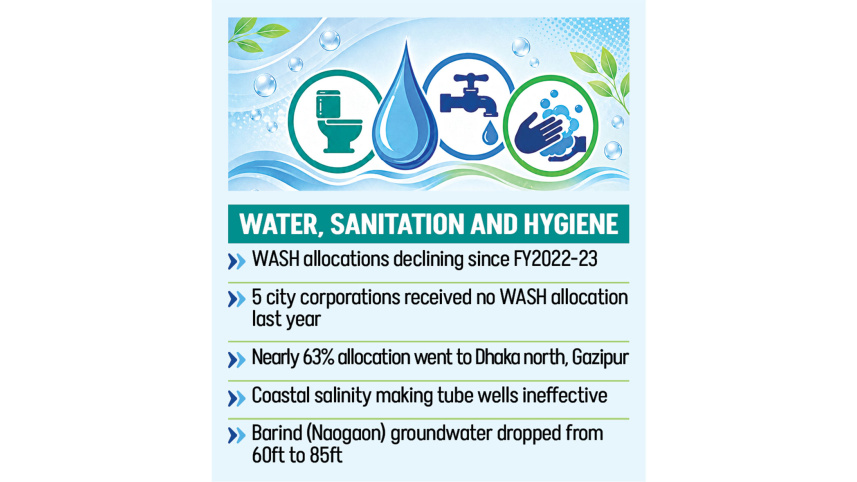
Zillur said WASH allocations under the ADP have been declining since FY2022-23 despite growth in the overall ADP size. Dhaka south, Rajshahi, Rangpur, Cumilla and Sylhet city corporations received no WASH allocation last year, while nearly 63 percent of the total WASH allocation went to Dhaka north and Gazipur.
The paper said the Dhaka Water Supply and Sewerage Authority continues to receive the largest share among the four WASAs, while the Department of Public Health Engineering receives comparatively less funding despite being responsible for rural water and sanitation services nationwide.
The presentation also pointed to mounting regional challenges. In coastal areas, rising salinity is making tube wells ineffective, increasing dependence on rainwater harvesting and reverse osmosis technologies. In the Barind region, particularly in Naogaon, groundwater levels have reportedly dropped from around 60 feet to 85 feet over the past seven years, it said.
Rapid urbanisation is also placing pressure on sanitation services in slums and smaller towns, where many residents cannot obtain legal water connections due to land ownership complications.
The keynote paper identified five major challenges: declining allocations, unequal distribution, weak integration of WASH priorities into climate adaptation planning, underutilisation of allocated funds, and poor expenditure tracking due to the absence of dedicated WASH codes in the government’s financial management system.
It recommended increasing allocations, ensuring equity-based distribution, strengthening climate-resilient infrastructure, and introducing dedicated WASH budget codes in the iBAS++ system.
Mohammad Zubayer Hasan, a member of the International Water Association; Ishrat Shabnam, country director of Practical Action Bangladesh; Md Fazlul Haque, deputy chief executive officer of SAJIDA Foundation and representative of End Water Poverty, and Md Saiful Islam, project coordinator of the Bangladesh Water Integrity Network, spoke at the event.
 For all latest news, follow The Daily Star's Google News channel.
Comments