


From sea to summit
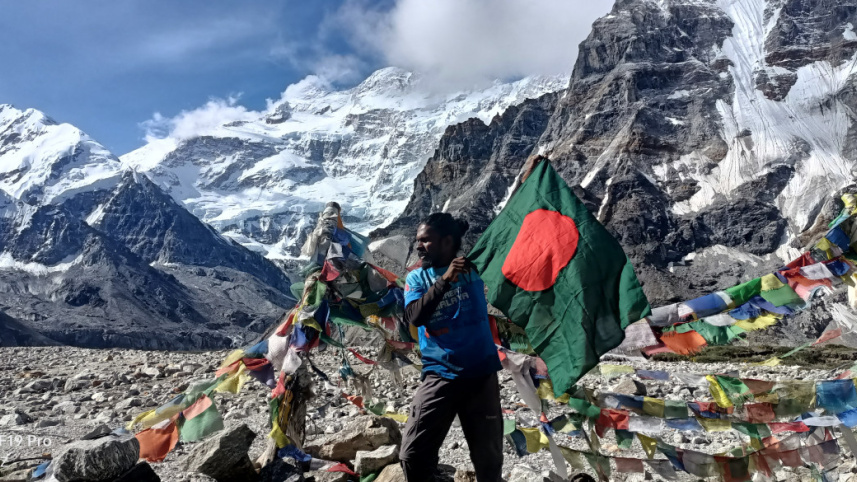
On May 19, mountaineer Ikramul Hasan Shakil stood just metres away from achieving his lifelong dream -- reaching the summit of Mount Everest.
Despite being the closest he had ever been to turning his dream into a reality, doubt began to creep in. The weather had turned against him, reducing visibility completely.

However, despite the hurdles, Shakil steeled his mind and made the ascent. And then finally, he had done it. The boyhood dream had come true.
Even though his time at the peak was brief, he had managed to stand on top of the world, a feat very few can claim, that too against all odds.
Shakil, who hails from Baghchala village of Gazipur, successfully conquered Mount Everest after completing the "Sea to Summit" expedition that began on February 25 in Cox's Bazar.
At a press conference at Bishwo Shahitto Kendra yesterday, Shakil shared the experience of his adventures with mountaineering enthusiasts and environmental advocates.
Ghanashyam Bhandari, Nepal's Ambassador to Bangladesh; MA Muhit, an Everest summiteer; and Tosan Paul, general manager of marketing at PRAN Agro Limited, were present at the event.
Through his journey, Shakil aimed to raise public awareness about plastic pollution and carbon emissions by adopting the eco-climbing model.
Eco-climbing, or eco-friendly mountaineering, emphasises minimising the environmental impact of climbing activities. It involves adopting practices that reduce waste, protect ecosystems, and promote sustainability in the mountains.
Speaking at the event, Shakil said he began the "Sea to Summit" from Inani Beach. His route took him through Chattogram, Cumilla, and Dhaka before reaching Tangail.
When he was denied permission to walk across the Jamuna Bridge, he decided to swim instead -- crossing three kilometres of the river in four hours.
He continued his journey through Sirajganj, Bogura, Panchagarh, and Banglabandha, entering India via Siliguri and Naxalbari, eventually reaching the Kanchenjunga region in Nepal.
From there, Shakil undertook a 64-day high-altitude trek, covering approximately 1,372 kilometres, and reached the Everest Base Camp on April 29.
Braving a severe snowstorm and high winds, Shakil successfully reached the world's highest peak.
"From the ocean to the Himalayas, plastic pollution is everywhere -- and we are the ones responsible," Shakil said. "I walked the entire way to demonstrate that zero carbon travel is possible. Along the way, I collected plastic waste to show just how deep the problem goes."
Shakil also urged aspiring climbers to take the sport seriously, saying, "Anyone who wants to climb mountains must first prepare mentally and physically. Proper training reduces risk and helps us understand the mountains better."
In 2014, Shakil received formal mountaineering training from the Nehru Institute of Mountaineering in India. He later joined expeditions to Mount Keyaz and Tiyazuri in 2015 and successfully summited Himlung Himal (7,000 metres) in 2019.
In 2022–23, he completed the Great Himalaya Trail -- a 1,700-kilometre journey across Nepal. Only 33 people in the world have completed the full trail and Shakil is the only Bangladeshi among them.
Ghanashyam Bhandari said, "The number of Bangladeshi mountain climbers in Nepal is gradually increasing. Nepal is ready to welcome them warmly, and we're encouraging it."
Speaking about the challenges he faced when seeking official support, Shakil said, "I carried my country's flag to the summit of Everest, but I had to fight until the last moment to even get my visa. For someone without connections, the barriers are even greater. If the government stands by mountaineers like us, many more young people will be encouraged to follow their dreams."
 For all latest news, follow The Daily Star's Google News channel.
Comments