


Govt braces for costly LNG future

The government is moving to expand the country’s LNG import capacity with another floating storage and regasification unit (FSRU) and a land-based facility as domestic gas production continues to decline and the cost of imported gas is rising sharply.
The move comes amid renewed concerns over Bangladesh’s dependence on liquefied natural gas following the recent shutdown of an Excelerate Energy-operated FSRU in Moheshkhali, which has disrupted gas supplies to the national grid.

The government is considering hiring a new FSRU capable of supplying around 550-600 million cubic feet of gas per day (mmcfd), while also moving ahead with plans for a land-based LNG terminal at Matarbari in Cox’s Bazar.
Yesterday, the cabinet committee on government purchase approved a proposal to install a new FSRU in the Kutubjom area of Moheshkhali. The project will be implemented through government-to-government procurement with China National Energy Engineering and Construction Co.
Rupantarita Prakritik Gas Company, a Petrobangla company, issued a request for expression of interest on June 28 to appoint transaction advisers and/or consultants for the proposed land-based LNG terminal.
The notice was revised on July 15, with the deadline for submitting expressions of interest extended to August 10 from July 27.
The moves mark a further step towards developing the Matarbari facility as Bangladesh seeks to increase its capacity to import and handle LNG.
The expansion comes at a time when the country is increasingly relying on imported gas to compensate for falling domestic production.
Petrobangla data show that domestic gas production dropped 22.1 percent over five years to 19.60 bcm in fiscal 2024-25. Over the same period, LNG imports increased from 6.12 bcm to 7.98 bcm.
In the first 10 months of fiscal 2025-26, domestic gas production stood at 14.84 bcm, while LNG imports were around 7.89 bcm, according to the latest Petrobangla MIS data.
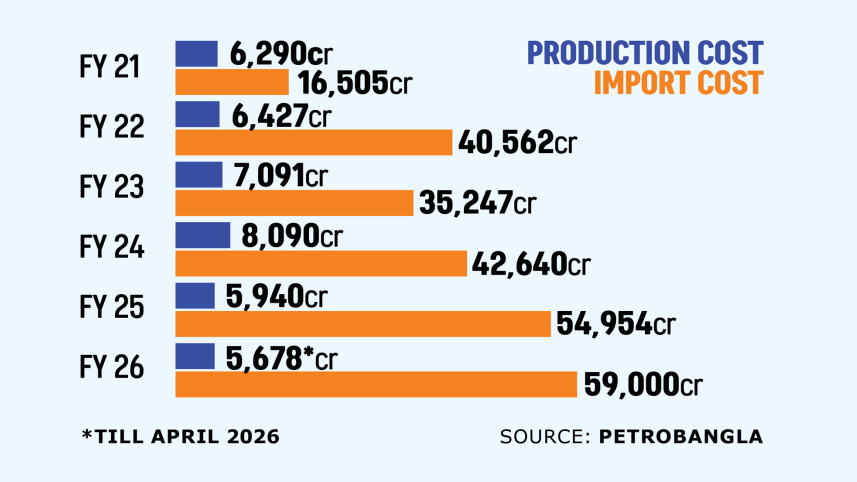
Meanwhile, the cost of LNG imports has risen from Tk 16,505 crore in fiscal 2020-21 to around Tk 59,000 crore in fiscal 2025-26, according to Petrobangla data.
The rising cost of imported LNG has also increased the government’s subsidy burden.
In fiscal 2018-19, when Bangladesh began importing LNG, the government provided around Tk 2,500 crore in subsidy. The annual subsidy rose to around Tk 6,000 crore in each of fiscal 2021-22, fiscal 2022-23 and fiscal 2023-24, before increasing to Tk 8,900 crore in fiscal 2024-25 and Tk 14,600 crore in fiscal 2025-26.
The latest FSRU disruption has also highlighted the risks associated with the country’s growing reliance on imported gas.
The shutdown of the terminal reduced gas supply to the national grid by around 450 mmcfd, bringing total supply down to around 2,150 mmcfd against the demand of nearly 3,800 mmcfd.
Bangladesh currently has two FSRUs operating at Moheshkhali with a combined regasification capacity of around 1,100 mmcfd, although actual supply varies depending on LNG availability and operational conditions.
The disruption showed how quickly a problem at a single LNG facility can affect the national gas supply system.
The proposed new FSRU would provide additional regasification capacity, while the Matarbari land-based terminal is expected to add longer-term capacity to the country’s LNG import infrastructure.
But expanding the LNG capacity would also require significant investment in supporting infrastructure and create a larger long-term requirement for foreign currency to procure imported gas.
LNG imports are significantly more expensive than domestic gas.
 For all latest news, follow The Daily Star's Google News channel.
 Petrobangla said last year that imported LNG cost around Tk 65 per cubic metre, while industrial consumers paid Tk 30 and captive power plants Tk 31.50 per cubic metre.
The difference means the government has to provide support to keep gas prices affordable for major consumers.
“We cannot simply take the current prices of LNG from the power sector and industries as the production cost would be more expensive to compete globally. But when we are thinking of importing more LNG, even at the regular rate, it would not be affordable for the industries,” said Shafiqul Alam, lead analyst for Bangladesh energy at the Institute for Energy Economics and Financial Analysis.
The latest decision shows that the government is shifting its focus from local gas exploration and renewable energy expansion towards LNG import, he said.
“It is not only FSRU installation -- we will need to import the LNG at volatile cost for years.”
The country’s LNG procurement is exposed to volatility in international energy markets, particularly as the country is increasing its reliance on costly spot-market purchases.
Any expansion of LNG import capacity would therefore involve not only investment in terminals but also the recurring cost of procuring LNG, along with the infrastructure needed to transport regasified gas to consumers, Shafiqul added.
Power, Energy and Mineral Resources Minister Iqbal Hassan Mahmood also acknowledged the infrastructure limitations facing LNG imports.
“If we rent an FSRU, we also need pipeline capacity, and there are limitations in our existing pipeline infrastructure,” he said at a dialogue on Monday.
Officials involved in the process also confirmed that the new facilities would require additional storage and pipeline infrastructure to connect them to the national transmission network.
Comments