


Fuel, fertiliser imports: Govt needs $2.61b extra until June

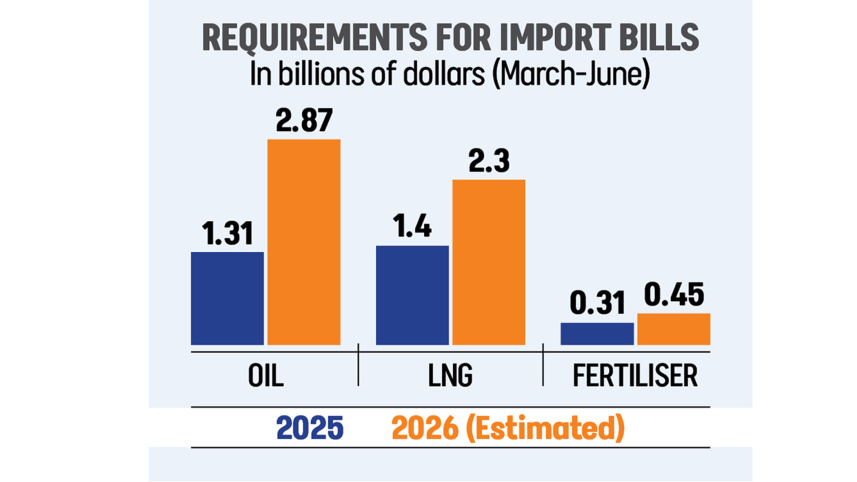
Bangladesh will need an additional $2.61 billion in foreign exchange to pay the surging energy and fertiliser import bills for March-June period.
The total import costs for oil, liquefied natural gas (LNG), and fertiliser will be around $5.62 billion, up from $3.01 billion in the corresponding period of last year, according to a finance ministry impact analysis.

Subsequently, the government is aiming to secure about $3 billion in emergency assistance from development partners, including the International Monetary Fund (IMF) and the World Bank (WB).
Finance Minister Amir Khosru Mahmud Chowdhury already placed the request during a meeting with officials of the two multilateral lenders on the sidelines of the ongoing IMF-WB Spring Meetings in Washington DC.
The WB has assured Bangladesh of both policy guidance and financial support, Khosru told reporters after the meetings.
“I hope we will receive the extra financing by June and in the next budget. Overall, the discussions have been successful,” he said.
The government is also in talks with other multilateral donor agencies to plug the additional financing gap, The Daily Star has learned from finance ministry officials involved with the proceedings.
Yesterday, at a virtual meeting of the Asia Zero Emission Community, a Japanese-led framework designed to promote decarbonisation, energy security, and economic growth across Asia, Prime Minister Tarique Rahman sought $2 billion in emergency funds from development partners to manage the inflated fuel import bills, reports BSS.
In March, the diesel price surged by 250 percent, while the LNG price doubled and the fertiliser price rose by 50 percent.
The foreign exchange pressures due to higher import costs and an expanded subsidy burden could persist until June, according to the ministry’s impact analysis.
The government has so far held off on passing the higher costs on to consumers, though it is considering price adjustments if additional external assistance is not assured.
The impact report estimates that Bangladesh will require an additional Tk 38,542 crore (about $3.2 billion) in subsidies between March and June to cover energy and fertiliser imports.
Of this, around Tk 18,000 crore would be needed for fuel alone, an extraordinary requirement not seen in previous years. Gas subsidies are estimated at Tk 13,930 crore, electricity at Tk 4,612 crore, and fertiliser at Tk 2,000 crore.
As a result, the total subsidy bill for this fiscal year, originally budgeted around Tk 59,000 crore, is now projected to balloon to Tk 97,542 crore, the report said.
The broader economic picture has also deteriorated: the monthly trade deficit widened between January and February, inflation edged up in March, and the taka remained under strain in early April.
“Taken together, these developments reduce the room to absorb the shock through reserves without risking a disorderly adjustment,” the report said.
As of April 9, gross foreign exchange reserves stood at $29.95 billion, according to data from the World Bank.
On Tuesday, WB President Ajay Banga said the institution could mobilise $80–$100 billion over the next 15 months for countries hit hard by the war, eclipsing the $70 billion provided during the Covid pandemic, Reuters reported.
This would include $20–$25 billion in the coming months through a crisis response window that allows countries to withdraw up to 10 percent of funds earlier than planned from previously approved programmes, with another $30–$40 billion from repurposed existing programmes in about six months, he said.
 For all latest news, follow The Daily Star's Google News channel.
 The IMF has separately announced up to $50 billion in emergency support for developing and low-income countries, while the Asian Development Bank has unveiled a special package for its developing member countries across Asia and the Pacific to help them cope with immediate economic pressures from the war.
Bangladesh has already begun informal discussions with the development partners about securing its share of the support.
Comments