


Fertility U-turn may imperil economy, healthcare

There was a time when family-planning slogans echoed across Bangladesh, on television screens, in newspaper pages, and at village doorsteps. Those messages have now largely faded. In their absence, a decades-long demographic success story is beginning to fray.
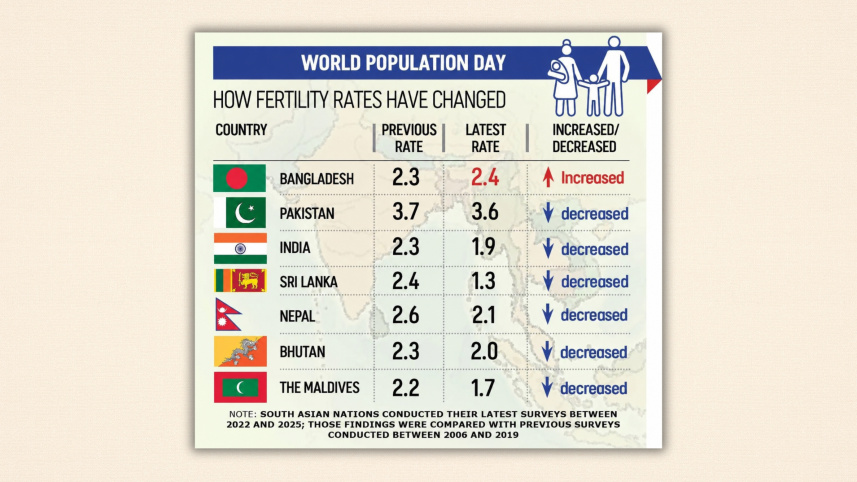
Bangladesh is now the only country in South Asia where fertility is rising instead of falling, adding fresh pressure on an economy already strained by high population density, food insecurity, and overstretched health services.

The country’s total fertility rate (TFR) rose to 2.4 children per woman in 2025, up from 2.3 in 2019, according to the latest Multiple Indicator Cluster Survey (MICS) by the Bangladesh Bureau of Statistics with Unicef.
Across the rest of South Asia, the trend has moved the other way. Pakistan, though still has the highest TFR in the region, has recorded a decline, while India has fallen below replacement level -- a threshold where a generation has enough children to replace itself.
Experts say the reversal reflects a weakening of Bangladesh’s once-vaunted family-planning programme, from pandemic-era disruptions and fewer household visits by field workers to its failure to reach younger couples on digital platforms.
They also point to policy uncertainty under the previous Awami League government, complacency after years of falling fertility, severe disruption in contraceptive supply during the interim government, and a renewed preference among some families for larger families.
Officials and experts warn that a sustained rise in fertility would strain the health system and economy, raise the dependency ratio, deepen poverty, and worsen maternal and child health and malnutrition.
Bangladesh’s fertility rate fell from 6.3 children per woman in 1975 to 2.3 by 2012, driven largely by the family-planning programme. It then remained steady for more than a decade, until the 2025 survey put it at 2.4, the first increase in decades.
Md Aminul Haque, a professor at Dhaka University’s population sciences department, said he had “very little positive to say about the current situation”. “An extra effort is now needed to reverse the trend, but unfortunately there has been very little discussion of this crucial issue.”
SUPPLY CHAIN COLLAPSE
The Directorate General of Family Planning (DGFP) data show a sharp fall in contraceptive supplies since the pandemic.
In January 2019, the DGFP supplied 99.24 lakh condoms, 72.35 lakh oral pills, 9.5 lakh injectables, 14,000 Intrauterine Devices (IUDs) and 35,000 implants. After the pandemic, the numbers dropped and saw a sharp decline after June 2024. By January this year, that had fallen to 7.54 lakh condoms, 21.96 lakh oral pills, 4.82 lakh injectables, 3,286 IUDs and 2,325 implants.
DGFP officials said unmet demand for contraceptives surged during the Covid-19 pandemic, but supply was not scaled up after the immediate crisis passed.
The shortage worsened after the Fourth Health, Population and Nutrition Sector Programme, which financed most contraceptive procurement, expired in June 2024.
The interim government approved a Tk 1,664 crore procurement project in November 2025, but funds were released only in April this year.
The directorate also has 25 percent of its 50,648 field-level posts vacant.
The impact is reflected in MICS data released in November last year. Contraceptive use among married women aged 15-49 fell to 58.2 percent from 62.7 percent in 2019, while the share of women whose need for modern contraception was met dropped to 73.5 percent from 77.4 percent.
Prof Aminul said the disruption has hit lower-income households hardest, as many cannot afford contraceptives, increasing the risk of unplanned pregnancies.
He also said the programme had failed to adapt to changing behaviour and technology, with little effective use of mobile phones, social media and other digital platforms to provide counselling or information.
Beyond programme failures, Prof Aminul pointed to a shift among some relatively well-off families choosing to have more than two children. He also said former prime minister Sheikh Hasina and some of her cabinet colleagues had publicly argued that a larger population could expand the labour force and support overseas employment, creating the impression that Bangladesh no longer needed to focus on population control.
 For all latest news, follow The Daily Star's Google News channel.
 The policy dilemma weakened governance in the sector, he said. Meetings of the National Population Council, the highest policymaking body on the issue, were not held for an extended period, while repeated requests to fill vacant family-planning posts went unanswered, Prof Aminul said.
He also pointed to complacency once fertility approached replacement level. “Many believed there was no longer any cause for concern.” Taken together, he said, these factors “played a significant role in the increase in fertility... the situation is still not under our control”.
Ziauddin Hyder, special assistant to the prime minister on health affairs, acknowledged the rise in fertility and the shortage of contraceptive supplies, saying procurement was now under way and stocks would be replenished within two to three weeks.
The government would pursue a more targeted population management approach, focusing on poorer and marginalised groups where fertility remains high, he told The Daily Star on Thursday.
“The increase from 2.3 to 2.4 is not the right direction. It has to come down, and it will come down,” he said, adding that Bangladesh must also focus on the health, nutrition and skills of the next generation if it is to reap the demographic dividend.
CHILD MARRIAGE
Ashrafi Ahmad, immediate past director-general of the DGFP, attributed the rise to persistent child marriage, rising adolescent pregnancy, the absence of comprehensive sexuality education, prolonged disruption to contraceptive procurement, and the gradual loss of policy focus on family planning.
Existing policy bars the family-planning programme from serving unmarried people, meaning “many young couples become pregnant soon after marriage because they lack accurate knowledge about contraception”, she said.
She also pointed to educational institutions, especially madrasas, where family planning and reproductive health are generally not discussed, creating an awareness gap.
MICS 2025 data show child marriage remains high at 47 percent, while the adolescent birth rate rose to 92 births per 1,000 girls aged 15-19 from 83 in 2019.
ECONOMIC, HEALTH COSTS
Prof Shafiun Nahin Shimul, director of the Institute of Health Economics at Dhaka University, said that while the rise may appear small in percentage terms, the absolute number of additional children is large.
Because children place the heaviest demand on health services, a growing child population will further burden an already stretched healthcare system, he said.
On the economic front, he said, a higher number of children would raise the dependency ratio, leaving fewer working-age people to support a larger dependent population and placing additional pressure on the economy.
Prof Aminul said the consequences would be especially severe for poor families and for maternal and child health, with additional treatment costs forcing many families below the poverty line.
“Maternal mortality and morbidity will rise, children’s health will suffer, and widespread malnutrition will leave an entire generation with poorer health outcomes.”
Comments