


Bringing the world to the hills

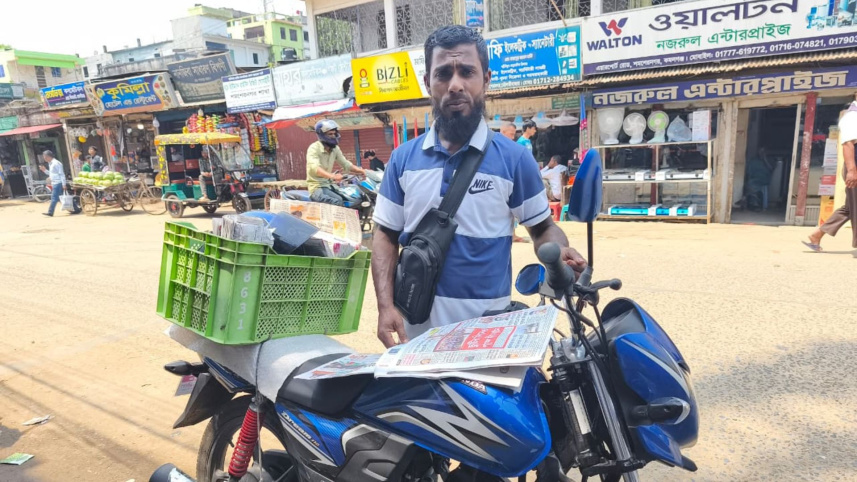
Before dawn breaks over the hills, 38-year-old Kaikobad sets out on a journey few would choose, yet many depend on. For more than two decades, he has carried the responsibility of delivering newspapers across nearly 100 kilometres of remote, winding terrain -- connecting isolated communities to the wider world.
Since 2001, this has been more than a job; it has been his only means of survival.

He said, “In the early years, I navigated the difficult hilly roads by bicycle and CNG-run vehicles. The work was grueling. Over time, with loan, I managed to buy a motorcycle -- an investment that transformed my daily struggle into something just manageable.”
“Each morning at 6:00am, I travel to Sreemangal to collect newspapers. From there, my long route begins -- crossing hills, moving from one upazila to another, and reaching areas where access is limited and alternatives are scarce.”
For many residents, the paper he delivers remains their only consistent link to news and information.
But that lifeline is now under threat.
An ongoing fuel crisis has made it increasingly difficult for Kaikobad to continue his work. He requires at least two litres of petrol each day, yet often spends hours in queues without success.
“At times, I return home empty-handed. When fuel is available, it comes at a steep cost — up to Tk 30–100 more per litre,” he said.
“My family survives on this work. If I do not go, no one along this entire route will receive newspapers,” Kaikobad says.
The consequences are already visible. Irregular delivery has reduced his income, while household pressures continue to mount. “The uncertainty of each day -- whether I will find fuel, whether I can complete my route -- has added a constant strain to my life,” he said.
He added, “Yet my struggle extends beyond personal hardship.”
In these remote hill areas, where digital access remains limited, printed newspapers still serve as a vital source of information. If his journey stops, an entire region risks losing its connection to daily news.
“His story is not just about one man’s struggle -- it reflects a silent reality in our society,” says Nurul Mohaimin Milton, president of the Kamalganj Sangbadik Samity.
Indeed, Kaikobad’s work highlights an often-overlooked truth: essential services in marginal areas frequently rely on individuals working in isolation, with little recognition or support.
Despite the challenges, he continues -- because this work defines him. It is his identity, his responsibility, and his only means of survival.
But as the crisis deepens, one question lingers: How long can he keep going like this?
“Kaikobad’s story is a reminder that beyond the headlines, there are countless individuals quietly sustaining the flow of information and services in underserved regions. Their efforts rarely make news, yet their absence would be deeply felt,” added Nurul.
A society’s humanity, perhaps, is best measured by how it treats these silent lifelines -- those who keep going, even when the road ahead grows uncertain, he said.
 For all latest news, follow The Daily Star's Google News channel.
Comments