


Ad-din hospital: Chain of failures killed the six newborns

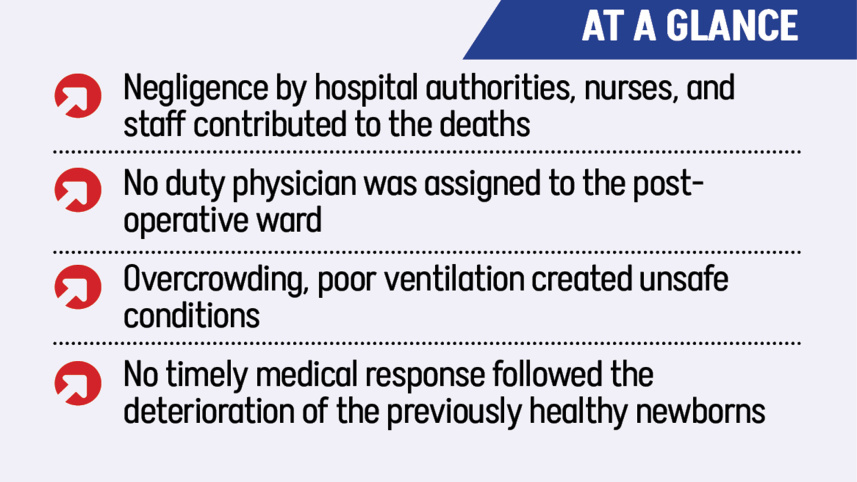
An investigation by the Directorate General of Health Services has found clear negligence by hospital authorities, nurses, and staff, as well as the absence of an on-duty physician, to be responsible for the deaths of six newborns at Ad-din Medical College Hospital in the capital’s Moghbazar last week.
The DGHS probe committee also found that severe overcrowding in a small post-operative room, coupled with an air conditioner remaining switched off for a prolonged period and the absence of any alternative ventilation system, created conditions unsuitable for the survival of newborns.

Additionally, the building’s infrastructure was unsuitable for operating as a 700-bed healthcare facility, and the post-operative ward in question was wholly inadequate for providing post-operative care, it said.
Health Minister Sardar Md Sakhawat Husain revealed the probe committee’s findings during a press briefing at the Secretariat yesterday -- eight days after the deaths of the newborns -- and vowed to take the toughest action by Sunday.
“We will go as far as the law allows us to be strict. This time, no one will be spared,” he said after reading out a summary of the findings of the DGHS probe committee.
Meanwhile, the DGHS yesterday issued a show cause notice to Ad-din Medical College Hospital asking why its licence should not be cancelled over the deaths of the newborns.
The hospital authorities were asked to give reply by 5:00pm of June 7, reads the show cause letter.
Speaking to The Daily Star after the briefing, acting director general of the DGHS Prof Pravat Chandra Biswas said the authorities served the a show-cause to the hospital under the Medical Practice and Private Clinics and Laboratories (Regulation) Ordinance, 1982. Under the law, the authorities have the power to suspend or cancel the hospital’s licence, which could result in its operations being suspended.
Contacted, Tariqul Islam Mukul, director of HR and company affairs at Ad-din Foundation, which runs the hospital, said, “We will not make any comment for now.”
Six newborns, aged between one and four days, died between 5:00am and 9:00am on May 27, triggering widespread public outrage and prompting health authorities to shut down the post-operative room and form two investigation committees.
The Health Ministry formed one committee, led by its Joint Secretary Md Mohsin, which submitted its report on Wednesday. Meanwhile, the DGHS formed a three-member committee, led by its Director (Disease Control) Prof Halimur Rashid, as the hospital falls under its direct purview.
A member of the ministry-formed committee said the findings of both reports were largely similar, as two members of the ministry committee also served on the DGHS committee.
The 700-bed medical facility is one of eight hospitals and four medical colleges run by the Ad-din Foundation.
The foundation’s Executive Director, Sheikh Mohiuddin, who is also the executive director of Ad-din Women Medical College, is the incumbent president of the Bangladesh Private Medical College Association.
WHAT THE FINDINGS SAY
The DGHS probe committee investigated six specific issues to determine the possible causes behind the unnatural deaths of six newborns.
It examined whether the post-operative ward was suitable for post-surgical patients and newborns; whether caesarean-born infants were transferred to special care units or incubators after birth and whether attending physicians had provided any specific medical advice; and whether any doctor or specialist was on duty in the ward at the time of the incident.
The investigation also looked into the physical condition of the newborns at the time of admission, the roles and actions of doctors, nurses, and other staff in the period leading up to the infants’ sudden deterioration, and broader issues related to the hospital’s environment and registration status.
According to the probe report, the post-operative room was enclosed on all sides and had no access to natural light or ventilation.
The room could only be accessed through two other rooms. The environment inside was found to be stuffy, while the air-conditioning unit was old and inadequate for the size of the room.
 For all latest news, follow The Daily Star's Google News channel.
 The post-operative ward measured approximately 900 square feet and was equipped with a single five-ton air conditioner.
Due to inadequate light and ventilation in the ward, and because the air conditioner remained switched off from 2:00am to 6:00am, the normal respiratory functions of the newborns may have been disrupted, creating a risk of death, the report states.
“Due to the air conditioner remaining switched off for a prolonged period and the absence of proper ventilation in the room, there was an inadequate oxygen supply, while carbon dioxide levels were higher than normal.”
Additionally, the room was overcrowded with at least 50 people inside, including the six mothers with their newborns, along with other patients and their attendants -- far exceeding the room’s capacity.
The committee found that all six newborns who died had been delivered through C-section and were physically healthy and normal under doctors’ observation after birth.
The report added that there was no duty physician assigned to the patients admitted to the post-operative ward. “Furthermore, from when the babies fell ill till when they reached a critical condition around 6:00am, no doctor was called, nor did any of them come to examine the patients.”
The probe further found that the nurses on duty showed severe negligence and a lack of cooperation, while there was no active emergency medical response despite the sudden deterioration of the newborns’ condition. “No responsible action was observed on the part of the hospital authorities, assigned physicians, or nurses.”
The report added that even after repeated calls from guardians, the nurses delayed action without informing any doctor, and no appropriate or timely medical measures were taken to prevent the deaths.
“The persons in charge of the existing administration were not capable of fulfilling the basic requirements for running a hospital.”
The committee also found a bakery within the hospital premises, which it deemed inappropriate, while the construction of multiple small glass rooms in various parts of the hospital had made the facility appear significantly hazardous. “The hospital’s infrastructure was not suitable for operating as a 700-bed hospital.”
When this correspondent asked whether the health authorities bore any responsibility, given their role in identifying such issues and granting or denying the hospital’s annual licence renewal, the minister did not give a direct answer.
“The bakery was located on the ninth floor of the building and may have escaped the inspector’s notice.”
However, when asked whether an inspector should have identified problems in the post-operative room, a critical section of the hospital, the minister asked how the inspector could have known that the authorities would keep the air conditioner non-functional on that particular day.
The probe committee also recommended that obtaining prior approval from the Department of Environment, following an inspection of the building intended for hospital operations, be made a mandatory condition for issuing new licences to private hospitals.
ACTION BY SUNDAY
At the press briefing, Health Minister Sakhawat said the post-operative room where the incident occurred had already been sealed, but the hospital could not be closed immediately because more than 200 patients were currently admitted there.
“We will review the legal options over the next two days and take a final and stringent decision regarding the hospital by Sunday.”
Responding to a query on whether the incident was being treated as mere professional negligence or a criminal offence, he said, “This is certainly a serious criminal offence, and a case has already been filed in this connection.
“Due to emotional reasons, the families took the bodies of the children without a post-mortem, which the accused may try to use as a legal loophole. However, this is not a hidden incident that happened in the dead of night. We have all the proof. I firmly believe that the honourable court will not grant any leniency to the accused.”
Comments