



Daisy Edgar-Jones to lead new adaptation of ‘Sense and Sensibility’
26 June 2026, 12:40 PM
TV & Film
‘Like a morning after a nuclear attack’
24 March 2023, 18:00 PM
Weekend Read
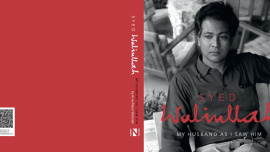
Book review: Nonfiction / Syed Waliullah: husband, artist, thinker, writer
17 August 2022, 18:00 PM
Books & Literature

Fear of sexual harassment triggering child marriage: survey
20 February 2022, 18:00 PM
Bangladesh

For the Love of Tea
7 January 2022, 18:00 PM
Star Literature
Court Corner / SC forms committee against sexual harassment
4 November 2021, 18:00 PM
SEXUAL HARASSMENT

UK-listed cybersecurity firm Avast in merger talks with NortonLifeLock
15 July 2021, 18:00 PM
Organisation News

THE FUTURE IS CENSORED
28 November 2019, 18:00 PM
Star Weekend

Change is the only constant
28 November 2019, 18:00 PM
Star Weekend
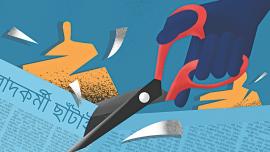
Media: Between a rock and a hard place
28 November 2019, 18:00 PM
Star Weekend

The marriage conundrum
Shoaib Hossain, a 26-year-old madrasa teacher, was well-thought-of by his neighbours for his honest and polite character. He was also venerated as a young hafiz (a person who has memorised the entire holy Quran) by the inhabitants of Charigram village under Singair upazila of Manikganj district.
19 October 2017, 18:00 PM

Are we covering suicide responsibly?
The month of October is yet to come to an end, but the country has already witnessed at least 15 deaths by suicide. It won’t be a surprise if that number increases—statistics show that thousands commit suicide in Bangladesh every year.
17 October 2017, 15:16 PM
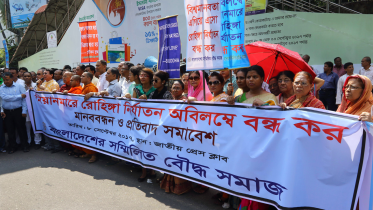
What do Buddhists in Bangladesh have to do with the Rohingya crisis anyway?
Unless we can remain vigilant and ensure that a politics of hate does not seep into our everyday lives and politics, there are fears that the religious sentiments of people may be exploited—and communalism fuelled—by certain quarters looking to benefit at the local and national level.
12 October 2017, 18:00 PM
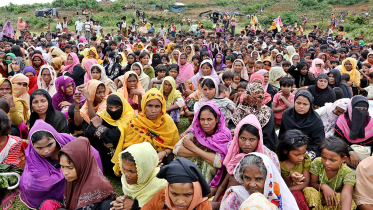
Voice of the host community
Despite severe resource constraints, they have remained resolute in upholding the dignity of the refugees, sacrificing their own interests. It's time that those at the helm of the state acknowledge their contribution and ensure their voices are heeded in planning and implementing the refugee management strategy.
12 October 2017, 18:00 PM
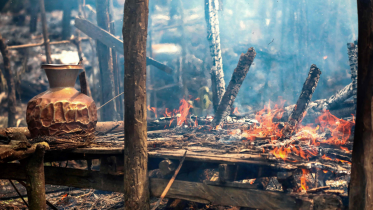
A better political economy of the Rohingya crisis
In short, while simple pecuniary motives can never be entirely discounted, particularly in Myanmar's borderlands, the political economy underpinning the current Rohingya crisis is far more complicated than is suggested in articles making a few sloppy references to megaprojects and land grabs.
12 October 2017, 18:00 PM
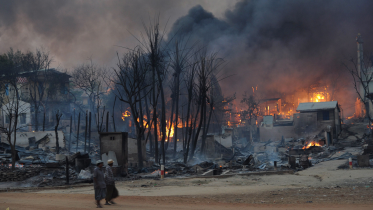
When religion is used by the military to justify their aims
The escalating displacement of millions of smallholders (mostly Buddhists) from the land was a major change as to who was to manage the land. Smallholders became refugees of a new economic ordering. Myanmar is not unique in this.
12 October 2017, 18:00 PM
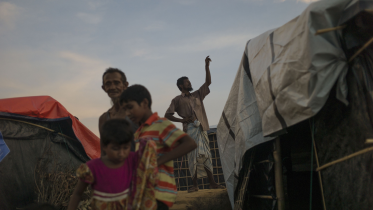
Locating the Rohingya in time and space
There is no instance in the world where after decades of experience of citizenship and of exercising the rights to electing their representative to parliament an entire population becomes stateless without security to life, property and honour, except of course in Nazi Germany.
12 October 2017, 18:00 PM
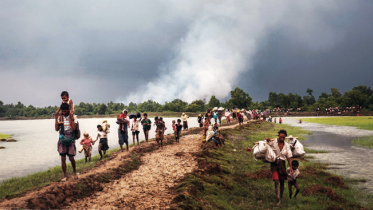
The tale of a persecuted people
This is the story of a systematically oppressed people—the Rohingya. (TIMELINE)
12 October 2017, 18:00 PM
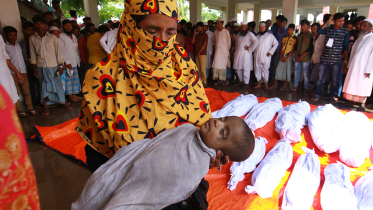
Genocide by any other name...
"The Myanmar government's failure to protect the Rohingyas makes a strong case for an intervention by the international community, either through taking measures stated in the R2P framework or by involving regional powers like China and India.” That is easier said than done.
12 October 2017, 18:00 PM

Securing Rohingya fates with sound foreign policy
Bangladesh needs to pursue a more aggressive and concrete policy regarding Myanmar. Repatriation of the Rohingyas should remain as the focus for which a “Coalition of Willing” must be formed.
12 October 2017, 18:00 PM
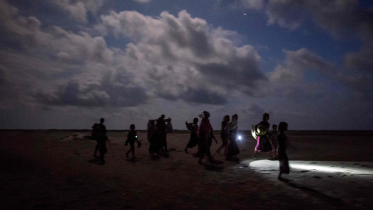
"One thing is clear—an ethnic cleansing or genocide is taking place in Myanmar"
If Prime Minister Sheikh Hasina's speech is any indication, we are going in a positive direction. There is initiative, there is a roadmap, and the international actors have been roused into criticising the situation. The sufferings of eight lakh people have been brought to the forefront.
12 October 2017, 18:00 PM
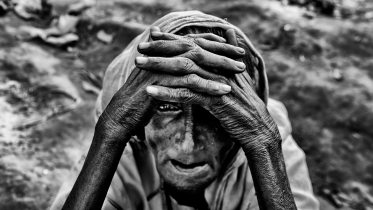
The nation and the citizen
The big challenge for us, as the Rohingya question unfolds and also as we face the challenges of rightlessness in our everyday lives, is: how do we translate the imagined into a reality, and whose dream and reality it is going to be?
12 October 2017, 18:00 PM
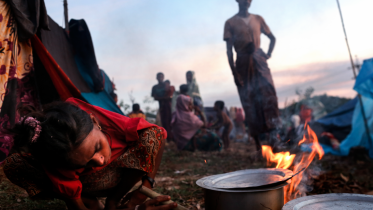
Without land and citizenship
Formerly the Rohingya refugees had been mostly peasants in Myanmar, differentiated in terms of their wealth and class status. After arriving in Bangladesh, they were all levelled in terms of the common predicament of meeting basic food needs, irrespective of their earlier status and economic conditions.
12 October 2017, 18:00 PM
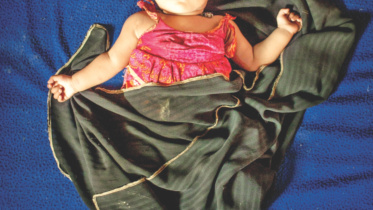
Born refugee
Conceived in the wombs of women crossing the border and delivered at refugee camps, Rohingya babies are born refugees. Their future is called into question as they are stateless under Bangladesh's Citizenship Law and are not recognised as children of citizens by Myanmar.
12 October 2017, 18:00 PM
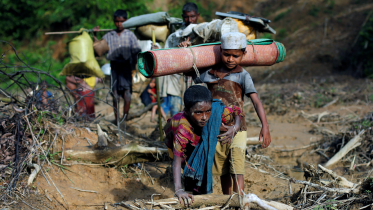
No place to hide
Nearly half of the newly displaced are children. Up to 60 percent of the new arrivals are children and 30 percent are children under five years old. Seven percent are infants less one year old.
12 October 2017, 18:00 PM
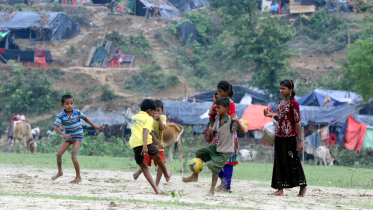
Listening to refugees—lessons learnt from the past
Mothers became concerned that their children were learning only Bengali alphabets, but what use would this be if at some point in their lives they returned to Myanmar as it was hoped that they would. We responded by adapting our system to the official Burmese alphabets as taught in schools in Myanmar.
12 October 2017, 18:00 PM

In the shadow of violence: Editor's note
In this special issue of Star Weekend, we tried to cover the persecution of the Rohingyas from various aspects. Written by renowned scholars with expertise in different fields, the articles argue for a more nuanced understanding of the crisis and suggest possible ways forward.
11 October 2017, 10:24 AM

Fragments
A constant torment, white noise reminding us of our losses and sufferings.
5 October 2017, 18:00 PM
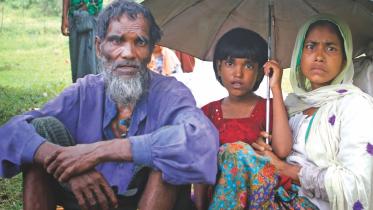
Living the genocide: in the grip of trauma
With no psychosocial assistance, Rohingya refugees are vulnerable to life-long PTSD.
5 October 2017, 18:00 PM
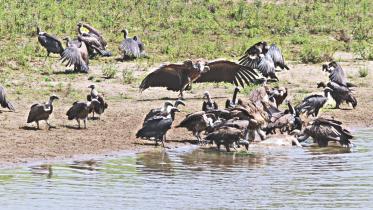
Bringing back 'Jatayu' from the clutches of 'Ravana'
The story of saving the vultures of Bangladesh
5 October 2017, 18:00 PM