


Zero malaria death by next year a stiff challenge now

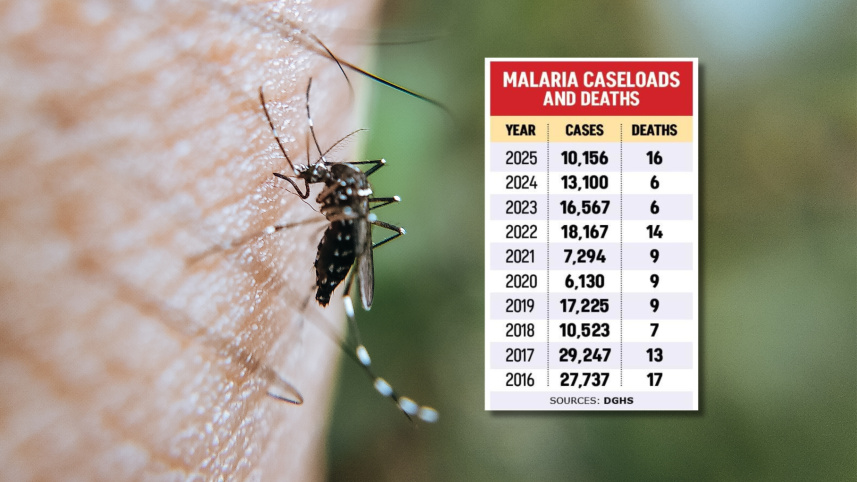
At least 16 people died of malaria in 2025, the highest in nine years, raising concerns over the country’s goal of achieving zero malaria deaths by 2027.
A total of 10,162 malaria cases were recorded last year, which is lower than the previous year but still a significant number given the country hopes to eliminate the mosquito-borne disease by 2030.

The issue of malaria deaths came into focus following the death of Commerce Secretary Mahbubur Rahman from malaria on Friday, ahead of World Malaria Day on April 25.
Although 460 malaria cases were recorded in the first three months of the year, Mahbubur is the first to die from the disease, according to the Directorate General of Health Services (DGHS).
The 58-year-old bureaucrat was admitted to a private hospital in Dhaka on April 13 due to a decrease in blood platelet levels. Later, he was diagnosed with malaria, according to a press release from the ministry.
Mahbubur had recently visited an African country and might have contracted malaria there, said DGHS officials. The directorate will conduct an “oral autopsy” to determine the circumstances surrounding his death.
Malaria is a life-threatening disease caused by parasites that are transmitted to people through the bites of infected female Anopheles mosquitoes.
According to DGHS data, a total of 10,158 cases were recorded from 13 districts last year. In addition, the central reporting team recorded four more cases, taking the total to 10,162.
Of these districts, the highest number of cases -- 5,023 -- was recorded in Bandarban, followed by 3,614 in Rangamati, 845 in Cox’s Bazar and 534 in Khagrachhari.
This means 10,016 cases, or 98.56 percent of the total, were recorded in these four districts.
A total of 16 deaths were reported last year, of which 11 were recorded in hospitals of Chattogram, two in the medical facilities of Cox’s Bazar and one each in Khagrachhari and Rangamati. One additional death was recorded by the central team in Dhaka.
Last year’s death toll is the highest since 2016, when 17 deaths were recorded, according to DGHS data. Between 2017 and 2024, the number of deaths ranged from six to 14.
A DGHS official said six deaths were reported from the Rohingya camps last year and hence the fatality rate is relatively high.
Between January and March, a total of 460 cases were recorded from five districts: Bandarban (214), Rangamari (179), Cox’s Bazar (49), Khagrachari (13) and Chattogram (5).
However, the numbers usually see a sharp rise during the peak malaria season, May to August, officials said.
Halimur Rashid, director (disease control) of DGHS, however, said they were on track to achieve the malaria elimination target.
In 2022, the national malaria elimination programme under DGHS had prepared “National Strategic Plan for Malaria Elimination and Prevention of Re-establishment of Malaria Transmission in Bangladesh 2024-2030”.
The strategy aimed at attaining zero mortality due to indigenous malaria by 2027 and eliminating malaria by 2030.
“Bangladesh has demonstrated significant progress in reducing the malaria caseload over the years, although fluctuations are reported in terms of upsurges in 2014, 2019 and again in 2022,” reads the executive summary of the strategy.
MA Faiz, former director general of DGHS, however, said that achieving both targets will be very challenging given the current situation.
 For all latest news, follow The Daily Star's Google News channel.
 Around 12 lakh Rohingya people are living in camps in Cox’s Bazar, many of whom travel to hilly areas outside the camps and become infected with malaria.
Many of them are not aware of the risks of malaria and often seek diagnosis late, increasing the risk of transmission in Teknaf and Ukhia.
Besides, the four districts with the highest malaria burden share borders with neighbouring countries, meaning elimination efforts will also depend on controlling the disease across the border, he told this correspondent yesterday.
Funding for malaria control has shrunk globally as well as in the country, posing another challenge.
“Besides, we presumed that our 51 districts are malaria-free, but to achieve elimination, we have to prove this scientifically with evidence,” he added.
Comments