


Prices of Ramadan essentials jump on first day


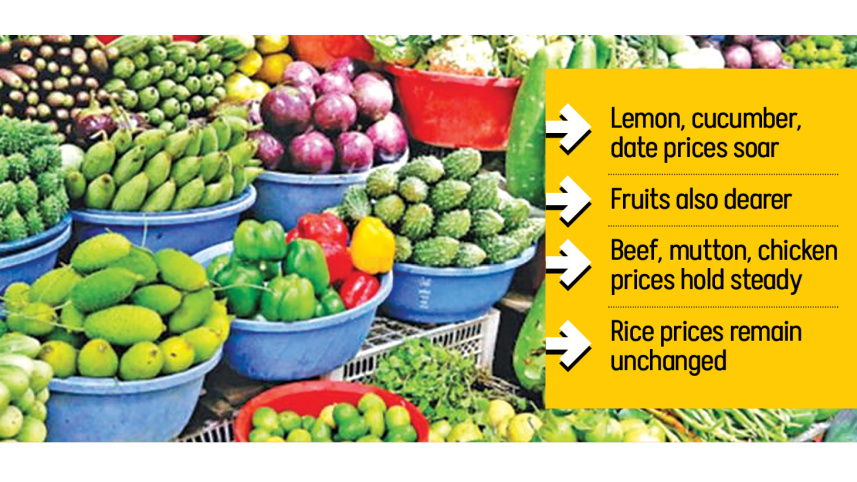
The prices of key Ramadan items edged up yesterday, the first day of the fasting month, with those of lemon and cucumber spiralling to a level that many consumers termed irrational.
In Dhaka’s kitchen markets, one had to shell out Tk 150 to Tk 200 to get four pieces of normal-sized lemons or limes; even the smallest-sized ones were priced at no less than Tk 40.

Fazlul Huq, who has been trading limes and lemons at Kawran Bazar for 42 years, however, pinned the price rise on the citrus fruits being out of season.
“While the fruit is grown year-round, the peak season only begins with the monsoon -- the months of January and February typically see a supply squeeze,” he said, adding that the wholesale prices have jumped by Tk 20 to Tk 30 per four pieces in just two weeks.
The price of cucumber, an iftaar staple, followed a similar trajectory, reaching as high as Tk 160 per kg for local varieties.
At Kawran Bazar and Mohammadpur Geneva Camp market, hybrid cucumbers were retailing between Tk 100 and Tk 120 per kg, but the preference for the local variety pushed its price to nearly double that of the hybrid ones.
Date, the most essential item for breaking the fast, saw a price hike of Tk 20 to Tk 50 per kg in just one day.
The most significant increase was observed in the case of the Zahidi variety, which is popular among low- and middle-income groups.
Zahidi dates that sold for Tk 280–300 per kg on Wednesday morning were retailing for Tk 350 by Thursday.
The better-quality Zahidi dates were selling for as high as Tk 500, almost double the price during Ramadan last year.
The premium varieties have also become dearer, said Abul Hossain, a date trader in Kawran Bazar.
The varieties that sold for Tk 440 last year are now Tk 500, while the high-end dates have seen a Tk 100 increase per kg, he said, adding that prices of premium dates like Ajwa and Mariyam ranged from Tk 1,000 to Tk 1,400 per kg.
The other fruits also saw similar price jumps.
Sagar bananas were selling for Tk 180 to Tk 200 per dozen, while apples and oranges retailed between Tk 350 and Tk 380 per kg, up from Tk 320 just a week ago.
Papaya prices also climbed, with Thai varieties selling for up to Tk 200 per kg.
In the protein segment, the price of beef remained steady but high at Tk 780 to Tk 800 per kg, while a kg of mutton costs Tk 1,300. However, the prices of fish, particularly of indigenous species like koi and catfish, rose by approximately Tk 100 per kg.
Despite the hike in perishables, the grocery and poultry sections provided some relief to consumers.
The prices for sugar, oil, lentils and salt remained unchanged, said Md Gofran, proprietor of Cumilla General Store in Kawran Bazar.
“These items haven’t seen a pre-Ramadan hike this time,” he said.
Poultry prices actually eased slightly due to lower-than-expected demand.
 For all latest news, follow The Daily Star's Google News channel.
 Broiler chicken was selling at Tk 190 per kg, down from Tk 200 two days ago, while Sonali chicken prices dropped by Tk 20 to retail at Tk 300 per kg.
Rice prices also stayed stable, with wholesalers attributing the steady trend to a slight dip in demand during the fasting month.
In Rajshahi’s Shaheb Bazar, lemon and lime that sold for Tk 20-25 per four pieces just days ago are now selling for Tk 50-60.
The price of cucumbers also jumped from Tk 60 to Tk 90 per kg, reports our Rajshahi correspondent.
“Like clockwork, the prices go up during Ramadan every year -- this is not unexpected,” said Monirul Islam, a buyer in Rajshahi.
Bipul Biswas, assistant director of the National Consumer Rights Protection Directorate in Rajshahi, said they are conducting regular drives to curb irregularities.
The situation was similar in Shariatpur’s Palong Madhya Bazar, where four pieces of lemon or lime are selling for Tk 60-100 on Thursday morning, reports our Shariatpur correspondent.
Meanwhile, in Chattogram, broiler chicken prices hit Tk 200-220 per kg, while eggplant and cucumber prices rose by Tk 20 per kg. Vendors in the port city blamed limited supply and high demand for the sudden hike.
Comments