


Talking costs you!
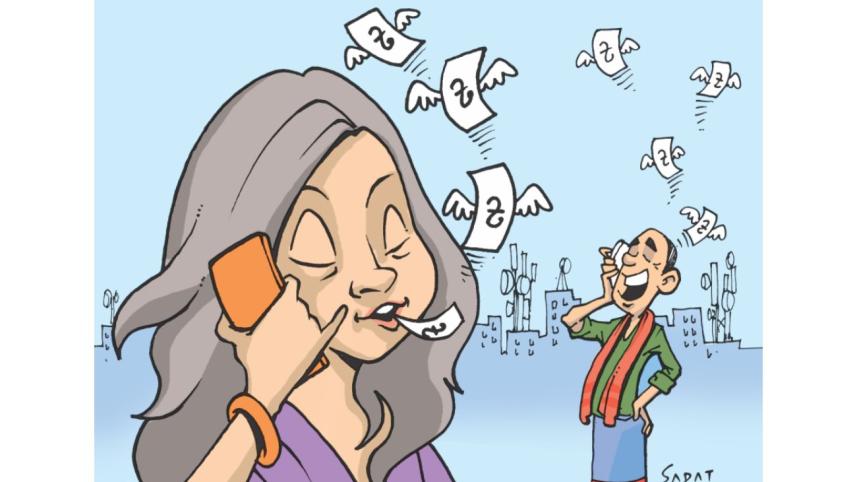
Hours after the finance minister yesterday in his budget speech proposed to slap 5 percent supplementary duty on services through SIM or RUIM cards, operators brought it into effect early today.
Mobile users will have to pay the extra supplementary duty from now on while using data, making phone calls, sending SMS or MMS and taking different other value-added services.

The National Board of Revenue (NBR) yesterday issued a Statutory Regulatory Order (SRO) to this effect, shortly after the finance boss's budget speech was over.
Mobile phone operators received the order in the evening. Immediately complying with the SRO, they started updating their billing system.
Around 11:40pm yesterday, operators were found to be working on the issue.
"We are working on it though some technical challenges are there," said Ekram Kabir, vice president of communications and corporate responsibility at Robi, last night.
Some operators have decided to run advertisements in media to make users aware of the extra money they will be charged.
In the early hours of this morning when this story was being filed, many users who used their phones around that time complained they were charged extra money for various services including outgoing calls.
Previously, if a customer spent 100 takas s/he had to pay 15 takas more due to the existing 15% VAT on those services. As per the new duty, a customer will have to pay 20.75 takas more, according to sources.
They also said the government will now earn more through this new duty.
"The government is likely to earn Tk 1,000 crore more through this new supplementary duty," a chief executive officer of a mobile phone operator said, wishing anonymity.
He, however, said it will badly impact the sector.
"We expected a total elimination of the SIM tax, which would help us more to achieve the government's vision of Digital Bangladesh. However, we are concerned that imposition of 5 percent supplementary duty on mobile services is likely to be burdensome on our valued subscribers, which may eventually dent the total revenue of the industry," said Ekram Kabir.
SIM TAX REDUCTION
Although tax reduction on SIM cards from Tk 300 to Tk 100 has come as a boon for mobile operators, the proposed budget for the next fiscal year has not mentioned anything about relaxing corporate taxes.
"With a view to ensuring the continued development of this mobile sector, making the IT service easily attainable through mobile phone and thus ensuring sustainable growth of this sector, I propose to levy Tk 100 as SIM tax for both the instances of issuance and replacement of mobile SIM cards," the minister said.
Mobile operators are generally upbeat about the SIM tax reduction. SIM tax was first introduced in the sector in 2005 at Tk 800, which was reduced to Tk 600 in 2011 and to Tk 300 in 2013.
Earlier in a pre-budget discussion, Association of Mobile Telecom Operators of Bangladesh (AMTOB) appealed to the revenue regulator for complete withdrawal of SIM tax and VAT on internet uses, and a significant reduction of corporate taxes.
About tax regulation, Abu Saeed Khan, senior policy fellow of Colombo-based ICT think-tank LIRNEasia, said, "The budget talks about taxes which are only collected by the NBR, but it never shows the hidden tax imposed by the telecom regulator which has been hindering the development of the country."
Last year a new Tk 100 tax on every SIM card replacement and 22.5 percent VAT and tax were also introduced for buying mobile handsets, which already have affected the industry heavily.
 For all latest news, follow The Daily Star's Google News channel.
Comments