


Concerns should be taken seriously: UN
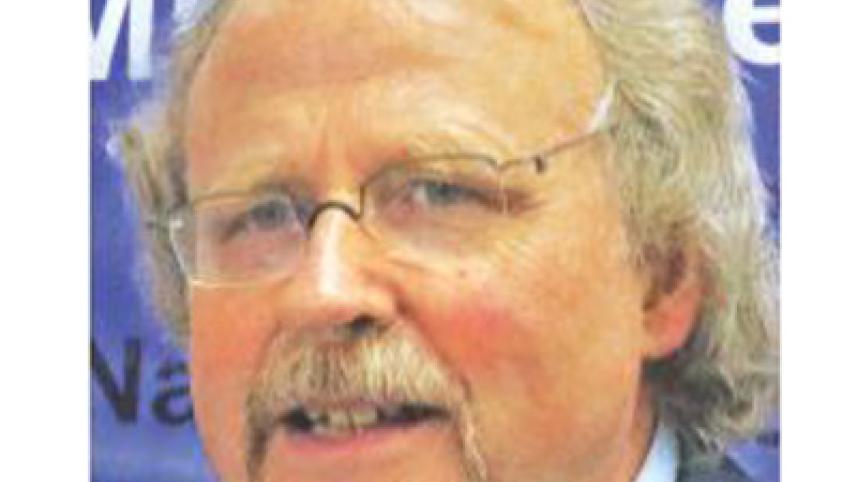
The civil society's concerns about the shrinking space for public engagement should be taken very seriously, said Heiner Bielefeldt, UN special rapporteur on freedom of religion or belief.
"They indicate the urgent need to take action in order to improve the conditions for communicative public engagement rather than creating more legal and political insecurity for civil society activities," said the UN expert.

Bielefeldt made the observations in a 20-page press statement on his preliminary findings of his nine-day visit to Bangladesh. He said he would present a report containing his conclusions and recommendations to the UN Human Rights Council next year.
The "shrinking space" for the civil society, concerns over section 57 of the ICT Act, and freedom of religion had been the most pressing issues that came up in his discussions with human rights activists, journalists, academics and independent intellectuals in Bangladesh, he says in a statement released at a press conference at the Jatiya Press Club yesterday.
"While chiefly feeling under pressure from religious militants, some [civil society members] have also experienced friendly fire, as one interlocutor phrased it.
"Even civil society activists who in principle very much agree with the 'secular' political agenda of current government have expressed feelings of alienation and frustration," the UN special rapporteur said in the statement.
UN Resident Coordinator in Dhaka Robert Watkins was with him at the press conference.
On the section 57 of the Information and Communication Technology (ICT) Act, Bielefeldt said the application of the act is even much wider and the punishment threatened by far more draconian than those of the blasphemy law in the Criminal Code of Bangladesh.
"Although I could not find out any precise figures as to how often section 57 has been used to impose sanctions for hurting religious feelings or similar offences, this law undoubtedly has a chilling effect on civil society organisations, human rights activists and members of religious minority communities.
"It much contributes to the perception of shrinking space for frank public discourse," he stated.
Terming the act "a vague formulation" with scopes of arbitrary interpretation by the law enforcement agencies, Bielefeldt said, "I have taken note that section 57 of the ICT Act has become controversial also within state institutions, including the judiciary."
"Recent arrests of members of human rights organisations, which have long existed in Bangladesh, add to the perception of rapidly shrinking space, to the detriment of the two closely interlinked principles of secularism and democracy.
"In discussions with religious minority communities, 'indigenous' people and civil society organisations, I often sensed feelings of anxiety and insecurity."
He observed that such insecurity has different political, legal and social dimensions which may affect individuals and groups in various ways. "Insecurity of property claims, in particularly relating to real estate, sometimes comes in tandem with fears for one's own or one's community's physical security in the face of rising religious extremism."
Observing that there has been a decline in the number of minority populations, particularly the Hindus, in Bangladesh, Bielefeldt said more needs to be done to give them a sense of security.
The Hindu population came down to 8 percent of the total population from 23 percent in 1971, according to the statement.
The Vested Property Act "caused many Hindu families to emigrate to India and other countries. The government has tried to combat this phenomenon through the 2001 'Vested Property Return Act' ... However, the implementation of this act seems to be faced with enormous problems ... At the same time, incidents of land grabbing at the expense of Hindus continue even today," he continued.
Responding to a question, he said freedom of religion is not just about minorities, rather it is a right held by all human beings.
"The Constitution of Bangladesh, which enshrines the principle of secularism while at the same time proclaiming Islam as the official state religion gives rise to ambiguities that have a direct impact on human rights in the country, including the protection of religious minorities."
Viewing freedom of expression and freedom of religion as closely interlinked, Bielefeldt in the statement laid emphasis on protecting the internet activists and bloggers.
 For all latest news, follow The Daily Star's Google News channel.
 "Restrictive legislative and administrative measures, which currently seem to shrink the space for religious or political dissent and public discourse, even when enacted with the intention to defend secular democracy, may thus inadvertently erode the very principles which these measures are supposed to protect."
The UN special rapporteur noted that some of the measures established to preserve secularism seem to lead to the opposite result.
"For instance, a number of official statements on the recent murders of online activists were ambiguous. While condemning the threats and acts of violence, government representatives also admonished individuals expressing critical views on religion, asking them not to go 'too far' in their criticisms," Bielefeldt said at the press conference.
On the Chittagong Hill Tracts (CHT), he says, "Much insecurity concerning real estate also exists in the CHT ... Legal insecurity of religious property, in combination with other factors, is a major reason underneath the feelings of vulnerability and insecurity still existing among the indigenous peoples in the CHT region ...
"In the CHT, where the religious landscape has always markedly differed from that of the rest of Bangladesh, demographic changes have been even more pronounced, not least as a result of government-induced population transfer in the past," Bielefeldt added.
During his August 31-September 9 visit, Bielefeldt met various government officials and local authorities in Dhaka and Chittagong Hill Tracts. He also held meetings with representatives of religious and diplomatic communities, as well as with academicians, civil society organisations and the UN officials.
Comments