


Air pollution driving up respiratory diseases


The outdoor department of the country’s premier respiratory treatment facility in the capital’s Mohakhali was so packed with patients that staffers were struggling to manage the crowd.
Clutching their medical test reports, many stood in front of doctors’ chambers because the seating arrangement was inadequate. With only a few minutes left before the outpatient services closed at 1:00pm, some looked visibly worried, unsure whether they would be able to see a physician.

“During the dry season, germs remain suspended in the air, and people inhale them. That is why more and more people suffer from respiratory diseases at this time.”
This scene unfolded at the National Institute of Diseases of the Chest and Hospital (NIDCH) on February 23. Several staffers said such situations have become frequent at the 870-bed specialised facility. Their claims are corroborated by the hospital’s yearly data showing a steady increase in patient numbers.
Linking the rise in respiratory cases to air pollution, NIDCH Director Golam Sarwar Liaquat Hossain Bhuiyan said, “During the dry season, germs remain suspended in the air, and people inhale them. That is why more and more people suffer from respiratory diseases at this time.
“Air pollution of various types -- dust, vehicle fumes and emissions from brick kilns – has increased, posing significant health risks, particularly respiratory problems. As a result, we are seeing a higher number of patients with asthma and COPD [chronic obstructive pulmonary disease],” he told The Daily Star on February 25.
He further said patients with asthma, in particular, suffer from symptoms such as cough, shortness of breath and wheezing. They can otherwise lead normal, healthy lives, but when they come into contact with certain triggering factors like air pollution, their symptoms worsen and the disease goes out of control.
Many patients come to the outdoor department with symptoms such as cough that doesn’t subside easily, he said.
“Most people are engaged in some form of work, and when they go to their workplaces, they are exposed to these pollutants. Due to this repeated exposure, the number of such patients at the outdoor department has increased.”
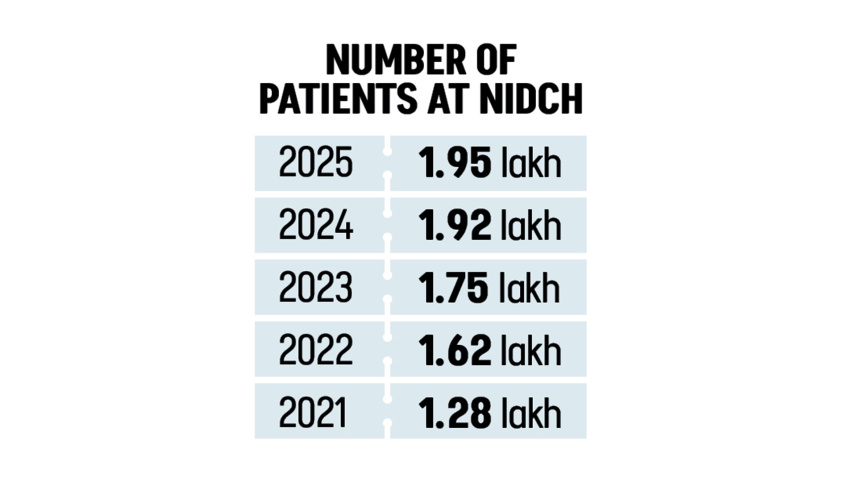
With Dhaka and other major cities seeing a rise in air pollution, the number of patients at NIDCH -- the top referral centre for respiratory diseases in the country – increased to 1.95 lakh last year from 1.92 lakh in 2024. The number was 1.75 lakh in 2023; 1.62 lakh in 2022; and 1.28 lakh in 2021, show the data.
Of the 1.95 lakh patients last year, the highest number -- 1.60 lakh -- sought care at the outdoor department, while 19,461 received treatment at the emergency unit and 15,886 were admitted to the hospital, according to the data.
Patients of all ages -- from neonates to elderly people -- visited the hospital, with those aged between 25 and 49 dominating the tally.
Health experts warn that health risks are especially high for patients with already‑compromised lungs.
Safiul Islam, an associate professor at NIDCH, said, “Air pollution is very dangerous for people with post-tuberculosis complications, pneumonia, or congenital lung problems. We are observing a rise in such patients at the hospital.”
One such patient is 50-year-old Abdur Razzaq, who came to NIDCH on February 23. He had undergone treatment around three years ago when fluid accumulated in his lungs.
The street vendor from Narayanganj’s Bhulta said he remains exposed to polluted air as he lives and works in an industrial area.
“I have been suffering from cough over the last few days and consulted a local doctor. He advised me to undergo some tests,” Razzaq said.
Shihab Uddin, an employee of a private company in Motijheel, said, “My daughter suffers from sinusitis and often falls ill due to air pollution. Her condition gets better in the monsoon when rains bring down the pollution level.”
VERY UNHEALTHY AIR
As the dry season continues, Dhaka city’s air quality has remained at unhealthy levels for more than a month. The city’s Air Quality Index (AQI) crossed 300 on February 25 and 26, placing it in the “hazardous” category.
 For all latest news, follow The Daily Star's Google News channel.
 In Savar, the situation was even worse. The AQI there hit 443 on February 26 while it was 418 the day before, according to real-time data from the Department of Environment (DoE) which classifies an AQI above 300 as hazardous.
On both days, Dhaka’s air quality was the worst among major cities across the globe, with an average AQI of 177 and 172. Beijing and Kathmandu jointly ranked second, according to IQAir, a Switzerland-based private company that monitors air quality.
Between 1998 and 2023, Bangladesh saw a 66 percent surge in PM2.5 pollution caused by fine particulate matter measuring 2.5 micrometres or less in diameter, shows the Air Quality Life Index (AQLI) published by the Energy Policy Institute at the University of Chicago in October last year.
Last year, the annual average PM2.5 level in Dhaka stood at 90.35 microgrammes per cubic metre, about 16 times the annual limit of 5µg/m³ recommended by the WHO, underscoring a severe public health risk.
The PM2.5 level rises significantly during the dry season compared to other times of the year. Last month, Dhaka’s average PM2.5 concentration rose to 193 microgrammes per cubic metre -- 38 times higher than the WHO standard.
According to last year’s report by the Energy Policy Institute, air pollution is cutting Bangladeshis’ average life expectancy by 5.5 years, making it the country’s deadliest external health risk.
It warns that the health toll caused by particulate matter pollution far exceeds that of tobacco use, malnutrition, or unsafe water. Smoking cuts life expectancy by about two years, while malnutrition reduces it by 1.4 years.
When contacted, DoE Additional Director General Ziaul Haque said there has been a sharp rise in air pollution in the capital. “The burning of solid waste in Matuail, Amin Bazar and several other areas could be contributing to the spike.”
In August last year, the interim government declared Savar a degraded airshed and halted operations of 106 brick kilns. However, 30 to 40 kiln owners obtained permission from the High Court last month to resume activities.
DoE sources said brick kilns account for around 58 percent of Dhaka city’s total air pollution, with vehicle emissions, construction activities and other sources contributing the remainder.
Comments