


Climate change causing rights violation
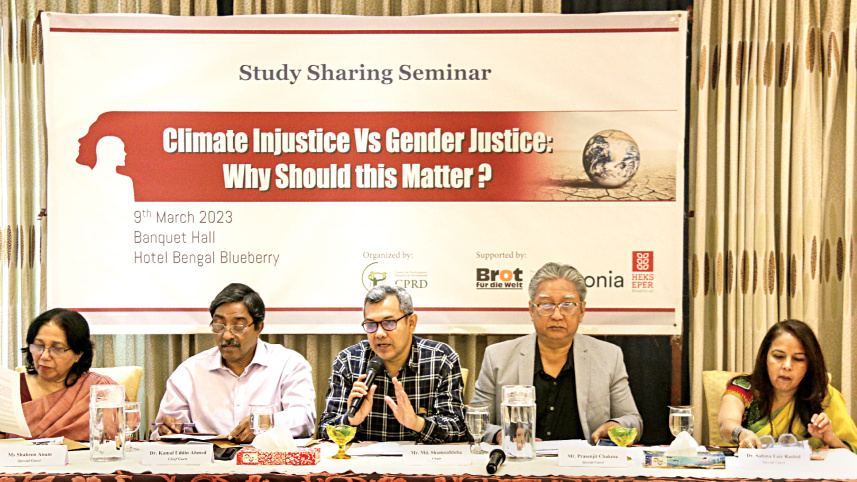
Due to climate change, women in the southwest coastal region of Bangladesh have been facing several violations of their gender rights, according to a study.
The study, titled "Climate Injustice vs Gender Justice: Why Should This Matter", was conducted by Center for Participatory Research and Development (CPRD). Md Akib Jabed, project coordinator (climate justice), and Naznin Sultana, CPRD research and advocacy officer, revealed the study findings at a seminar held at a city hotel.

The right to life and security, right to self-determination, right to means of subsistence, right to health, (Women's) right to water, right to a standard of living -- including adequate houses, food, water, sanitation -- and right to education were violated due to the climate change, the study mentioned.
Besides, the right to social security, right to property, right to free choice of profession and employment, right to protection of health and safety in working environments, including the safeguarding of the reproductive function and right to freely choose a spouse and to enter into marriage only with full consent were also violated.
The study mentioned that natural calamities, salinity, forced displacement, consequent dropping out of school and unemployment, health issues and child marriage as a way of "transferring risks" on the parent's end, have resulted in the violation of the rights mentioned above.
Addressing the event as chief guest, National Human Rights Commission Chairman Kamal Uddin Ahmed urged development activists to carry out a more detailed study on the issue, particularly on the violation of human rights of the affected and marginalised communities.
"Women of all age groups are highly vulnerable to the cumulative impact of climate change. Human rights violations of women may lead to massive disasters in the future and these should be incorporated into the policies and research initiatives in this regard," said Shaheen Anam, executive director of the Manuser Jonno Foundation (MJF).
The seminar was chaired by Md Shamsuddoha, chief executive of CPRD, while Prasenjit Chakma, assistant resident representative of UNDP Bangladesh, and Sabina Faiz Rashid, dean and professor of Brac James P Grant School of Public Health, spoke as special guests.
 For all latest news, follow The Daily Star's Google News channel.
Comments