


A controversial decision

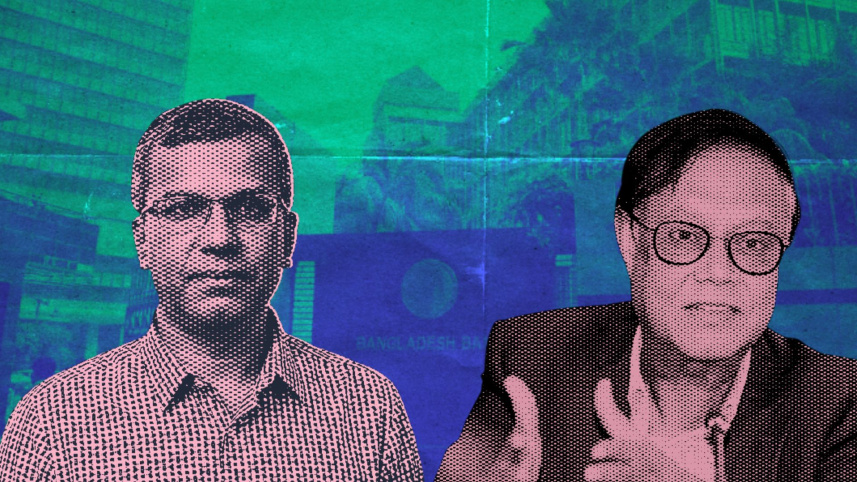
Critical decisions are usually judged by three things: their merit, method, and meaning or significance. The government’s decision to remove Dr Ahsan H Mansur from the post of Bangladesh Bank governor has failed in all three aspects. Since the news broke on Wednesday, there has been widespread questioning about its merit; it was crude, undignified, and mobbish in terms of method; and it is quite incomprehensible in terms of meaning, particularly as to its timing.
First, let’s look at the merit of the decision. Of course, the new government has every right to make new appointments in key positions so that the best-suited individuals are there to implement its policies. This is especially necessary for pivotal posts such as the governor of our central bank. But what is the merit of Wednesday’s decision?


This particular position deals with the most sensitive sector in the economy—banking—which has long been plagued by mismanagement, corruption, cronyism, capital flight, and so on. The depletion of our reserves and syphoning of profit abroad has led to a severe crisis that the central bank has been struggling to deal with. Every word or action of the governor affects the economy. The governor does not just control the central bank; through his leadership, he influences the whole banking sector. And the sector has been suffering from structural, institutional and managerial problems. The huge and largely unmanageable non-performing loans (NPLs) have been caused by inefficient, politically compromised, and corrupt leadership from the Bangladesh Bank.
Given the pivotal role that the central bank governor plays in controlling the important aspects of the economy, do the questions of academic qualifications, personal experience, institutional exposure, training and knowledge of how the global economy functions justify the appointment of the person now adorning the post? This is no criticism of him personally, but a focus on the bigger picture—the needs of the country and specifically of this government. How competently will he be able to serve the government’s goals, as enshrined in its 31-point programme? The new governor may be very well-suited for many things, but for this?
An awkward fact that may greatly impact his credibility is that he had his own loan rescheduled just in December last year. There are two kinds of loan defaulters: wilful and circumstantial. We hope he did not fall into the first category. Loan default is the biggest disease of our banking system and has greatly affected the operations of all banks. How sternly and decisively the new governor will deal with other loan defaulters when he was one himself is an open question. Rescheduling loans does not exonerate the borrowers; it merely gives them a way out of the predicament.
Another question concerns the governor’s political affiliation. He was a leading member of the election team that brought such grand success for BNP in the February 12 election. Is this a reward? Has our experience not taught us that such a position should go to a non-political, unbiased professional? Is it not also a lesson from the past regime that the central bank must not become an extension of the finance ministry, and must be given an element of autonomy in its operations? To ensure that, the governor must be a person of stature, spine and confidence to operate independently. Above all, he must be a non-partisan professional. How are we to interpret that this government has knowingly appointed a direct party activist as the governor of Bangladesh Bank? Then what is the difference from the past?
The finance minister said the government was implementing many changes and making many new appointments, and that the appointment of the new Bangladesh Bank governor was a part of that process. This comment makes it clear that in the finance minister’s mind, the central bank is akin to other departments of his ministry. So, again, what is new in the new government’s dealings with the Bangladesh Bank?
Then comes the question of “method”—the way the decision to appoint the new governor was implemented. For the argument’s sake, let’s accept that the government needed to appoint a new governor, that the person chosen was the right one, and that the decision needed to be implemented quickly. Could the process not have been more dignified? Minimum courtesy demands that the finance minister call Mansur to his office and inform him of the decision, or at least inform him over the phone. Minimum decency demands that he be given some time to vacate his office, say farewell to his staff, and leave with some show of honour. Instead, he heard about his departure from the media and decided to leave office on his own. Around the same time, an adviser to Mansur was allegedly mobbed and forced out of the central bank premises by a group of disgruntled officials.
Such behaviour stands in sharp contrast to the standard set by the head of the government. The prime minister’s demeanour of dignity, sobriety and composure in dealing with the processes of decision-making and their implementation contrasts starkly with the indignity that a man holding the position of central bank governor was made to suffer by the finance ministry.
Finally comes the “meaning” of the decision. What does it signify? What message is the government trying to convey through this dramatic and humiliating change at the top of such a critical and sensitive institution—one that has been severely maligned and weakened in the past and whose rebuilding is so crucial? Why remove the governor at this very moment, when the new government is settling down, learning how the vast machinery of government functions, reorganising the law enforcement agencies, and making new appointments to other key posts?
The removal also comes against a man who succeeded in addressing many of the problems our economy faced following the ouster of Sheikh Hasina. His 18-month tenure can be defined by aggressive macroeconomic stabilisation. Ahsan Mansur successfully transitioned the country to a more market-based exchange rate, which many feared would depress the value of the taka. But the taka actually stabilised against the dollar. During his time, our gross forex reserves increased from $25 billion to $35 billion. He followed a strict and tight monetary policy to contain inflation and prioritised economic discipline and price stability over loose credit. He took bold steps to restructure the boards of at least 11 troubled banks. Generally speaking, he accurately diagnosed the financial sector’s vulnerabilities and strengthened the central bank’s supervision. Most importantly, he was able to create a sense of confidence about the country’s economy at the international level. This is one area where the country not only needs to perform well but also needs to convince the global market that it is performing well. Ahsan Mansur was able to do that to a large extent. His removal may trigger uncertainty on the global stage and further jeopardise our recovery.
One of the pledges of Prime Minister Tarique Rahman has been that every major action of his government will be well-justified and transparent. The justification given by the finance minister refers only to the right of the government to make new appointments. Not a word so far explains why this appointment came so suddenly, dramatically, and insultingly to the incumbent.
The greatest damage this action may cause stems from the impression that it was done in response to “mob” pressure. There is no indication that this decision followed deep analysis of the situation, careful weighing of the various factors that accompany a change in such a vital position, or serious consideration of its implications. It came amid a gathering of some staff with demands that were mostly administrative in nature.
One of the first pledges the new government made was not to allow mob rule. Will what happened at the Bangladesh Bank not trigger similar moves in other institutions? We urge the prime minister to examine this event very carefully and reflect seriously on what it means for his government and what he needs to do to prevent a repeat. Such actions cast a questioning shadow over the government, and some consequences may be long-lasting.
Mahfuz Anam is the editor and publisher of The Daily Star.
Views expressed in this article are the author's own.
Follow The Daily Star Opinion on Facebook for the latest opinions, commentaries, and analyses by experts and professionals. To contribute your article or letter to The Daily Star Opinion, see our guidelines for submission.
 For all latest news, follow The Daily Star's Google News channel.
Comments