


Punashcha Dhaka: Revisiting the city’s social and cultural past
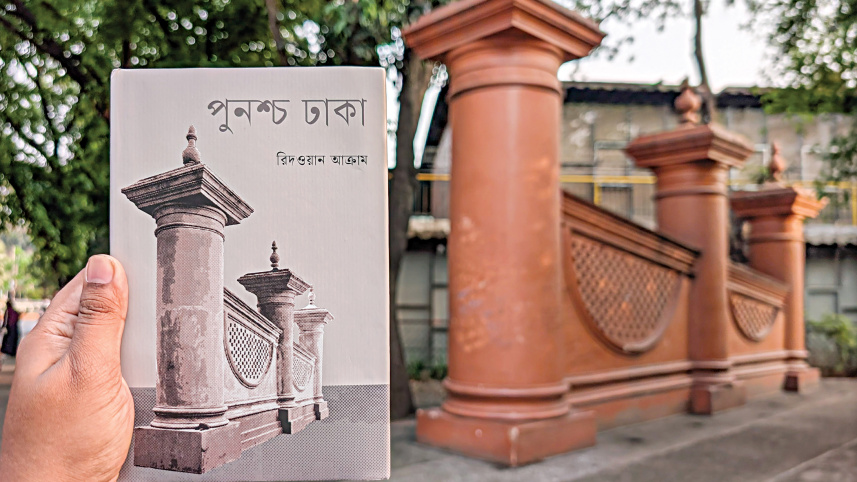
Dhaka has always been a city that returns to itself. Every alley, riverbank, and ruin seems to hold another story waiting to be rediscovered.
It is this endless wave of memories that Ridwan Akram’s book “Punashcha Dhaka: Charsha Bacharer Dhakar Samaj O Sanskriti” seeks to explore. Published by Kathaprokash, the book revisits more than 400 years of the capital’s social and cultural history, presenting Dhaka as a layered historical landscape.

The title “Punashcha Dhaka” itself announces a return. According to the author, writing about the city never truly concludes. The past often appears in small, overlooked details that have shaped Dhaka’s identity. Some stories remind us of the city’s golden past, while others trace its decline and transformation over time. Though they may sound like tales, they are rooted in history.
Akram structures the book thematically, allowing readers to explore Dhaka through different phases of its past. The chapters are arranged under sections such as Transport, Festivals, Administration, and Conflict. Through these categories, the author paints a mosaic of the city’s everyday life across centuries, its administrative structures, its cultural rhythms, and the professions and practices that once defined urban existence.
One of the book’s strengths is the historical anecdotes it brings to light. Dhaka became a Mughal provincial capital about 400 years ago, under Subahdar Islam Khan Chisti. The book revisits this period and raises curious questions about him, such as how he died in Dhaka and how his body was taken nearly 1,706 kilometres away to his final resting place.
The narrative also uncovers lesser-known chapters of the city’s history. According to the book, in 1790, foreign soldiers introduced horsecarriages for hire, marking an early chapter in public transportation in the city. The book also traces the origins of Ramna Park, which was first established during the Mughal era and has since witnessed many phases of the city’s historical transformation.
The book is complemented by historical photographs gathered from a variety of archival sources. Many come from the British Library’s collection, while others have been sourced from other repositories. These images add a visual dimension to the narratives, helping readers imagine the city’s transformations across time.
Speaking about the book, Akram emphasises the responsibility that comes with writing history. “Books live through detailed work, proper research and readers,” he explains. According to him, the task of a historical work is not only to document facts, but also to create a meaningful connection with its readers.
The author also notes that the history of Dhaka exists in pieces scattered across different sources. His effort, he says, was to gather those pieces together. “The history might be here and there, but I took the initiative to collect them,” he shares, adding that the work involved large-scale interviews and consultation with legitimate sources.
At the same time, Akram believes that historical writing must offer something fresh. “A book should give readers the taste of something new, something they may never have heard before.”
In fact, Punashcha Dhaka is not the result of a single period of writing. Rather, it is a compilation of his essays and research gathered over many years. “I did not write this in one sitting,” the author explains. “It is a collection that began many years ago, bringing together many of my writings about Dhaka’s history in one place.”
In that sense, Punashcha Dhaka works both as a collection of history and an invitation to rediscover the city. By bringing together archival sources, stories, and research, Ridwan Akram reminds readers that beneath Dhaka’s busy present lies a rich past that still echoes through its streets.
 For all latest news, follow The Daily Star's Google News channel.
Comments