


‘Ostad, bamey plastic, daine tesla’: Decoding Dhaka’s bus talk

You must be reading the heading and thinking -- since when did Bangladesh quietly enter the Tesla-importing business, and more importantly, what does any of that have to do with Dhaka traffic?
Fair question. Suspicious, even. But stay with me.

This is fun. Now, we all know “fun” and “Dhaka traffic” don’t usually belong in the same sentence, so let me clarify right away: this is not the window-seat-on-a-double-decker kind of fun, where a timely breeze shows up and Bijoy Sarani somehow lets you pass in one go -- let’s not get carried away.
But it is the kind of fun that makes those long, unmoving stretches of traffic -- where you’ve already questioned your timing, your choices, and occasionally, your entire existence -- feel just a little less like punishment.
Because let’s be honest, opting out isn’t really an option. Unless you own a helicopter. In which case, congratulations -- this piece is not for you.
For the rest of us, however -- those firmly committed to the daily ritual of going nowhere slowly -- bear with me. This might not clear the road ahead, but it could make the wait feel slightly less pointless, and just a little more tolerable.
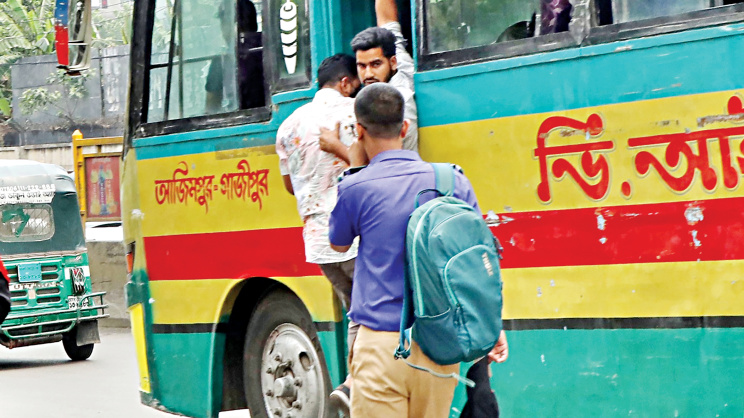
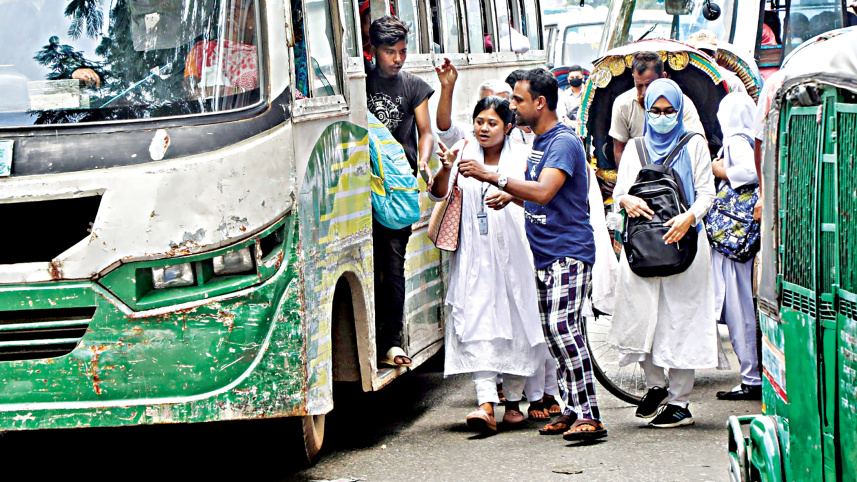
So, here’s the thing: if you sit long enough in Dhaka traffic -- and we all do -- you start to realise it has a coded language. A very specific, high-speed, no-time-for-full-sentences kind of language, mostly spoken by bus helpers hanging off moving vehicles as if they are absolutely committed to defying gravity.
Take the classic: “Ostad, bamey plastic!”
Now, if you are unfamiliar with Dhaka’s dialect of survival, you might assume this is an environmental complaint. It is not. “Plastic” is not litter here. It is not waste management. It is a private car -- smooth, shiny, air-conditioned, very much dent-able, and therefore immediately categorised as something to watch out for.
In fact, once you start paying attention, you realise Dhaka traffic is less about lanes and more about materials. Electric rickshaws are now confidently referred to as “Teslas” -- a piece of information that would deeply unsettle Elon Musk -- while private cars remain firmly labelled as “plastic,” for reasons that feel both insulting and strangely accurate.
Then comes the phrase that practically runs the city: “Borabor, shamne clear!”
Now, “borabor” deserves respect. It is doing the work of at least five sentences: keep moving, adjust if needed, squeeze a little more, become reckless, accept your fate.
And “shamne clear?” That one is pure fiction. Not a lie exactly, just a hopeful interpretation of reality that the standstill has somehow been lifted.
Of course, what makes all of this even more interesting is that none of these helpers actually arrive in Dhaka speaking this language.
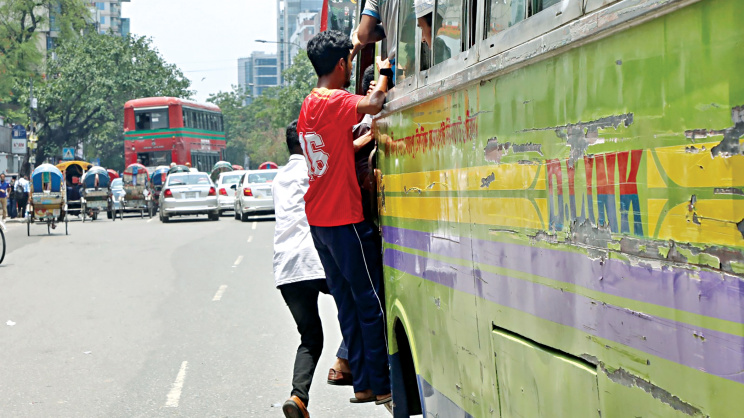
Bus helpers come from Noakhali, Barishal, Rangpur, Mymensingh and other parts of the country, each bringing their own dialect and tone. In any other setting, I am sure they would need subtitles to understand one another. And then Dhaka happens. The city trims everything down. Words get shorter. Sentences get sharper. Tone does most of the work.
There’s no time for grammar when five vehicles are trying to occupy the same space.
So, what emerges is this shared, improvised language -- efficient, direct, and just loud enough to cut through everything else.
And it works. Not perfectly, not peacefully, but just enough.
Even more fascinating is that bus helpers don’t hold a monopoly on this system. Rickshaw-wala mamas have their own competing dialect, or code, or set of signals.
Even the humble rickshaw bell has syntax here: One tring means presence. Two trings mean warning.
 For all latest news, follow The Daily Star's Google News channel.
 A desperate, continuous tring-tring-tring means: “move! Or my Tesla is going to dent your plastic!”
Comments