


Solar power lit up the chars, but not for long

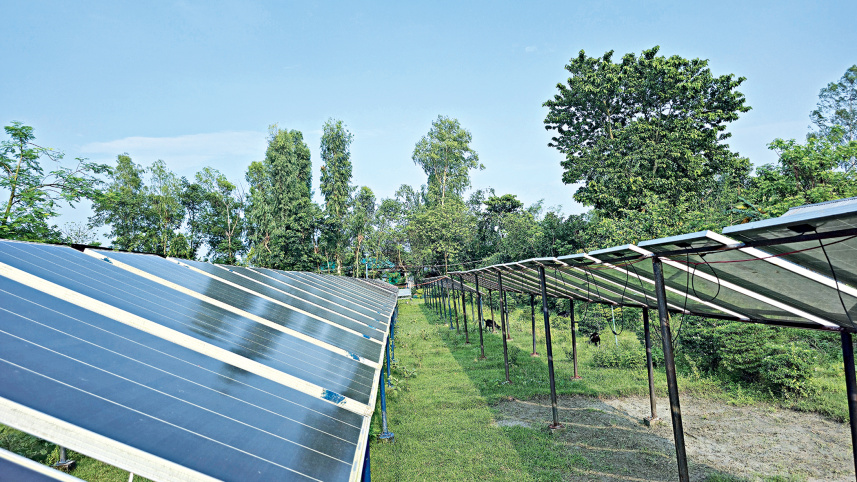
The evening comes early for Gaibandha’s Rasulpur. With sundown, the char disappears into utter darkness for anyone watching from Balashi Ghat on the other side of the Jamuna, where the business of life continues under bright lights with much noise.
At first glance, the river island appears devoid of any civilisation. But keep staring, and tiny star-like dots will start peeking from the void. Each one is a solar-powered home, filled with people.
 For all latest news, follow The Daily Star's Google News channel.
 The house closest to the mainland — a cluster of four tin shanties — belongs to Raja Mia and his nephew Ful Mia. Neither knows his exact age, but both reckon they are past 40. This March, they got electricity for the first time in their lives.
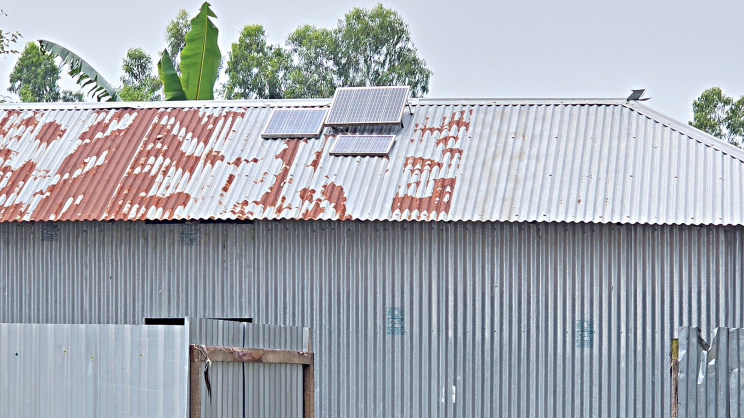
“A group of university students came and installed the solar [system],” Raja says with a large smile, gesturing toward three panels propped outside his bedroom that the family shares with three cows. Inside, a single 60AH battery stores whatever the day’s sun managed to collect.
Twenty houses are powered by the three panels. They get to run three light bulbs for a few hours on a good day. Raja is ecstatic. He can now light the room he shares with his family and three cows, charge his feature phone at home, and watch his daughter study at night.
His neighbour Sabuj Mia is unmoved. “I refused to take the connection. My house turns to an oven during summer. If I can’t even run a fan when I need it the most, what’s the point?”
Raja does not entirely disagree. The family still keeps lanterns. On overcast days, the panels barely charge. Any other electric device is out of the question. And yet he is grateful. The bar, in Rasulpur, is that low.
SOLAR HOMES’ REALITY
Chars, formed by river erosion and sedimentation, cover roughly 8 percent of Bangladesh. These lands are home to over 20 million people, who are among the most vulnerable in the country, deprived of most basic rights. They are accustomed to losing their land to the river. Most remain beyond the reach of the national grid, their lives governed by daylight and the last boat to the mainland.
Solar entered the country in mass scale in the early years of this century when the state-owned Infrastructure Development Company Ltd (Idcol), which finances renewable infrastructure, launched a Solar Home Systems (SHS) distribution programme in 2003. Backed by the World Bank and the International Development Association, the programme covered remote, off-grid areas, including chars.
At the time, there were roughly 20 million unelectrified rural households, covering 25 percent of the population, with a rural electrification rate of under 27 percent. What followed was remarkable in scale. The programme, through successive phases, helped more than 5.4 million people in remote rural areas gain access to electricity through SHS. Over 5.3 million units were eventually distributed. Bangladesh was celebrated internationally as a solar success story.
But scale masked quality. “Under the programme, we installed systems providing just about 30 to 40 watts of power,” says Enamul Karim, who joined Idcol in 2004 and now heads its Renewable Energy programme. “They can only light a bulb for a few hours.” The systems were, by design, minimal — entry-level access at entry-level capacity. The assumption was that the market would mature, costs would fall, and residents would upgrade. It largely did not work that way.
A 2021 study published in the journal Climate Policy found that the intended maturation of the market for off-grid solar did not occur alongside the gradual reduction of the programme’s subsidy scheme, resulting in a lack of service and technology providers and continued high system prices unattainable to poor households.
On the chars, that failure was compounded by geography. Technicians could not easily reach them. Replacement parts rarely arrived. And when the batteries — warranted for five years but often lasting eight or nine — finally gave out, residents were left to manage on their own.
“Some opt for smaller capacity batteries, or try to repair locally,” Karim says.
Another 2021 study published in the journal Energy Research and Social Science, specifically examining solar home systems on remote islands in Bangladesh, found that the main benefits reported by users were light at night and mobile phone charging — and that for the rural poor on islands, solar home systems had negative rather than positive impacts on poverty, partly because of the financial burden of maintaining systems they could not afford to replace or repair.
The arithmetic has never been simple. A 2024 BUET study puts the average monthly income of char residents at just over Tk 14,000. A 100-watt solar panel costs between Tk 3,200 and Tk 8,000. But a panel alone is not enough for a household. Batteries are more important, and costly.
Jorina Akhter in Notun Char of Chilmari in Kurigram has one 100-watt panel — carried from a previous char she used to live in that is now swallowed by the river. It powers two lights and a fan.
“We have to balance,” she says. “We try not to use both at the same time. But we don’t pay bills, so it’s fine.” She wants to upgrade. No one has come forward to help.
A proper setup — reliable enough to run a household through a monsoon week of cloud — costs upwards of Tk 1 lakh, nearly an entire year’s income for the average char resident.
Noor Nabi, a ward council member in Chilmari, spent Tk 1.20 lakh since 2009 building a system with three panels with a total capacity of 400 watts and two batteries of 200AH. When much of the country suffered load shedding earlier this year, his fans and lights ran without interruption. That is the ceiling of individual solar done well. For most char residents, it is out of reach.
Mohammad Ishak of Rasulpur never got that far. He lost his house — and the panel on its roof — to the river a few years ago. He has not been able to replace it.
A joint research by four universities across four countries on Bangladesh’s SHS initiative, published in the journal Energy Economics, found that constrained borrowers in poor rural areas pay a poverty penalty when trying to access solar home systems through market-based programmes. Meaning, the poorest residents end up paying proportionally more for worse equipment, widening rather than closing the energy gap.
THE GROWTH SOLAR STIRS WHEN DONE BIG
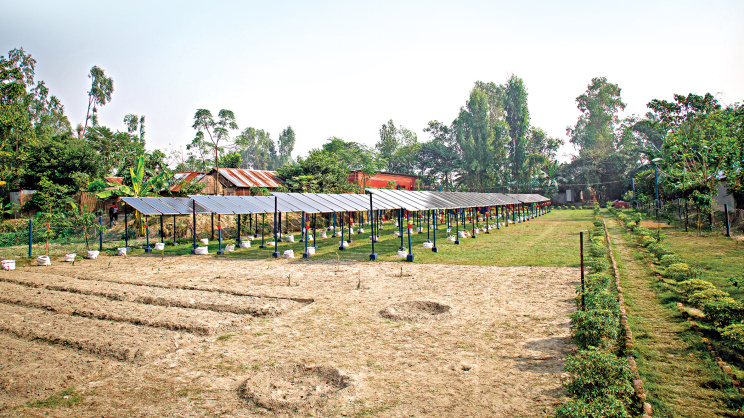
Kabilpur sits only an hour away from Rasulpur but feels like a different world. Pucca roads. High ground. Vast fields of maize, paddy, and mustard. Its own bazaars — tea stalls with televisions, grocery shops, tailors, electronics. One solar project by non-governmental organisation Friendship now powers over 160 households, shops across markets, schools, madrasas, and mosques — all connected through prepaid meters under a 57.6 KWP system.
“There is a change in psychology,” says Ajgar Ali, caretaker of the project on the north side of the char. “Four years ago, people didn’t know what they were missing. Now they want a television, fridge, oven. They want electricity for longer. We cannot survive without it anymore.”
The bazaar now runs until eight or nine at night. People of all ages fill a tea stall from early afternoon, drawn by snacks and a small television. The moment power comes on, all eyes go to the screen. Around 20 to 30 refrigerators have entered the char. Solar pumps have replaced diesel-run shallow pumps for irrigation. “Diesel costs a lot. Solar pumps don’t need fuel,” Ali says. “It’s like the more we get, the better.”
Unlike Rasulpur, Kabilpur has scale, shared infrastructure, maintenance, and metered accountability — precisely what the SHS programme could not deliver to isolated households buying small units on credit.
The World Economic Forum, citing World Bank data, noted that in communities with adequate solar infrastructure, markets became active after dark, households could run televisions, fans, and refrigerators, and streets were lit at night. That transformation requires a threshold of power that individual 30 to 60-watt systems never crossed.
A similar project has been launched in Chilmari, where Abdur Rahman and his wife Jamila Khatun sell fertiliser, pesticides, and groceries from a shop powered by a solar mini-grid.
“I lost my legs in an accident a few years before. This shop is everything to me. And getting to run a refrigerator and lights has boosted my business manyfold. I can keep it open till 9-10pm now,” he said.
He has a separate solar system for his house, making sure that power is on at all times when he needs it.
An NGO official, familiar with solar projects in char areas, describes the difference from the inside.
“On Goynar Putul char of Kurigram, where a solar-powered micro-grid was launched in 2021, the national grid later arrived. But residents still preferred the solar-powered line,” said the official, preferring anonymity.
“The grid goes off for a long time in storms,” he said. “Solar supply is more reliable.”
The Friendship project in Kabilpur recently upgraded from lead-acid to lithium-ion batteries.
“The old ones have less capacity and longevity. The new hybrid batteries start supplying automatically once fully charged,” solar project caretaker Ali says.
But even Kabilpur’s projects have limits. On bad weather days, supply may not start until late afternoon and cuts out before ten at night. The appetite the electricity created is now outrunning what the system can deliver. “I want a motor-run water pump at home, but it needs around 1,000 watts,” says Ali. “We cannot use anything that requires high power. When you think like that, the capacity is too low.”
The tariff structure -- Tk 97 fixed monthly plus Tk 5 per unit -- has also drawn complaints.
“Those who have their own solar are better off,” says Jalil Hossain, a regular at the tea stall. Sitting beside him, Jamal Mia, his bright red beard visible across the room, agrees. “We don’t get enough power from this project, but we still have to pay.”
Ali acknowledges the tension but frames it differently. “It is much better than not having power. But now that people have had a taste, they cannot survive without it.”
Bangladesh’s Renewable Energy Policy 2025 sets a target of 20 percent renewable energy by 2030 and 30 percent by 2041. Renewable capacity stood at just 1,690 MW at the end of last year, far short of the roughly 5,851 MW required to meet the 2030 goal — requiring deployment of around 760 MW per year through to 2030.
The new policy marks a deliberate shift away from the household solar model that defined the previous era, toward utility-scale solar, hybrid systems, and battery storage. The chars and their two decades of off-grid experience are not central to that conversation.
Idcol is also considering a new programme using larger systems and lithium-ion batteries.
“If we can finance a 3 KWH capacity system for a household, those using 200-250KWH a month will have their needs completely met,” Karim says. It would be implemented across the country. There is also the question of cost. Whether the next programme reaches the chars in any meaningful way, and whether it addresses the maintenance gaps that hobbled the last one, remains an open question.
Back on Rasulpur, the nights stay quiet. The boat to the mainland leaves before sunset. Life still largely revolves around daytime. Whereas in Kabilpur, people gather in tea stalls from early afternoons to wait for the TV to turn on.
Comments