Rooh Afza: The making of a South Asian icon

Across the Indian subcontinent, the moment of iftar often begins with a familiar ritual.
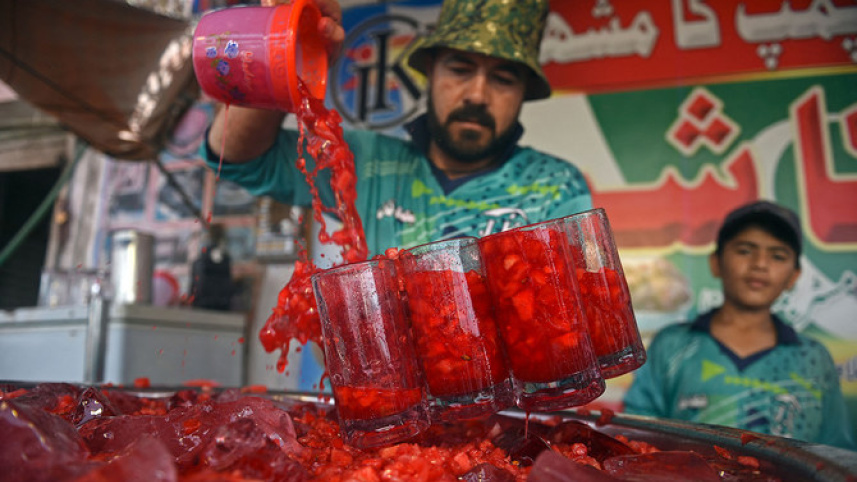
Dates are placed on the table, fritters arrive in fragrant heaps, and in tall glasses waits either lemonade or a deep crimson drink, cool and fragrant, shimmering with ice.

That drink is "Rooh Afza", a syrup whose very name translates loosely as “refresher of the soul”.
More than a beverage, Rooh Afza has become an emblem of Ramzan evenings in Bangladesh, India, and Pakistan.
For over a century, its rosy sweetness has signalled the breaking of the fast, a small but deeply symbolic pleasure after a day of abstinence.
Its remarkable durability lies not merely in taste but in tradition.
An enduring old-world elixir
The story of this famed scarlet syrup begins in 1906 in Old Delhi, where Hakeem Hafiz Abdul Majeed, a practitioner of traditional Unani medicine, sought a remedy for the punishing summers of north India.
Majeed blended herbs, fruits and flowers traditionally believed to cool the body and prevent heatstroke.
The result was a ruby red syrup combining rose, kewra, herbs and fruit extracts, a formula that quickly gained popularity as a restorative summer drink.
It was a drink designed not merely to quench thirst but to soothe the spirit -- a promise that remains unbroken even today.
What began as a medicinal tonic gradually evolved into a cultural phenomenon.
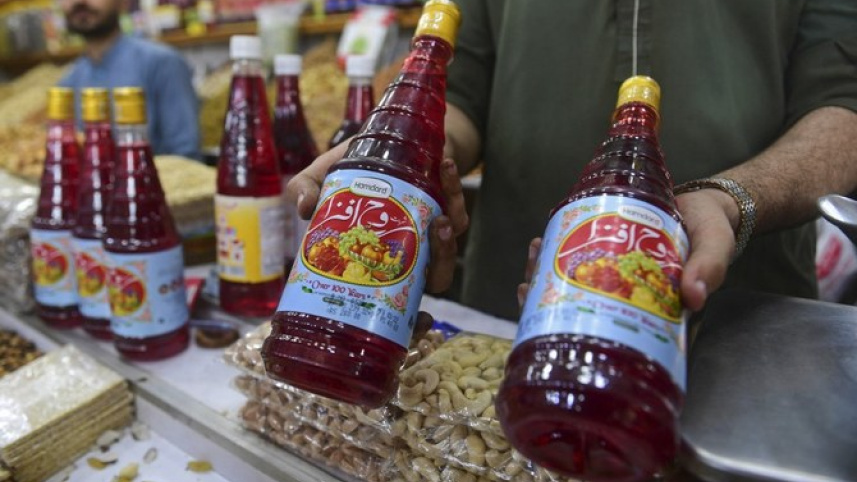
Mirza Noor Ahmad’s vivid 1910 label designs lent the drink a visual identity that mirrored its sensory richness and over the years, Rooh Afza’s recipe evolved while maintaining its essence -- a balance of cooling, aroma and sweetness that could cut through the sweltering summer heat.
Partition and the making of a subcontinental icon
History intervened dramatically four decades later.
The Partition of India fractured the subcontinent, dividing families, businesses and cities.
Yet Rooh Afza survived the rupture.
Hakeem Hafiz Abdul Majeed passed away in 1922. Then his wife Rabea Begum established a charitable trust in the name of herself and her two sons.
Majeed’s sons carried the brand across new borders.
Hakim Abdul Hameed remained in India, while Hakim Mohammad Saeed migrated to Pakistan in 1948 and established a new branch of the company in Karachi.
 For all latest news, follow The Daily Star's Google News channel.
 The syrup eventually came to be produced by three related entities -- Hamdard India, Hamdard Laboratories (Waqf) Pakistan, and Hamdard Laboratories (Waqf) Bangladesh.
In an era defined by geopolitical division, Rooh Afza quietly became a shared cultural inheritance.
Despite political fault lines, the same red drink appeared in glasses from Delhi to Karachi to Dhaka.
The chemistry of nostalgia
Part of Rooh Afza’s enduring charm lies in its optical and olfactory sensation.
The aroma is sui generis -- a melange of floral and fruity scents. The colour is unmistakable -- a rich crimson that turns pale pink when diluted with water or milk. The flavour is delicate yet unmistakably sweet but layered.
Food historians quoted by The Guardian describe the drink as an example of culinary nostalgia, a product whose emotional meaning exceeds its ingredients.
For many, Rooh Afza is inseparable from childhood memories of Ramzan evenings -- stirring syrup into cold water, and the sudden relief of the first sip after sunset.
The drink of Ramzan
Rooh Afza’s association with Ramzan is so strong that many households treat it as a seasonal necessity.
During the fasting month, dehydration and heat exhaustion are constant concerns, particularly in the subcontinent’s sweltering climate.
The syrup’s original purpose as a cooling tonic therefore aligns perfectly with the needs.
Mixed with chilled water or milk, it becomes a quick restorative drink.
Rooh Afza has been deemed “the king of Ramzan drinks” in South Asia, appearing on countless iftar tables from bustling cities to villages.
More than just a seasonal refresher
Another reason for its longevity lies in its adaptability.
Rooh Afza is rarely confined to a single form. It flavours milk drinks, sherbets, ice desserts and falooda.
The concentrate’s versatility has allowed it to remain relevant even as tastes evolve.
Cafés experiment with Rooh Afza milkshakes and mocktails, while home cooks fold it into puddings, jellies and frozen desserts.
Flowing through time, transcending borders
Food and drink often serve as subtle bridges between divided societies. Rooh Afza exemplifies this phenomenon.
In a region often marked by political tension, Rooh Afza occupies an unusual cultural space. It belongs simultaneously to several nations yet feels native to each.
The bottle, the label, and the same rose-scented sweetness are familiar across three countries whose histories diverged sharply.
Around 120 years after its creation, Rooh Afza remains an enduring commercial success.
Supermarket shelves across South Asia still display the distinctive bottle, its ornate label echoing the aesthetic sensibilities of early 20th-century.
Its survival is remarkable in an age dominated by global soft-drink giants.
While multinational brands flood markets with carbonated beverages, Rooh Afza continues to hold its ground through heritage, ritual and memory.
Ultimately, the drink’s longevity cannot be explained purely by marketing or flavour. It endures because it occupies a moment rather than merely a market.
Rooh Afza still performs the promise contained in its name -- sweet refreshment for the soul.

Taylor Swift wins MTV’s new artist director award

‘AI is coming, but people want real things’: Tom Cruise

There was only one Leonard Cohen

‘Continuum’ showcases 60 artworks by three artists to Bhumi Gallery

Netflix, British Library team up to bring viewers back to books behind screen favourites

‘Daredevil: Born Again’ to end with third season

Japan Festival returns to Dhaka after 7 years

‘Abar Hothat Brishti’ to hit cinemas in October

AvoidRafa to hold first solo concert in Dhaka