


Inside Dana Wyse’s pharmacy of desire


At a table in Bangladesh this January, Canadian conceptual artist Dana Wyse slid a small plastic packet across the surface as if offering medicine. Inside sat a brightly coloured capsule and a printed promise of instant transformation. Fame without labour. Love without vulnerability. Certainty without doubt.
No one believes the pills work. That is precisely why they do.

For more than three decades, Wyse has manufactured fictional remedies under her ongoing project “Jesus Had a Sister Productions,” packaging desire itself as a consumer product. The works resemble pharmacy merchandise or airport impulse buys -- objects designed to reassure before they are even understood.
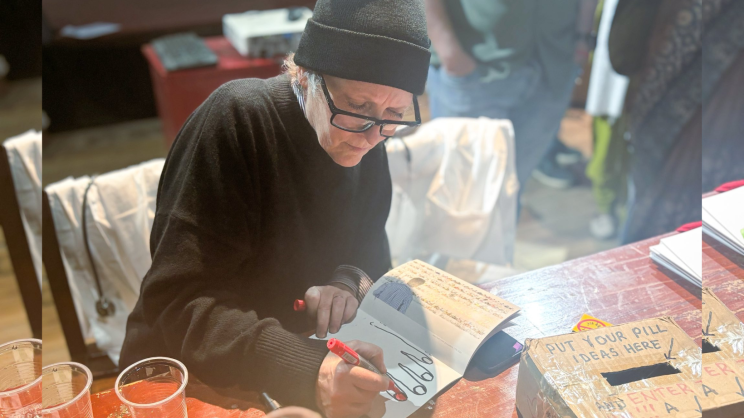
Dana’s arrival in Bangladesh carried the strange familiarity of a travelling salesperson, except that nothing she sells intends to cure anything at all.
The fantasy she exposes predates modern markets. Capitalism merely refined its aesthetics.
Today, sleep arrives through tracking apps and supplements engineered for optimisation. Beauty through routines disguised as self-care. Happiness through productivity systems, promising calm as a reward for discipline. Even rest feels measurable.
Choose correctly, consume wisely, optimise relentlessly — and uncertainty might retreat.
Yet exhaustion persists. Confidence feels rented. Pleasure arrives, curated and leaves behind fatigue mistaken for achievement. Lack is not erased; it is redesigned and returned as another purchase. Wyse’s pills simply say the quiet part aloud.
The world-renowned artist visited Bangladesh in January, where this correspondent had the opportunity to interview her.
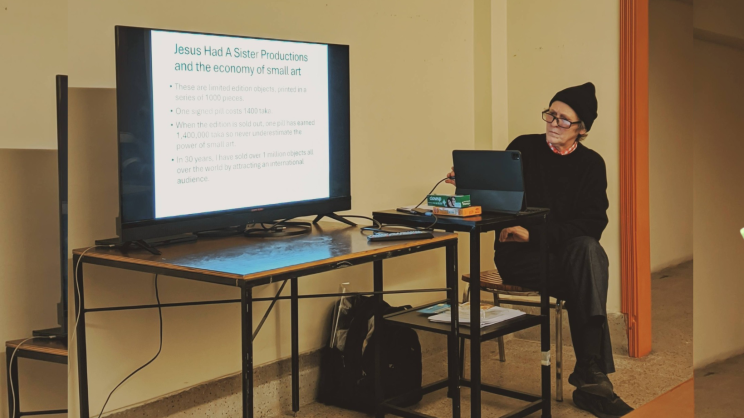
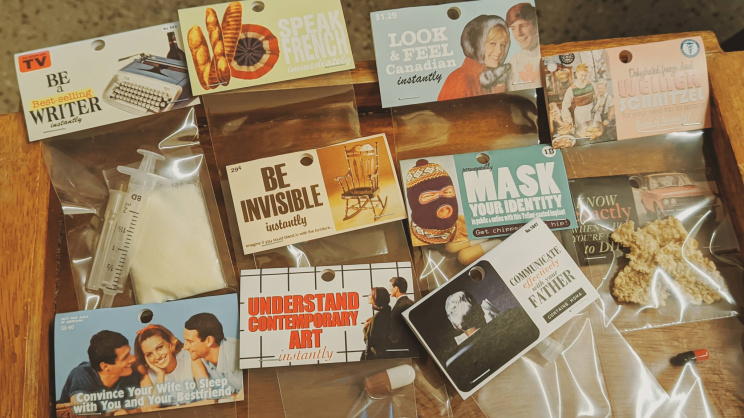
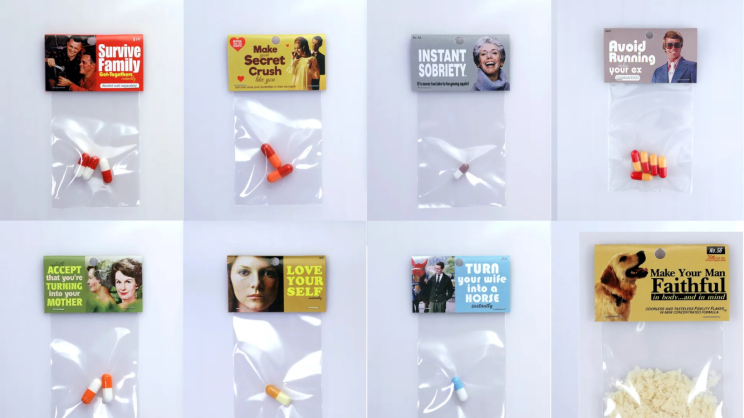
Her ongoing project, “Jesus Had a Sister Productions”, consists of hundreds of small plastic packets resembling pharmaceutical products. Inside sit brightly coloured “pills” accompanied by outrageous guarantees: “Become a Millionaire the Old Fashioned Way”. “Stay in Love Forever”. “Completely Control Your Family”.
They hang in museum shops across the world. They promise transformation, but offer none. And that very absence is the ‘work’.
Wyse borrows capitalism’s visual grammar — branding, typography, packaging — not to sell solutions but to expose how readily people want to believe in them. The objects hover between joke, irony and confession. Laughter arrives first, then hesitation.
Why does this feel plausible? Her own origin story sounds suspiciously like one of the artworks.
The first pill she ever made, an “Instant Fame” capsule, appeared at a modest exhibition in a Paris apartment. Within days, a major newspaper reviewed the show. Months later, she appeared on a magazine cover.
“One small pill incredibly altered the course of my entire life,” she recalls.
For more than thirty years, she has travelled from Los Angeles to Luang Prabang and Bangladesh carrying a suitcase filled with promises she never intended to fulfil.
Audiences inevitably ask the same question. Do they work?
“The truth is, I don’t know,” she says. “But when the mind focuses on a wish, it begins a mysterious chain of events.”
Intention, she believes, alters behaviour. Imagination produces momentum. The artwork grants no miracle; it exposes the longing for effortlessness. Humour becomes an entry point, rather than a shield.
According to the artist, ideas often begin with irritation — a mosquito refusing to die, a bar of soap repeatedly disappearing beneath bathwater until she imagines embedding a magnet inside it simply to end the inconvenience.
 For all latest news, follow The Daily Star's Google News channel.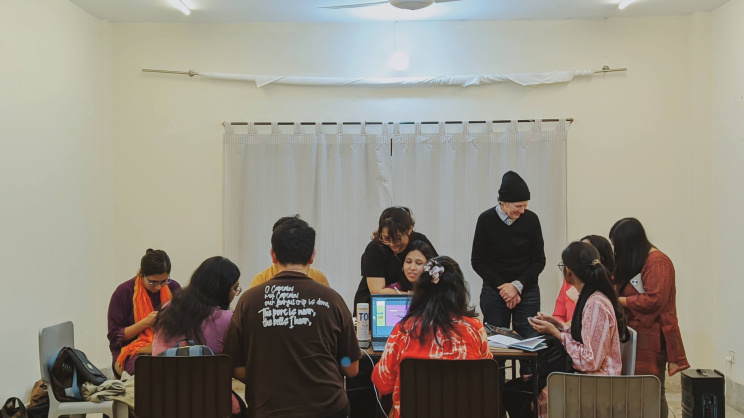
Sometimes, inspiration arrives through archival images. Her Paris studio contains decades of vintage magazines. “An image always talks”, Dana says.
A photograph of a man walking a horse becomes the absurd pill “Turn Your Wife Into A Horse Instantly.” The harmless image mutates into a domestic fantasy about power and intimacy — the desire to change others without consent.
Even artificial intelligence provokes speculation. “What if my mother lied?” she jokes. “What if I’m a robot?” The humour disguises a philosophical question. How does anyone verify reality when belief constantly rewrites it?
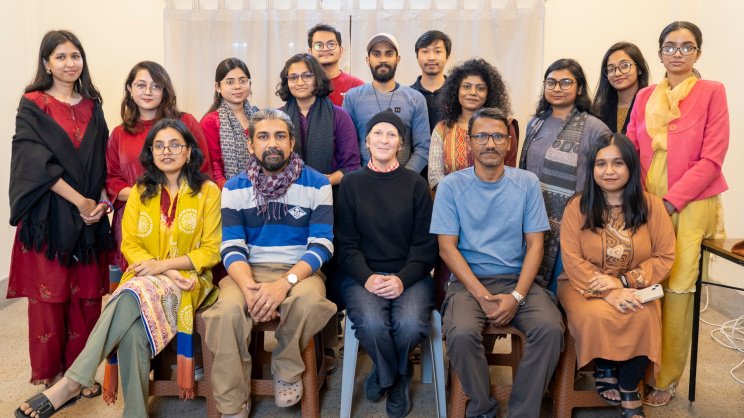
Earlier this year, these questions travelled to Chittagong through “Medicine,” a collaborative exhibition organised with students from the Institute of Fine Arts.
There was no hierarchy. “The students were teaching me,” she says.
Participants translated her framework through local metaphors. Seeds gathered from the Chittagong Hill Tracts reflected growth and displacement. Honey suggested collective labour. Amulets negotiated belief between tradition and modern anxiety.
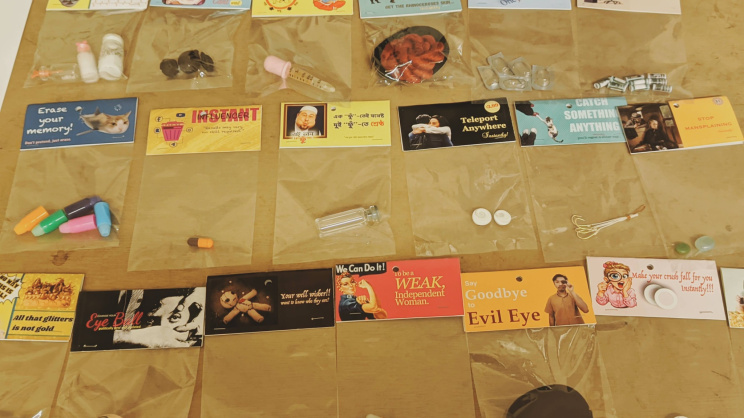
“What I love,” she adds, “is briefly seeing life through someone else’s eyes.”
In Bangladesh, satire encountered a different urgency.
Rapid urban expansion and widening aspirations have produced their own ecosystem of promises — professional success, upward mobility, curated happiness. Self-improvement circulates beside familial expectation and social scrutiny.
Wyse’s fictional remedies felt unexpectedly familiar. “When humour enters,” she explains, “the spectator relaxes. That’s how the message hits the target.”
Capitalism remains both subject and medium. By mimicking retail packaging, she inadvertently created demand. Collectors began purchasing the works in large numbers. Her studio slowly transformed into a functioning business — the very system she intended to critique.
“We unconsciously learn typography. We unconsciously learn how to read images,” she says. “We are literally born to shop.”
The contradiction forced adaptation.
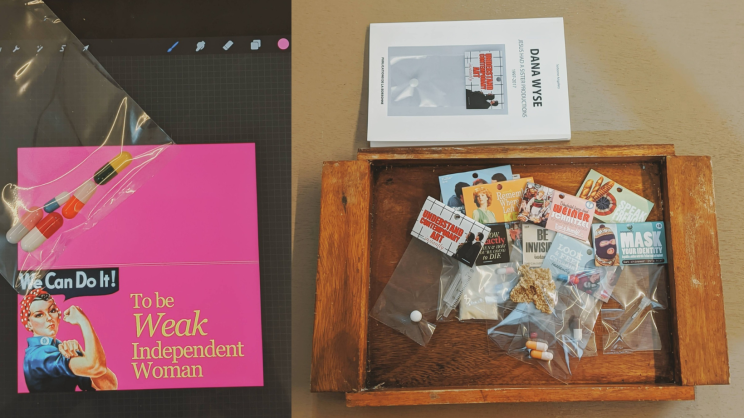
Now, when collectors order a ‘pill’ online, she often includes an additional artwork they never requested — sometimes unfinished, sometimes experimental.
“I try to remove value from art,” she says. “If it’s free, I’m allowed to make mistakes.” Satire, she insists, resembles composing music — adding and subtracting until the tone feels right.
Dana rarely imagines an audience. “That would terrify me.” The pills began as a way to laugh at herself. Recognition arrives as a connection rather than ambition.
“My work is about the joy of being alive,” she says. “And the fear of being alive.” She offers no cure.
Instead, she frames existence itself as improbable comedy, an irony of and around the absurdity of it— humans suspended on what she calls a drifting pebble in space, building monuments while losing socks.
Wouldn’t it be comforting to believe in a ‘pill’ that guarantees order? Her art refuses that comfort. It offers permission instead — to play, to imagine, to accept vulnerability without disguise. “By suspending disbelief,” she says, “we invent our lives.” The packets remain sealed behind plastic sleeves, promising miracles.
The real transformation happens elsewhere — in the quiet recognition that certainty was never the medicine we were looking for.
Comments