


Yayoi Kusama, artist of infinity, dies at 97
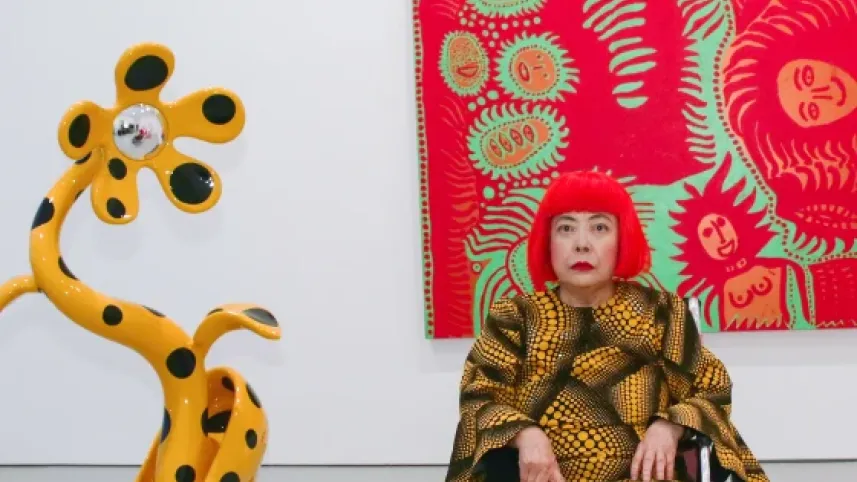
Yayoi Kusama, the Japanese avant-garde artist who transformed polka dots, mirrors and pumpkins into a distinctive visual language, died at a Tokyo hospital on August 14, aged 97, her official website and the Yayoi Kusama Museum announced on Thursday.
For decades, Kusama turned experiences that began as childhood hallucinations into paintings, sculptures and installations that explored repetition, infinity and the dissolution of the self. She continued painting until her final days, according to a statement from her museum and foundation.

Born in Matsumoto, Nagano Prefecture, in 1929, Kusama moved to the United States in 1957 and established herself in New York’s avant-garde art scene during the 1960s. Her practice extended beyond visual art to performance, fiction and poetry.
Her early experiences with hallucinations became central to her artistic vocabulary. Kusama recalled seeing patterns spread across ceilings, windows, pillars and her own body. Repetition became both a subject and a method, with dots and nets appearing across canvases and later expanding into three-dimensional environments.
Her work challenged the conventions of the male-dominated New York art world. She staged provocative performances and produced sculptures that confronted sexuality, the body and the boundaries of artistic practice. Yet she struggled for recognition while several of her male contemporaries gained greater institutional attention.
Kusama returned to Japan in 1973. In 1977, she voluntarily entered a psychiatric hospital in Tokyo, where she continued to live while working from a nearby studio. Her mental-health struggles remained closely connected to her artistic practice, rather than preventing it. Reuters reported that she continued to paint throughout her final years.
The artist’s international standing changed dramatically in the late 20th century. In 1993, she represented Japan at the 45th Venice Biennale with a solo presentation at the Japan Pavilion. The official Japan Pavilion record notes that Kusama had already made an unofficial intervention at the 1966 Biennale, when she laid 1,500 mirrored balls on the ground.
The 1993 presentation became an important moment in the reassessment of her work in Japan and abroad. Her installations subsequently entered major museums and galleries around the world, while her Infinity Mirror Rooms became among her most recognisable creations.
The installations use mirrors, lights and repeated forms to create seemingly endless spaces, placing visitors inside the work rather than simply before it. That immersive quality helped introduce Kusama to audiences far beyond the traditional art world.
Her recognition continued to grow in later life. She received the Asahi Prize in 2001, France’s Ordre des Arts et des Lettres in 2003, Japan’s Order of the Rising Sun, Gold Rays with Rosette in 2006, the Praemium Imperiale for painting in 2006, and Japan’s Order of Culture in 2016.
The commercial market followed her institutional recognition. Her paintings and sculptures became highly sought after, while exhibitions of her Infinity Mirror Rooms attracted large international audiences.
Yet the motifs that made Kusama globally recognisable were rooted in deeply personal concerns. Her pumpkins, in particular, became a recurring symbol, rendered in vivid colours and covered with her characteristic dots.
The Yayoi Kusama Museum and Yayoi Kusama Foundation said she remained committed to art until the end of her life and to her belief in art’s capacity to bring hope and strength to people around the world. Her Tokyo museum will continue its exhibition “KUSAMA’s POP” through August 30, as scheduled.
Kusama’s career ultimately traced an extraordinary arc: from a young artist whose visions isolated her from the world to an artist whose repetitions became instantly recognisable across it. Her dots multiplied, her mirrors extended space, and her pumpkins became objects of collective memory.
 For all latest news, follow The Daily Star's Google News channel.
Comments