


‘Molotov Man’: The photograph that outlived a revolution
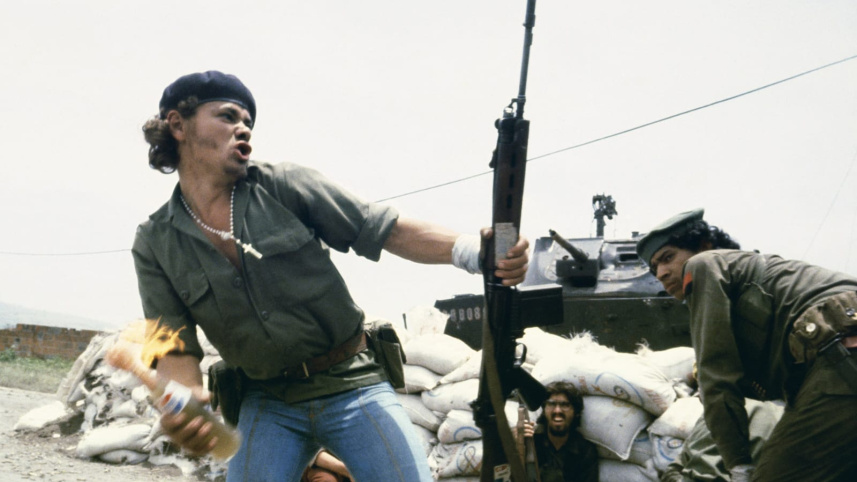
On the afternoon of 16 July 1979, in the northern Nicaraguan city of Estelí, a young man named Pablo Aráuz found an empty Pepsi bottle, filled it with petrol, lit it and threw it at the local headquarters of the National Guard. An American photographer standing a few feet away made a picture of him doing it. Somoza fled the country the next day. The dictatorship his family had run for 43 years collapsed two days after that.
The photograph is called “Molotov Man”. Aráuz, known to everyone as Bareta, has been throwing that bottle ever since.

A country and a photographer
The Somoza family had governed Nicaragua since 1937. Their instrument was the National Guard, a force the United States had armed and trained, and Washington kept backing them for four decades on the reasoning that a friendly dictator was preferable to an unfriendly election. The opposition organised slowly. The Sandinista National Liberation Front, named after a guerrilla leader the Guard had assassinated in 1934, was founded by student activists in Managua in 1961 and spent most of the next 15 years being hunted.
What broke the arrangement was a murder. On 10 January 1978, Pedro Joaquín Chamorro, editor of the newspaper La Prensa and the most prominent critic of the regime, was shot dead in Managua. Nobody believed the government’s account. A hundred and twenty thousand people came to his funeral, a general strike followed, and a country that had been quietly angry for 40 years stopped being quiet.
Susan Meiselas arrived five months later. She was 30, from Baltimore, and had studied anthropology before she studied photography. Her only substantial body of work at that point was a book about women who performed in travelling carnival strip shows in New England, made over three summers while she taught photography in New York public schools. She had joined the Magnum agency in 1976. She had never covered a war.
She has said she went because she wanted to see what American foreign policy actually looked like on the ground. Her passport and press card let her move between the Sandinistas and the Guard, a freedom almost nobody inside the country possessed. She stayed for a year. She shot in colour, which at the time was slightly disreputable for serious conflict work, colour being associated with advertising rather than with witness.
What is actually in the picture
Most people remember the photograph as a silhouette of a man throwing a bomb. Look at it properly and it is far stranger than that.
He is leaning back, arm fully extended, the bottle lit and still in his hand. He wears a beret over dark curly hair. A crucifix has swung out from his chest, thrown clear by the speed of the motion. In his other hand he is holding a rifle, and that hand is wrapped in a bandage. Behind him, a few metres back, other fighters are crouched low behind sandbags. He is the only one standing.
Each of those details does something. The Pepsi bottle is an American consumer product turned into a weapon and thrown at an American-armed government, which is a joke the photograph makes without saying anything. The crucifix belongs to a specific history: liberation theology was a real force in the Nicaraguan revolution, and priests served in the Sandinista government afterwards. The photograph later ran on the cover of a Nicaraguan church magazine. The flame is small because the weapon is homemade and the building is fortified.
The bandage is the detail that stays with me. Nobody arranged it. It does not serve any argument. It simply says that his hand was already hurt, that this was not his first hour of fighting, and that the man who became a symbol was a body that could be broken.
Meiselas made the picture from low down and close in. Low angles enlarge people. Combined with the backward lean, the angle turns a man throwing a bottle into something closer to a statue. She was not shooting from safety with a long lens. The composition also depends on what she left out. There is a whole battle in that frame, and the crop pushes it into the background. A wider frame would have been a photograph of an insurrection. This one is a photograph of a man.
The picture leaves
Within a year of the revolution, the image was everywhere in Nicaragua. It appeared on matchbooks made for the first anniversary. It went onto posters, stamps, T-shirts, brochures and woven straw rugs. People painted it as murals and cut it into wall stencils. Bareta’s silhouette became the visual shorthand for what the country had just done to itself.
Then it went further than anyone intended. In the 1980s, the Sandinista government used the image to recruit a popular militia against the Contras, the rebel force the CIA was funding out of Honduras, pairing it with graffiti reading “No Pasarán”, a slogan borrowed from the Spanish Civil War. At the same time, in the United States, the Contras were putting the same image in fundraising material as evidence of communist aggression. Two sides that were shooting at each other were using the same photograph to raise men and money.
The strangest chapter came much later. In 2003, an American painter named Joy Amina Garnett found a cropped JPEG of the figure online. She did not know who had taken it, who the man was or what country he was in. She painted him as part of a series about people in states of extreme emotion and titled it “Molotov”. A cease-and-desist letter arrived from Meiselas’s lawyer, and the internet did what the internet does. Artists around the world began posting their own versions in protest, an episode that came to be known as “Joywar”.
The two women eventually met at a symposium on fair use in 2006 and wrote a joint essay for Harper’s Magazine the following year. Their disagreement is worth reading because neither of them is obviously wrong. Garnett asked whether the author of a documentary record gets to control what that record means forever. Meiselas’s answer was that stripping the context turns a named man’s specific act on a specific day into a generic image of rage, and that she owed it to him not to let that pass without objection.
The man himself
Meiselas went back to Nicaragua in 1990 to find the people in her photographs for a film called “Pictures from a Revolution”. She found Bareta driving a lumber truck, delivering timber, still a Sandinista and raising a family. He had no objection to how the picture had been used. He understood it as belonging to a collective struggle rather than to him. Later, his likeness was adopted as the official emblem of the overthrow, and a monument to him was put up in his home town.
So there are three parties with a claim on this photograph. Meiselas holds the copyright. Bareta did the thing it records. And the people who have reproduced it since, in Nicaragua and elsewhere, have used it for whatever they needed at the time. The claims are all reasonable and they do not agree with each other.
The picture is a record of something that happened. A man named Pablo Aráuz threw a petrol bomb at a garrison in Estelí on the afternoon of 16 July 1979. The same picture was also used by the Sandinistas and by the Contras while they were at war with each other, and by a painter in New York who had no idea what she was looking at. Those things are all true of one photograph.
A photograph does not hold its meaning by itself. The meaning comes from what is attached to it, and that can be taken off. It is worth keeping in mind now, when most of the images we see reach us cropped, with no caption and no idea who made them. Somebody made each of them, and somebody is in them, and both of those people usually had something specific in mind.
 For all latest news, follow The Daily Star's Google News channel.
Comments