


5 books that capture the soul of lunar exploration
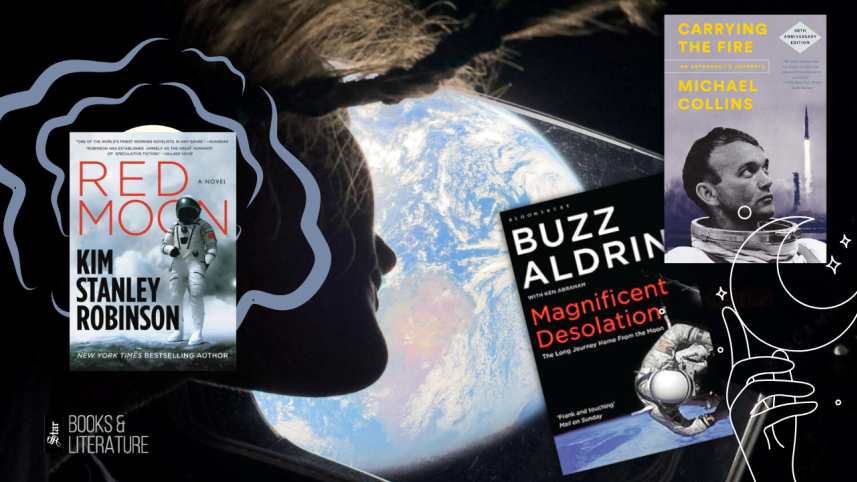
On April 1, 2026, the Artemis II mission sent four astronauts on a flyby around the moon. It is the first crewed mission of the Orion spacecraft and the first time humans have travelled beyond low Earth orbit since Apollo 17 in December 1972. On the second day after launch, NASA astronaut and Artemis II commander Reid Wiseman looked out from one of Orion's windows and captured a spectacular view of Earth. After more than 50 years, humanity once again saw Earth from beyond low Earth orbit, and the image stirred a collective sense of wonder and joy. For a moment, we saw our home as it truly is: beautiful, brightly blue, and eternally fascinating.
Here are five books that celebrate the curiosity that took us to the moon. Not for conquest, but for humanity, and for the simple, profound need to know.

Space: The Human Story
Tim Peake
Penguin, 2024
This book is best suited to readers looking for an accessible introduction to the history of human spaceflight. Only 676 humans have ever travelled to space. It is easy to see them as superhuman. But in Space: The Human Story, British astronaut Tim Peake reminds us they are beautifully, messily human. It offers a breezy overview of human spaceflight, spanning both American and Soviet/Russian endeavours. He shares the quirky, tender, and sometimes ridiculous side of spaceflight. From sneaking a corned beef sandwich into orbit during Gemini III to scribbling “MAKET” (Russian for “dummy”) on a mannequin’s forehead, Peake captures the absurd and human side of spaceflight.
In the book, Peake admits: "Humans are expensive and create trouble. Messy, temperamental, not always obedient." So why send us at all? Because we are curious. About the Grand Canyon. About the moon. About anything we cannot reach ourselves. After all the rockets and innovation, the first moon landing "boiled down to the basic human act of walking”.
Carrying the Fire: An Astronaut's Journeys
Michael Collins
Cooper Square Press, 1974
Michael Collins's Carrying the Fire is the autobiography of a man who flew to the Moon but never walked on it. He was the command module pilot of Apollo 11, the one who stayed behind in orbit while Neil Armstrong and Buzz Aldrin became legends. He writes about his spacewalks on Gemini 10 and his years as a test pilot. He also writes about his historic, lonely orbit around the far side of the moon, where for 48 minutes out of every two hours he was completely cut off from every human being who had ever lived. And he writes about his crewmates with tenderness and precision. Of Neil Armstrong: "I can't offhand think of a better choice to be the first man on the moon", and of Buzz Aldrin: "He would make a champion chess player; always thinks several moves ahead."
Orbital
Samantha Harvey
Grove Atlantic, 2023
The book won the Booker Prize in 2024. Samantha Harvey's Orbital unfolds over just 24 hours aboard the International Space Station. Five astronauts and cosmonauts from Japan, America, Britain, Italy, and Russia circle Earth 15 times—four men and two women.
Harvey writes like a poet who has borrowed an astronaut's eyes. In each 90-minute orbit, her characters do more than run experiments. They gaze down at the thin blue ribbon of atmosphere that holds every life humanity has ever known. And they wonder. About God. About whether any of it means anything. About why we keep burning our only home while also building ships to leave it. Harvey's prose is quiet, aching, and breathtaking. She turns a space station into a cathedral. A window becomes a prayer, and an orbit becomes a meditation on love, loss, and the terrifying beauty of being alive.
Magnificent Desolation: The Long Journey Home from the Moon
Buzz Aldrin, Ken Abraham
Crown Archetype, 2009
 For all latest news, follow The Daily Star's Google News channel.
 Buzz Aldrin became the second human to walk on the moon. When he looked down at that alien world, he chose two words: "Magnificent desolation." The moon, as he describes it, is magnificent but desolate. The book is about what came after the landing.
Aldrin returned home as a global hero with no purpose. He was sent on a relentless world tour. His Air Force career crumbled. He wrote openly about his mental health struggles, which later spiralled into alcoholism. Two marriages collapsed. He sold cars for a living, and wrecked them while intoxicated. But, slowly he found his way back through sobriety. He eventually found stability with Lois, who became one of the great joys of his life. He found a new mission: advocating for Mars, for space as both a human endeavour and a commercial dream. Aldrin's prose is honest, unflinching, and unexpectedly tender.
Red Moon
Kim Stanley Robinson
Orbit, 2018
Set roughly 30 years in the future, the novel imagines a colonised moon. American Fred Fredericks arrives to install a communications system, only to witness a murder and be forced into hiding. A celebrity reporter and a minister's daughter are swept into a political web that will change everything. Robinson asks what it means to be human when home is just a blue dot in the distance. It is ideal for readers who want their lunar exploration fiction to be smart, political, and deeply human.
Ohona Anjum writes, rhymes, and studies English literature.
Comments