


The knife is always ready 5 books for the season of sacrifice
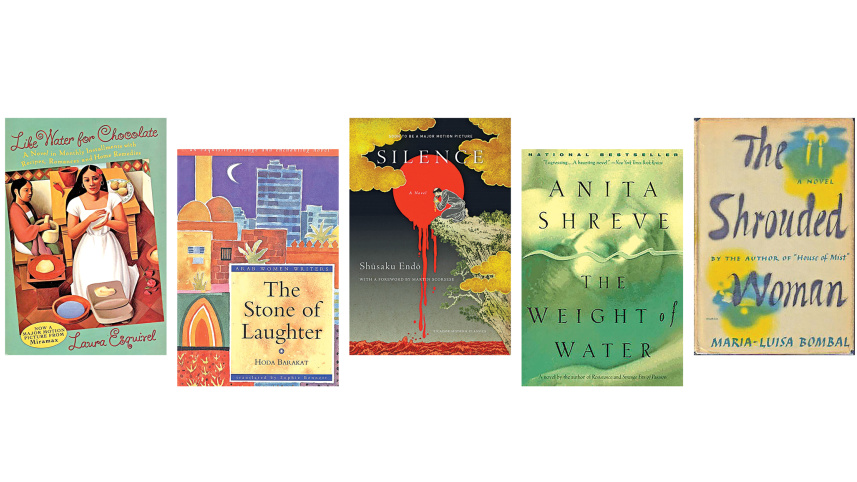
One thing the season of sacrifice whirrs though the air is the reminders of the story behind it. The intention behind the willingness, the grief behind the bravery and the miracle of God’s mercy. But not always do heavenly rams come to rescue the unprophetic man from the tragedies of the routined sacrifices made. Yet, finding the delicate beauty in our shared experience of suffering is a human tendency we are unable to outrun, despite the trembling hands and perspired backs that lead to it. And what better ceremony to celebrate the emblematic than reading about the alliteration of our offerings? That’s exactly what these novels glide through—the very spectacle of sacrifices we, as human beings, trace throughout our lives—womanhood, love, duty, faith, survival, making each of us little prophets mimicking God’s original instrument for the symbol of sacrifice—rehearsing the oldest story ever told: the offering up of something we cannot bear to lose.
Like Water for Chocolate

Laura Esquivel
Doubleday, 1992
Tita is born in the kitchen and never quite leaves it. The tethers of her tradition decree that the youngest daughter cannot marry, and she must devote herself entirely to her mother’s care until death. When she falls in love with Pedro and her mother refuses the match, Pedro does the only thing he can think of: he marries her sister instead, to remain close. Tita is made to bake the wedding cake and her tears fall into the batter. The body, Esquivel understands, will say what the mouth has been forbidden to and so Tita’s grief transfers into every dish she prepares, her desire into every meal consumed by a household that takes and takes without ever honoring her for giving. She upholds a duty she did not choose with the kind of patience of someone who has accepted an impossible situation despite her own wishes.
Any daughter who has ever cooked for a household that consumed her quietly will recognise this kitchen—Esquivel’s architecture of sacrifice, and the particular devotion of preparing a feast for everyone’s satisfaction but yourself.
The Stone of Laughter
Hoda Barakat
Interlink Publishing, 1995
Beirut is at war with itself, and Khalil refuses to be. He cooks, cleans, and he loves quietly, without declaration—a man too soft in a city that decides his quiet existence is some sort of treason. He belongs to no faction, raises no weapon and chooses no side. He believes that remaining soft is its own form of resistance. The war persists to win Khalil over to violence.
Barakat’s novel, written in a Beirut basement during the shelling, understands something most war literature misses, that the deepest casualties are not the ones the bombs reach but the ones the atmosphere slowly colonises. The Stone of Laughter is sure to make you wonder whether the things you have given away slowly across the quiet attrition of days count as sacrifice at all, or only as loss.
Silence
Shūsaku Endō
Sophia University Press, 1966
A Portuguese Jesuit priest named Rodrigues in the 17th century travels to Japan to find his mentor, rumoured to have renounced his faith under torture. Rodrigues cannot believe it. He goes to witness and to strengthen the hidden Christian communities being persecuted by the Tokugawa shogunate, to prove that a man of true faith does not break. But the Japanese authorities find a way to test Rodrigues’ faith beyond his breaking point. They do not torture Rodrigues, instead, they torture his Japanese converts in front of him, and tell him that the torture will stop the moment he steps on a a bronze image of Christ. His faith asks to be sacrificed for their bodies—his God for their pain. Despite Rodrigues understanding the theological weight of his act, he offers his faith—almost as though death for their sins.
Endō was a Japanese Catholic writing from inside a tradition that was not native to his culture, and the novel’s final theological position and that Christ speaks to Rodrigues in the moment of apostasy and tells him to step—that this too is an act of love, was so radical, it was condemned by the Church.
The Weight of Water
Anita Shreve
Little Brown, 1997
In 1873, two women were murdered on a desolate island off the coast of New Hampshire. A man was hanged for it and the one survivor said nothing.
 For all latest news, follow The Daily Star's Google News channel.
 More than a century later, a photographer named Jean travels to the island to research the case, and from a Portsmouth archive, discovers what appears to be the survivor’s own account of that night. What it reveals is not what anyone expected, least of all Jean, whose marriage is quietly unravelling around her as she reads.
Anita Shreve moves between two women, two silences, a century apart uniting them by the womb of violence: years of swallowed feeling, love that curdled slowly in the dark, the weight of a life organised around something that was never going to be returned. Unconventional within the stereotypes of sacrifices, this is the type of sacrifice built not in the spurred act but the long, unwitnessed endurance for survival that makes a vast and irreversible veil of guilt shroud the person with what they have done, something they cannot confess, undo, or call anything other than what it cost them.
The Shrouded Woman
María Luisa Bombal
Farrar Straus and Giroux, 1948
Ana María is dead. She lies in her coffin in a Chilean drawing room while the people who loved her, failed her, and needed her file past to pay their respects. Beyond her sight of them, for the first time, she can finally see herself.
The novel is a recollection of her memories, the men she loved, lost, and stayed for anyway, the performance of a marriage she carried on long after it stopped being real, the self she set aside so extensively that she forgot to mourn it. By offering herself to her children and duties, she surrendered herself and said nothing of what she actually felt.
The novel ends in something startlingly close to peace, maybe because the acts of offering were worth the life, or maybe because she can finally, mercifully, stop.
Mrinmoyi is a pseudonym for the girl who likes to read too many books and watches too many films. Mail her @uzma131989@gmail.com to talk about anything from plant biology to the significance of Sappho.
Comments