


Pure water crisis across half of Pirojpur district
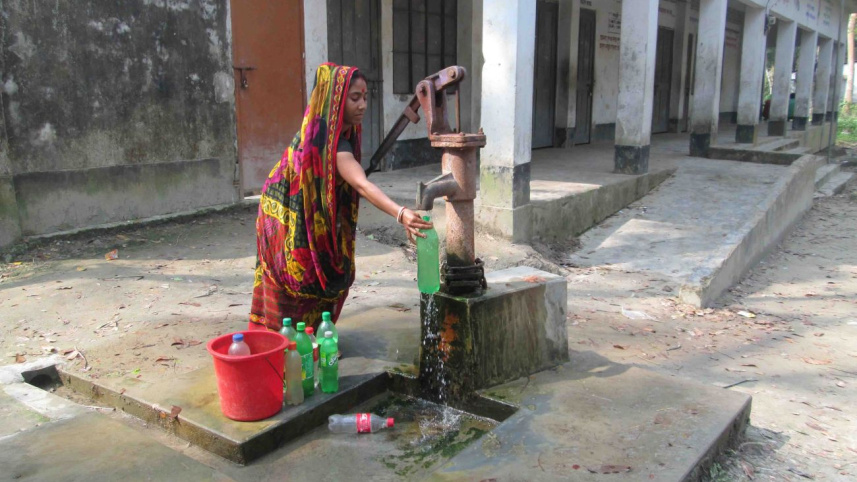
Every morning Sabita Rani Mandal, 45, of Paschim Baniary village of Matibhanga union in Pirojpur's Nazirpur upazila, collects three jars of tube well water for her household. But the water must be stored for three days before being fit to drink. Like all families in the area, hers will have to wait for the iron content of the water to settle in the bottom of the jar.
With no deep tube wells in the area there is no way around the problem. According to public health engineering department officials, the Bangladesh standard for iron that is acceptable for human consumption is up to 1 milligram per litre; but in shallow tube well water from across Nazirpur, Mathbaria, Zianagar and Pirojpur Sadar upazilas iron content as high as 8.80 milligrams per litre has been detected.

Indeed water from deep tube wells is also often tainted. A deep tube well sample from Belua village in Nazirpur was found by public health engineering officials to contain 1.1 milligrams of iron per litre.
"Excessive iron consumption over a long period will result in health problems," says Zianagar upazila's health and family planning officer Dr. Sankar Kumar Gosh. "Iron increases acidity and harms kidneys. It makes teeth and nails black and weak and causes hair to become sticky, skin to become rough." A further difficulty with iron-heavy water is that it does not react well with soap, making general cleanliness a challenge.
Iron may be bad news but for Pirojpur's people the worse news is that arsenic and high salinity also contaminate water supplies.
According to public health engineering officials, arsenic contamination is to be found in water supplies in all seven of Pirojpur's upazilas, affecting from 15% of shallow tube wells in Mathbaria to 36% of shallow tube wells in Bhandaria.
Many tube wells exceed the 0.03 milligrams per litre in arsenic content limit for drinking water. "If we find arsenic content as high as that," says Md Rustum Ali, sub-engineer in Pirojpur Sadar upazila, "we forbid people to draw the water." In Pirojpur Sadar's Kadamtala union, one tube well recorded 0.07 milligrams per litre of arsenic, he adds.
Aware that arsenic is a health hazard which in the long term causes damage to lungs, kidneys, skin and liver, and may cause heart disease, cancer, stroke and diabetes, villagers in many arsenic affected areas use shallow tube well water only for household work. As a result, some homes have no choice but to rely on pond water, often without pursuing the basic health precaution of boiling it first, for drinking.
"Our tube wells contain high levels of arsenic," says Sarmin Sultan, 38, a housewife of Kadamtala village in Pirojpur Sadar upazila. "Therefore we collect drinking water from a nearby canal in the dry season when pond water levels are low."
The salinity problem meanwhile is prevalent in five of the seven upazilas and particularly acute in Mathbaria, Zianagar and Nazirpur. "People cannot drink the deep tube well water in many areas due to salinity," says Ali.
With the highest level of acceptable salinity set at 1000 milligrams per litre, wells in Pirojpur Sadar with up to 2600 milligrams per litre and wells in Mathbaria with as much as 5,000 milligrams per litre offer significant health risk. Consuming saline water over a long period can cause kidney damage, and health problems like hypertension and diabetes.
"From childhood I have been drinking tube well water," says Bidhan Chandro Biswas, 55, of Nazirpur's Baniary village. He currently suffers high blood pressure and other physical problems.
In many areas of Pirojpur district the only safe drinking water is rainwater, which cannot be stored to cover the whole year. "In rainy season we get pure water," says Md Hafizur Rahman from Jankhali village in Mathbaria. "We try to store it but in the dry season we still face a crisis."
"From about February to July saline water fills rivers and canals," says Hazrat Ali, a local of the same village. "The situation only improves after the rain begins."
"Within 6 months wells of maximum depth often draw saline water," says Pirojpur's executive engineer Md Yasin Arafat. "Deep tube wells are not the full solution. It's really an emergency to establish a desalination water purification plant and parallel infrastructure to remove the arsenic and iron. Such systems can prove effective, but are costly to implement."
In the meantime the local government, rural development and cooperative ministry plans to improve reserved drinking water supplies sourced from rain water, systems that should be effective soon, adds Arafat.
 For all latest news, follow The Daily Star's Google News channel.
Comments