


Mustard reverses farmers' fortune
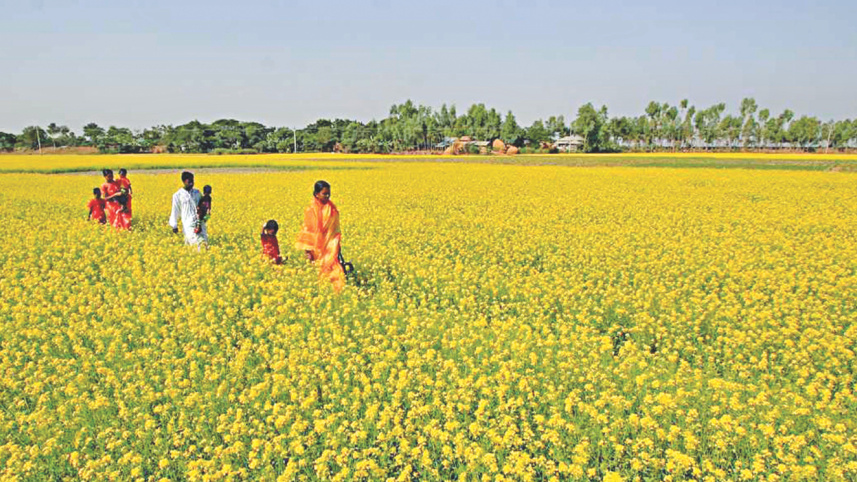
Shefali Bewa of Altafnagar area in Dupchanchia upazila said she started mustard farming in her five bighas of land four years ago and bought two cows with the profit from selling the mustard.
Cultivation of mustard has brought good fortune to farmers in the district during the last few years.

Fariduddin, deputy assistant agriculture officer, on behalf of the Department of Agriculture Extension (DAE), said 27,500 hectares of land had been targeted for mustard cultivation in the 12 upazilas of the district this year, whereas 25,555 hectares were actually brought under cultivation.
Around 38,333 tonnes of mustard are estimated to have been cultivated in the district this year, the source said.
Three hundred hectares of land were brought under mustard cultivation in Sadar, 4,850 in Kahaloo, 1,005 in Shajahanpur, 1,900 in Sherpur, 1,980 in Dhunat, 4,000 in Nandigram, 3,300 in Dupchancia, 3,200 in Adamdighi, 450 in Shibganj, 700 in Gabtoli, 1,920 in Sariakandi and 1,950 in Sonatola upazilas of the district, the source added.
The DAE source added that mustard was cultivated on 28,770 hectares of land and 48,000 tonnes were produced in 2015, and on 27,210 hectares producing 41,090 tonnes in 2014.
Landless Arun Kumar of Talora Paulpara area in Dupchanchia upazila said that he leased two bighas of land for Tk 12, 000 and earned a profit of Tk 76,000 from mustard cultivation last year.
Farmer Sushil Kumar of Talora village in Dupchanchia upazila said he has been cultivating mustard on six bighas of land every year, and gets a yield of around eight maunds per bigha. Raw mustard was sold at Tk 1,900 to Tk 2,200 per maund and dried mustard at around Tk 2,500 per maund, he added.
Farmer Mozahar Ali of Kundagram bazar area in Adamdighi upazila said mustard is cultivated from the month of Agrahayan to Magh.
Abdul Jabbar Mia of Chandanbaisha village in Sariakandi union of the upazila said they lost aman paddy during the last flood and mustard cultivation can make up for the loss.
DAE officials said mustard cultivation also benefits the farmers engaged in apiculture.
Deputy Director (DD) of DAE in the district Protul Chandra Sarkar said that Bari-14, Tory-7, and Shompad are hybrid seeds of mustard that have been cultivated mainly in this district and give good yield.
Field level supervision and suggestions for applying fertilizers and insecticides by field level officers of DAE at yard meetings with the farmers have made it possible to reap large amounts of mustard every year, the DD added.
 For all latest news, follow The Daily Star's Google News channel.
Comments