


The illusion of choice in choosing science
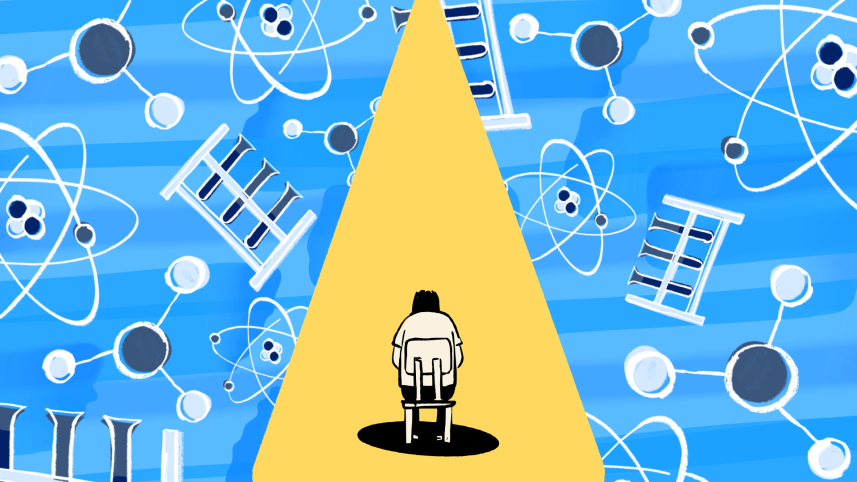
At the tender age of 13 or 14, all students of the National Curriculum and Textbook Board (NCTB) curriculum are faced with a choice: "Which academic stream are you going to choose: science, humanities, or business studies?" For the average student with decent grades, the answer is almost predetermined – science.
During the first class of ninth grade, after I had chosen science of my own volition, my entire section was held hostage by one teacher. He asked everyone, one by one, why they had chosen science. Most of my classmates were silent, simply absorbing his backhanded remarks like, "You chose this because everyone else did", or "Your parents forced you to, didn't they?"

When it was my turn, I answered, "I have questions about how my world works. I want answers to them." He just laughed in my face. That moment radicalised my perception of the education system. Societal obligation triumphs genuine intellectual drive, and you are dismissed if you attempt to stand out. Because the system was never really designed around individual motivation to begin with. It was designed to produce high-GPA statistics.
This contradiction becomes even more apparent when viewed through a critical lens. I gathered that if a student does not have a family member who majored in non-STEM routes, the pressure to take science is intensified further. This phenomenon is deeply intertwined with the state of the job market and the societal value in Bangladesh.
Students are not picking a stream to learn for the sake of learning; they are forced to reckon with employment opportunities before they have even come of age. It does not help that there is a pervasive, damaging preconception that students from non-STEM backgrounds face the highest rates of unemployment. This makes students and parents alike terrified that a degree in history or economics is a one-way ticket to professional obscurity. The irony is that many science students spend years grinding to complete a STEM degree just to pursue an MBA to end up as bankers – the very profession a business studies student could have pursued far more directly.
The deck is stacked against the non-STEM streams long before the choice is even made. In the years leading up to class nine, NCTB students are given a general science textbook that provides a reasonable idea of what the stream will entail. There is no such equivalent for business studies or humanities. Some might argue that the Bangladesh and Global Studies book serves this purpose for the humanities, but it can hardly be called a substitute when it does not introduce students to the foundational concepts of economics or political science. They are never given the chance to discover their aptitude for the social sciences.
Business studies fare no better. One chapter on statistics, buried within a broader curriculum, does not constitute meaningful exposure to accounting, finance, or the conceptual core of the stream. Students arrive at the point of choosing without ever having been given the tools to make an informed decision. The playing field is tilted before the game even begins.
The most disheartening part of this journey is that even students who do choose science find that the freedom supposedly promised by the stream rarely materialises in practice. According to official NCTB guidelines, science students have the option of taking statistics or engineering drawing in place of higher mathematics or biology as their fourth subject. This degree of flexibility is not granted in practice, however, as most colleges simply do not offer these alternatives, leaving students with the standard combination of subjects regardless of their individual strengths or interests. The track that is sold entirely on the promise of freedom turns out to be just as rigid as the others.
There is also the matter of what happens to students who either choose non-STEM from the outset or who attempt to switch streams after initial placement. Schools sometimes assign students to science automatically, without consultation, based on a GPA threshold they deem sufficient. They make the process of correcting this as troublesome as possible – contacting guardians and applying pressure in the name of counselling. Sometimes they are bold enough to say it outright: "You are making a mistake." The underlying message is clear: you are too good a student to make a choice like this.
Even for those who manage to switch tracks, the social environment rarely welcomes what is seen as an anomalous choice. Their decision is treated as a betrayal of their potential and a slight against the students who were deemed too inferior to study science in the first place.
The cumulative effect of all of this is a generation of students making one of the most consequential decisions of their academic lives under conditions of incomplete information, social coercion, and structural issues at an age when they are barely equipped to process any of it. The cultural problem is harder to fix through policy alone, but if institutional respect for all three streams is built into how schools are run, how teachers are trained, and how universities evaluate applicants, the social stigma would gradually erode. Reform has to happen at the structural level first. Until then, our students will continue to navigate an illusion of choice — trapped in a system that values their compliance far more than their curiosity.
Fabiha is convinced that her life is parodying Shakespearean commedia dell arte and is fighting to change the genre. Inspire her to make better life choices at: s.fabiha.amreen@gmail.com
 For all latest news, follow The Daily Star's Google News channel.
Comments