


NSU students organise protests against sexual violence
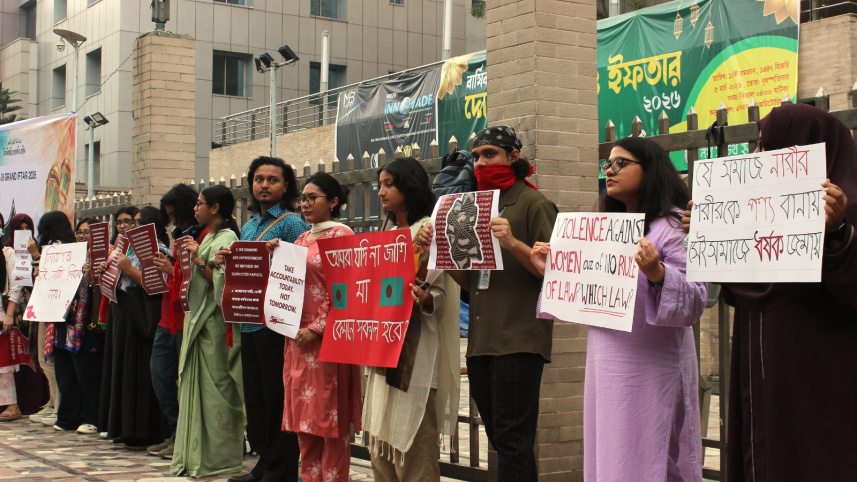
Students of North South University (NSU) held protests on March 5 and 8 outside Gate No. 8 of the university campus to protest what they describe as continued complacency by the Government of Bangladesh, elected officials, and law enforcement authorities in addressing the persistent sexual violence and murder of women and children across the country.
On March 5, the students held a silent vigil, which was organised as a symbolic act to represent the voices that, according to the students, have been permanently silenced by such acts of violence. They were joined by faculty members of the Department of English and Modern Languages.
 For all latest news, follow The Daily Star's Google News channel.
 On March 8, students of NSU, BRAC University, and Shanto-Mariam University of Creative Technology gathered in the same spot to mark International Women’s Day by demanding a safer and more secure country for women and children. They recited original poetry, calling out the citizens to be more proactive in the cause, as well as the Bangladeshi government for its inaction.
The students stated that Bangladesh has long struggled with violence against vulnerable populations, specifically women and children of all ethnicities and backgrounds. Through these demonstrations, they expressed solidarity with victims and survivors of sexual assault and called for urgent institutional reforms to ensure justice and accountability.
Their demands are as follows:
- Life imprisonment be imposed on convicted rapists.
- Televised trials be conducted for rape cases.
- Reform the police force to ensure an effective response to sexual violence. Remove barriers to filing rape cases and ensure all police stations accept complaints immediately.
- Marital rape must be recognised as rape regardless of the age of the victim. The rapist cannot marry, nor should they be able to coerce the victim into retracting their complaints legally.
- Students of all genders be equally educated on women’s rights from primary school through higher educational institutions.
The group emphasised that in a nation where women constitute more than half of the population, they can no longer accept what they describe as a culture of degradation and dehumanisation. Citing data from Dhaka Metropolitan Police, they noted that only 24 perpetrators have reportedly been convicted in the past five years, a figure they consider alarmingly low compared to the scale of reported sexual violence.
They further stated that merely demanding justice in a system where it is frequently delayed is no longer sufficient. According to the students, immediate institutional reform is necessary at every level of governance—from the highest offices of the state to the most remote villages—where women and children may remain vulnerable to predatory violence.
The students also called for an end to impunity for perpetrators who escape justice through influence or coercion. They demanded strict enforcement of the Women and Children Repression (Prevention) Act, 2000, and urged amendments to Section 375 of the Penal Code, 1860, so that the offence of rape includes male victims and individuals from the third gender community. In addition, they advocated for the integration of gender-based violence awareness courses into school, college, and university curricula in order to combat the culture of victim-blaming and stigmatisation of survivors.
Concluding their statement, the students urged citizens across the country to raise their voices against injustice and resist social pressures that discourage support for victims of violence. They emphasised that the pursuit of a safe and dignified society for all must remain a collective national priority until every individual can feel secure in both private and public spaces.


Comments