Is the CFA worth it? Bangladeshi candidates weigh in
A Chartered Financial Analyst (CFA) is a professional designation signifying advanced proficiency in investment management and financial analysis. It is offered by the CFA Institute, an organisation that measures and certifies the competence and integrity of financial analysts. Candidates must have a bachelor’s degree, pass three levels of exams covering topics such as accounting, economics, and ethics, and have three years of work experience to obtain the CFA charter.
A growing number of students and young professionals in Bangladesh are choosing to pursue the qualification, albeit for very different reasons.

For some, like Anik Mahmood, CFA, Deputy Head of Research at UCB Stock Brokerage Ltd., the CFA pathway felt like the natural extension of a finance degree. “I enjoyed studying finance,” says Anik. “Coursework on equity research, capital markets, and financial statement analysis and valuation greatly interested me, and with the CFA being the gold standard qualification, it naturally felt like the next step.”
On the other hand, Kashfia Binte Hassan, an analyst at Lion City Advisory Limited, embarked on the CFA journey to challenge herself and dismantle existing stereotypes against women. “Women are often not taken seriously in the workplace, and their competence is frequently scrutinised, particularly in a quantitative field like finance,” remarks Kashfia. “I want to push myself to achieve greater heights and gain the knowledge needed to successfully complete the tasks I am assigned. Thus, the CFA programme seems to be a stepping stone towards a smoother career path, as employers and people, in general, tend to take you more seriously once they see that you are dedicated enough to put in this much effort.”
For many at present, earning a CFA has become the ideal way to distinguish themselves in a competitive job market in the financial sector. Such was the case for Kazi Ajwad Ahmed, CFA, currently working as a financial planning and analysis (FP&A) manager. “I wanted to distinguish myself from the rest of the job seekers, which was the primary reason to pursue the CFA,” Ajwad notes. “Apart from that, the CFA seemed to offer employability both at home and abroad. It increased my options while still allowing me to stay in the country with my parents, which was a priority for me.”

While individual motivations may differ, universities have also played an important role in encouraging students to consider the qualification. The CFA Institute, the global non-profit providing finance education to professionals across the globe, works closely with universities through its University Affiliation Program (UAP). The programme recognises academic institutions that broadly align one or more degree programmes with the CFA programme curriculum. The Institute assesses whether a university has a viable cohort of students currently enrolled in the academic degree programme and whether the curriculum contains the required minimum number of semester hours of coursework while demonstrating broad alignment with the CFA curriculum. Currently, six universities in Bangladesh are part of the UAP network. Selected students from these universities not only receive a discount on registration fees but also gain access to the CFA Program Learning Ecosystem, which offers students study plans, e-books, practice questions, mock exams, and a discussion forum.
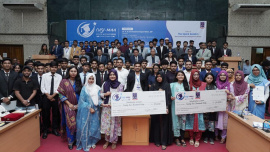
Reflecting on the role his university played in reinforcing his interest in the qualification, Samin Al Fattah, a member of the champion team of the CFA Research Challenge 2026, said, “Back in 2023, when I was a first-year student, my university signed an MoU with the CFA Institute, which became my formal introduction to the programme. Although I already had a vague idea about it, that event played a key role in cementing my goal, as I hoped to secure a scholarship.”
While candidates pursue the CFA for different reasons, charter holders say that the certification’s greatest value lies in how they apply the knowledge in their everyday professional lives. Anik, for instance, notes how the CFA curriculum plays a central role in his daily responsibilities as a research professional. His work involves analysing macroeconomic and industry data, monitoring sector trends, building valuation models, and communicating investment insights. He also works with foreign investors, whose growing focus on environmental, social, and governance (ESG) considerations has made sustainable investing increasingly relevant, although ESG implementation in Bangladesh is still at an early stage. He further says that the CFA curriculum also provides a strong understanding of buy-side and sell-side research, enabling professionals to better serve clients and navigate different roles within the investment industry.

Echoing this sentiment, Ajwad says that the CFA curriculum has become an integral part of his daily work: “Whether I'm preparing forecasts, analysing financial statements, building valuation models, or evaluating capital investments, the concepts I learned through the CFA programme help me make more informed decisions and communicate financial insights more effectively.”
Even before earning the certification, many candidates say they begin to notice the practical value of the curriculum in both their studies and early careers. Regarding this, Samin says, “The concepts I had studied in my university coursework started making more sense after I began studying for the CFA. Since our courses have to be completed within six months, there is often limited time to explore topics in depth. Preparing for the CFA gave me a broader perspective on what I had already learned, and many of the concepts finally started to click. It also made me more attentive in my university classes.”
“One of the biggest realisations I had was that I genuinely enjoy building financial models from scratch,” Samin continues. “Every company is different, and there is no universal template that analysts can simply follow. Creating structure and meaning from that ambiguity is incredibly satisfying, and I enjoy the sense of autonomy that comes with it. Had I not pursued the CFA, I would not have been exposed to the wide range of career paths available to a finance graduate. Apart from that, passing CFA Level I also gave me an edge when applying for entry-level analyst roles focused on the capital market.”
Like Samin, Kashfia believes that pursuing the CFA gave her a competitive advantage when entering the job market: “So far, I have published two macroeconomic reports and recently carried out the equity valuation of an asset management company. Pursuing CFA Level I gave me the confidence to take on the daily responsibilities of my role as an analyst. The knowledge I gained through the programme helped me approach these tasks with greater confidence and a stronger analytical foundation.”
Beyond helping candidates in their professional lives, the CFA curriculum has also influenced the way they manage their own finances.

“In many ways, I have become my own financial manager,” Kashfia remarks. “Compared to many of my peers, I have become more confident and disciplined in managing my finances. I apply the concepts I have learned to my own financial decisions. I actively invest in the stock market, save half of my monthly salary through a DPS, and maintain a fixed deposit account.”
Despite its many benefits, candidates unanimously agree on one thing: the CFA journey is far from easy. From dedicating more than 300 hours of study for each exam level to balancing preparation with a full-time job, the journey can be both isolating and mentally demanding.
“You could say that I lived like a monk during my preparation,” says Anik. “I would wake up early and dedicate one to two hours to studying before heading to work. I limited my time at social gatherings so that I could return home and continue from where I had left off in the morning. I also reserved my weekends for studying, leaving very little room for recreation.”
For some candidates, the demands of the programme extend beyond long study hours, requiring difficult compromises in their personal lives. Such was the case for Ajwad, who says, “I got married a few months before my Level III exam, and it was excruciating to spend my time studying instead of going out with my wife whenever I had the chance.”
Time, however, is not the only investment candidates have to make. CFA exam fees, which are charged in US dollars, can be quite expensive for aspirants in Bangladesh due to the exchange rate. Coupled with relatively low pass rates and the gruelling study hours required, the financial burden can discourage many students from taking the exams. As a result, candidates often feel immense pressure to pass each level on their first attempt, even though doing so is not always possible.
 For all latest news, follow The Daily Star's Google News channel.
Samin puts the financial commitment into perspective: “A four-year Bachelor of Business Administration (BBA) degree at my university cost me around 1,20,000 taka, while registering for just the CFA Level I exam cost around 1,60,000 taka.”
To improve their chances of success, many candidates also invest in supplementary learning resources, which can make earning the certification more expensive.

Ajwad says, “I focused on the video lectures provided by Mark Meldrum. It cost extra and made the whole thing even more expensive, but without it, I don't think I would have been able to pass.”
Ultimately, whether pursuing the CFA is worth it depends on an individual's career aspirations. Critics argue that the qualification may be more rigorous than what the Bangladeshi market currently demands, as the country has relatively limited use of complex financial instruments such as derivatives, and many organisations still view the finance function primarily as an accounting department rather than a strategic business partner.
Yet, for the candidates and charterholders we interviewed, the value of the CFA extended well beyond the designation itself. From improving technical competence to opening doors to new career opportunities, they viewed the journey as a worthwhile investment despite the sacrifices it demanded.
Tazrin is a finance major and a contributing writer at The Daily Star. You can reach out to her at rashidtazrin1@gmail.com.

A heart emoji, an alleged beating: CU student handed to police over suspected Chhatra League links

TV Series / The Grand Tour enters a promising new era

10 injured in Comilla University clashes over library seating

Dhaka College, Ideal College students clash at Science Lab

CUET 'shutdown' enters fifth day

Reflections / Exploring the resurgence of analogue media

Career / The journey of a Bangladeshi cancer researcher at Harvard

Press Release / UIU celebrates historic achievement of aerial robotics team