


Pursuing a degree in urban & regional planning: What you should know
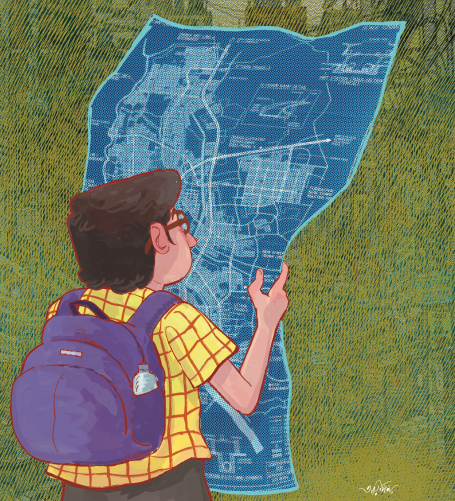
Stuck in traffic, some of us like to watch all the construction work taking place on the city streets around us. Some of us might even think about changing the look of the city entirely: a traffic light here, a roundabout there, a new park with a cycling lane, or increasing the width of the pavements and roads.

If you have ever seriously considered bringing such changes to your city, why not pursue a field of study that allows you to do exactly that: urban and regional planning, or URP for short.
What to expect from URP?
URP is a subject offered to students in only a few Bangladeshi universities: Bangladesh University of Engineering and Technology (BUET), Rajshahi University of Engineering and Technology (RUET), Chittagong University of Engineering and Technology (CUET), Khulna University of Engineering and Technology (KUET), Khulna University (KU), Jahangirnagar University (JU), Pabna University of Science and Technology (PUST), and, the most recent addition to this lineup, the Military Institute of Science and Technology (MIST).
Interestingly enough, URP doesn’t make you an engineer. Rather, you pursue a Bachelor of Urban and Regional Planning (BURP) degree to become a planner.
In general, it’s quite a broad subject as it covers areas such as civil and infrastructure-related aspects, water and drainage, urban planning, rural and regional planning, transportation, landscape planning, climate change, and environmental planning, among others. It also discusses policy-level planning and different national policies and development plans, as planners are needed to make the city more liveable for its citizens.
Each semester, students usually have two sessional courses where they work on relevant, recent, or trending planning issues, such as flash flooding or rising temperatures due to the lack of forestry in cities. Students also conduct field surveys, collect data, do analysis, and prepare research-based reports. And, like every other department, they have to do a thesis on issues regarding the subject and defend it in their final year.
The life of a URP student is also fascinating. Khandaker Ruhama Amin, a current student at BUET, shares his insights: “The programme is highly interdisciplinary, allowing us to develop skills in planning, design, research, geographic information system (GIS), and data analysis. Like architecture, our curriculum also includes several studio and lab-based courses, where completing two or three major projects within a single term is common.”
Amin also notes that many student projects address real-world planning issues, and some have been recognised and adopted by planning organisations and government agencies across Bangladesh.
MIST’s addition to the list
The new addition to the URP family, MIST, started its first batch with the 2025–2026 academic admission cycle. Hence, there was a fear about studying a subject that was only recently launched at the university. Yet, the students there are quite happy with their department. Their teachers are also passionate about teaching the subject.
Arafin Sabir, one of the students of MIST URP, shares his thoughts: “It's a unique experience, not having any seniors from our department to guide us with coursework as we are the very first batch. But our classrooms and labs are well furnished and well equipped, and we will get a geospatial lab within the next few months, which is exciting.”
Junaid Imam Adib, a lecturer at MIST, gave an interesting insight about their academics as well: “Teaching the very first batch of students is an exciting part of my career as we have the opportunity to help establish the academic foundation of the programme."
When asked about how they are overcoming their lack of previous experience as a department, he shed some light on how he has a personal tie with his alma mater, which helped with academic exchange, sharing expertise, resources, research collaboration, laboratory and technical support, and professional networking.
“As I am a graduate from RUET, my work here is heavily inspired by what my university taught me. Ultimately, the goal is to build up a strong and independent URP programme at MIST by any means,” Adib adds.
An uneven planning field
Just like every other major, not all universities teach the subject with the same level of care. Some universities have outdated curricula and discourage independent research projects. This is, unfortunately, a problem mostly in public universities which aren’t purely engineering schools. Aside from the general issues often seen in an average public university in Bangladesh, like session jams, teacher politics, irregular classes, and poor lab and classroom facilities, as these universities aren’t truly engineering-focused, their curricula also reflect that, as students mostly study the theoretical parts of subjects rather than focusing on practical research and lab work.
Redowan Sikder, a student at Jahangirnagar University, sheds more light on this problem: “Very little research budget is allocated to our URP department and, as this is one of the majors where without research you can’t really learn anything, we suffer a lot. Our classrooms are shabby, and we only get two lab rooms, both of which are underdeveloped and are equipped with computers that can’t properly run the programmes needed for lab work. We also don’t get premium access to research websites with our university email accounts like many other universities.”
 For all latest news, follow The Daily Star's Google News channel.
 Even though he is quite frustrated with the state of his department, Sikder does agree these problems aren’t exclusive to just the URP department at his university. He acknowledges that such problems can be seen in some public universities, irrespective of what subject you major in.

Biases against URP as a subject
There is, sadly, a negative connotation about URP as a low-ranking subject – something people choose out of desperation simply because they wish to study at a public university.
Ishmam Zaman Arno, a URP student at CUET, says, “Even though I had the opportunity to study at the Department of Food Engineering & Tea Technology at Shahjalal University of Science and Technology (SUST), I didn’t like the university and decided to go for URP at BUET. I really don’t regret it as I got inspired by the achievements of my alumni, and as the subject is quite flexible, I can pursue a subject of my choosing for my master’s and PhD.”
Amin also chose URP due to her rank in the admission examination, but currently she's thriving in her department, often getting the limelight on her department's announcement page due to her performance in extracurricular activities.
As URP is a pretty broad subject and there are only a few people graduating from this department every year, the students have a slight competitive advantage with regard to landing jobs compared to some of their peers.

Career and higher study opportunities for URP graduates
For higher studies, the US is a common destination for URP graduates, along with Canada, Australia, and certain parts of Europe. As is the case with most fields, funding is generally more available for PhD programmes than for master's, so many graduates often find it easier to get admitted directly into PhD programmes. That said, some PhD programmes require a master's degree as a prerequisite, and many URP students handle this by doing a master's in Bangladesh first, using the time to gain research and work experience, before applying for a PhD abroad.
Rezaul Bari Ishan, a graduate from CUET who is completing his PhD at the University of North Carolina at Greensboro, shares his own experience as a student who is pursuing higher studies abroad: “I am currently doing my research on electric vehicle (EV) charging accessibility, spatial equity, and infrastructure planning, particularly looking at how access to public EV charging varies across different neighbourhoods and communities.”

Ishan also highlights some of the other fields from which students can base their own higher studies on: “URP connects with many areas such as GIS and remote sensing, transportation, environmental planning, sustainability, disaster management, housing, urban analytics, and regional development. This diversity gives students more options to choose a research field based on their interests and pursue higher studies in different disciplines.”
URP graduates looking to pursue a career in Bangladesh often look for options within the public sector, including those available at Rajdhani Unnayan Kartripakkha (RAJUK), and other development authorities such as Chattogram Development Authority (CDA), the various city corporations, Local Government Engineering Department (LGED), Dhaka Transport Co-ordination Authority (DTCA), and organisations working in housing, transportation, environment, and disaster management. The private sector also offers viable career options for URP graduates, mostly at national and multinational development organisations, consultancy firms, and research organisations, amongst others.
Academia is another route many URP graduates consider. Universities often retain their top-performing graduates as lecturers straight out of the programme.
Niaz Mahmud Zafri, an assistant professor from BUET who is currently on leave as he is pursuing a PhD at the Massachusetts Institute of Technology (MIT), shares his experience: “Being a faculty member at a young age has helped me understand my students and what they want from the programme, as I was in their place just a few years ago. The students already have a strong interest in mathematical, computational, and data-driven topics, and there was a shortage of courses like that during my time as a student.”
“When I became a faculty member, I realised that planning is not purely a technical or engineering field,” Zafri adds. “Planners need to understand people, society, institutions, and the broader ideas, philosophies, and theories behind planning before applying computational tools. So, my perspective eventually became more balanced. Being able to understand both the student and teacher perspectives helped me contribute to a more updated curriculum that reflects today's data-driven planning practice without losing the strong theoretical foundation that planners need.”
Hence, if you are worried about limited career options in URP, rest assured that the field offers diverse paths for your future. For prospective students preparing for the admission test, this is your opportunity to consider a career as a planner and help solve the critical urban challenges we face daily.
Fabiha is going to put herself in time out for trying to juggle so many things as though she were part and parcel of a circus party. Give her juggling tips at s.fabiha.amreen@gmail.com.
Comments