


You can still whiten your black money
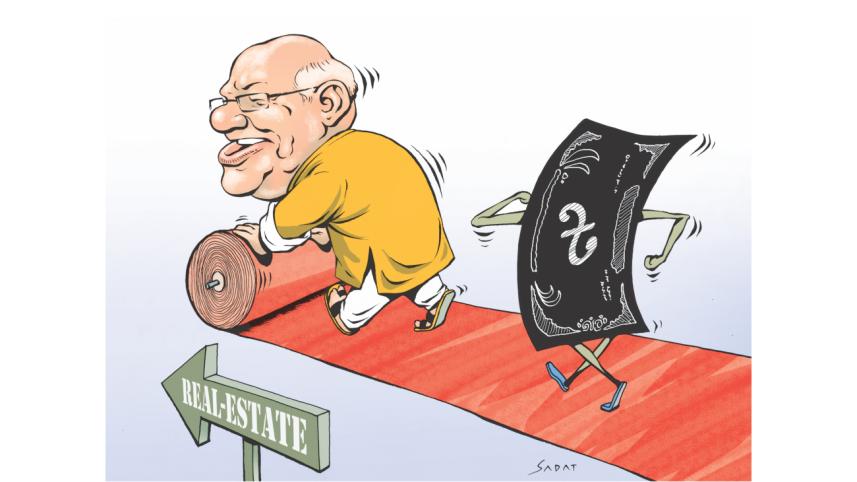
The scope for whitening undisclosed money remains in place in the proposed budget for the upcoming fiscal year with only a couple of changes to the provisions.
Legalising untaxed incomes by investing in real estate, which was introduced last year, has been made easier by decreasing the tax rates.

At the same time, the government has shrunk the scope for whitening money by paying a 10 percent additional tax, offered in 2012-13 fiscal year.
For the FY 2015-16, tax rates on buildings and apartments in municipalities in the district areas have been cut down to Tk 600 to TK 800 per square metre of floor space from Tk 1,000 to Tk 1,500.
At upazila levels, it has been fixed at between Tk 400 and Tk 600 depending on location, down from Tk 700 to Tk 1,000 in the FY 2014-15.
For voluntary disclosure of black money, a new provision has been introduced prohibiting use of the sectors enjoying tax exemption or reduced tax rates in availing the opportunity.
Many use these sectors for whitening their money so that they have to pay less tax. This means they resort to illegal ways for legalising black money, said officials of the National Board of Revenue (NBR).
They also say that the proposed changes aim to stop tax evasion and boost investment in real estate outside the metro cities.
Despite criticisms, Finance Minister AMA Muhith has always defended allowing black money to be whitened.
"These two provisions can be extended as they are necessary to ensure balance in the tax payment system. It should be mentioned that the privilege will not apply to money obtained through terrorism and corruption," he had told parliament the day before passing the budget for the current fiscal year.
He had added that only the money earned through legal ways could be whitened.
Former NBR member Aminur Rahman finds Muhith's claim only partially true.
"But the reality is that the NBR has no mechanisms to verify whether an amount of untaxed money is earned through legal or illegal ways."
Citing examples of different countries including India, Aminur said Bangladesh should stop allowing the scope for whitening money.
Former finance adviser to a caretaker government AB Mirza Azizul Islam said, "I have always opposed the scope for whitening black money as it is immoral."
Instead of continuing this year after year, the sources of black money should be identified and blocked, he said.
"If it cannot be verified whether an amount of money is earned through legal ways or not, what's the logic behind giving the scope?" he argued.
Debapriya Bhattacharya, distinguished fellow of the Centre for Policy Dialogue, said the government should formulate a law to bring into the mainstream economy black money and benami properties (properties purchased in someone's name but financed by someone else) bought in and outside the country.
Once enacted, the law would make the entire process transparent, and there wouldn't be any need to ponder over the issue of money whitening every year, he observed.
Interestingly, like last year, Muhith carefully stayed away from touching on the issue in his budget speech in parliament yesterday as well.
 For all latest news, follow The Daily Star's Google News channel.
 The money-whitening opportunity is given almost every year but it never brought the government any substantial revenue.
Only 205 people whitened undisclosed money through voluntary disclosure of income in FY 2013-14. Through this, the NBR earned only Tk 18 crore.
The data of the current fiscal year was not yet available with the NBR.
The history of this controversial privilege provides an even bleaker picture. Between 1972 and 2013, around Tk 13,808 crore was whitened, with the NBR receiving taxes worth Tk 1,455 crore, which is less than 1 percent of the revenue target in the proposed budget for the upcoming fiscal.
Comments