


Excessive spectrum for Wi-Fi under US trade deal imperils revenue
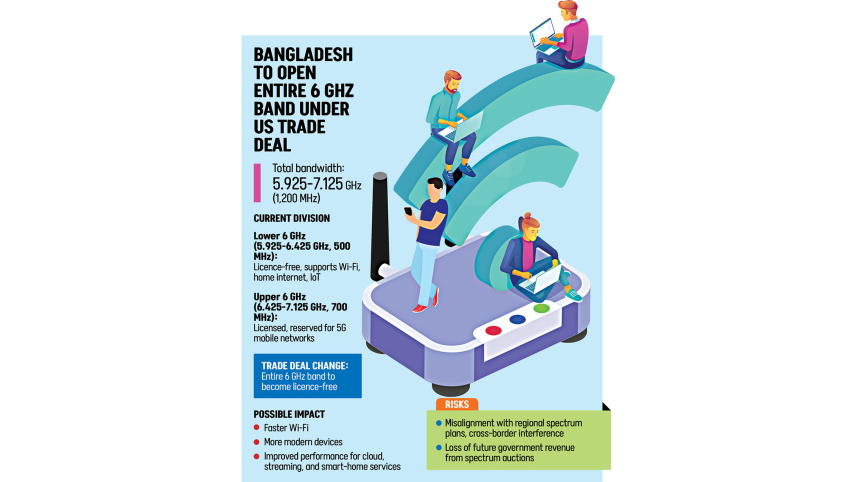
Bangladesh will open the upper parts of 6 gigahertz (GHz) band for unlicensed use, allowing devices such as smartphones, laptops, routers, smart TVs and VR headsets to use this spectrum, according to the reciprocal trade deal with the United States.
With this additional spectrum allocated for Wi-Fi, Bangladesh will have more than enough capacity to support connected devices simultaneously, but it may come at the cost of mobile connectivity, on which the country’s internet ecosystem heavily relies.
 For all latest news, follow The Daily Star's Google News channel.
 The deal also could cost the telecom regulator significant future revenue from spectrum auctions, officials at the Bangladesh Telecommunication Regulatory Commission (BTRC) said.
Besides, industry experts say that making both the lower and upper parts of the band licence-free could leave the country out of step with regional spectrum plans. This could lead to signal interference near borders and slower growth of mobile networks in the longer term.
In simple terms, think of the 6 GHz band as a long road. It starts at 5.925 GHz and ends at 7.125 GHz, giving a total width of 1,200 MHz.
This road is divided into two sections. The lower part, from 5.925 GHz to 6.425 GHz, spans about 500 MHz. It works like a public road, open to all. It is now mainly used for Wi-Fi, home internet and smart devices, and does not require a licence.
The upper part, from 6.425 GHz to 7.125 GHz, covers about 700 MHz. This section is more like a toll road. Companies must pay the government to use it, and it is usually reserved for mobile networks such as 5G.
Under the reciprocal trade deal, this “toll road” would effectively be opened up for free use. Since Bangladesh has already decided to dedicate the lower portion of the band to unlicensed use, the move would, in practice, render the entire band licence-free.
While that could improve internet speeds indoors and support a growing number of connected devices, it raises two key concerns.
First, most countries in the Asia-Pacific region plan to keep the upper portion for mobile services. If Bangladesh takes a different approach, signals using the same frequencies on either side of the border could interfere with each other.
Second, giving up the upper band means the telecom regulator would lose the option to sell that spectrum to mobile operators in future, potentially reducing a major source of revenue.
Telecom industry insiders say that US companies such as Amazon, Apple, Meta Platforms, and Google make devices, cloud services, streaming platforms, and smart-home products that rely heavily on Wi-Fi.
For them, more spectrum means better performance and sales for their products worldwide.
“Opening the upper 6 GHz spectrum band for licence-exempt WLAN/RLAN use may stimulate connectivity and innovation, but it also reduces potential fiscal revenues from spectrum auctions while increasing regulatory demands related to interference management and enforcement,” said MA Razzaque, chairman of Research and Policy Integration for Development (RAPID).
“The benefits of such spectrum liberalisation may accrue disproportionately to foreign technology firms and device manufacturers, given Bangladesh’s still evolving digital infrastructure, regulatory capacity, and limited domestic high-value technology production,” he added.
RISK OF FALLING OUT OF STEP WITH THE REGION
Bangladesh, one of the world’s most densely populated countries with more than 180 million people, faces rapidly rising demand for mobile broadband.
Projections suggest around 2,000 MHz of spectrum will be needed for International Mobile Telecommunications (IMT) services, yet mid-band availability remains limited.
To prepare, the government has already included the upper portion of the 6 GHz band in its national frequency allocation plan as a licensed band for mobile networks.
Dhaka has also submitted its position to the International Telecommunication Union (ITU), backing regional harmonisation of the upper 6 GHz band for licensed mobile use.
Several countries, including India, China, Sri Lanka, the Maldives, Laos and Cambodia, are pursuing similar plans.
Telecom experts say a sudden shift could disrupt that alignment and increase the risk of interference.
Anamika Bhakta, senior director at Robi Axiata, told The Daily Star that harmonisation within a region is crucial. It shapes the device ecosystem and determines how quickly a band matures. A lack of alignment, she said, can create interference issues in border areas.
“Most of the Asia Pacific countries, along with Bangladesh, have already adopted the upper 6 GHz band for licensed IMT spectrum, which will finally be approved in the World Radiocommunication Conference 2027 and will be included in the Radio Regulations of ITU. Accordingly, BTRC has already developed the roadmap for releasing the upper 6 GHz band,” she said.
“Going against the flow of other countries within the Asia Pacific region will isolate Bangladesh in terms of using the 6 GHz band.”
If both the upper and lower parts of the band are made licence-free, the government would also lose substantial revenue from future spectrum sales to mobile operators, Anamika further said.
“So, from the country’s interest perspective, it will not be prudent at all to keep both upper and lower 6 GHz band for license-exempt band,” she added.
QUESTIONS OVER CONSULTATION
A BTRC official said current projections show that around 500 MHz in the lower portion is enough to support Wi-Fi, WLAN, low-power indoor and Internet of Things (IoT) services. Bangladesh has already agreed to open this part for unlicensed use.
Officials stress that keeping the upper band for licensed mobile services is vital, both to maintain network quality in a densely populated market and to protect a major future source of government income.
According to Anamika, a huge amount of spectrum will be required in near future for the mobile operators to support the digital economy of the country. There is scarcity in the IMT band. So, it will not be possible to support them without the upper 6 GHz band.
Asked about the deal, BTRC Chairman Major General (retd) Md Emdad Ul Bari said there are regional differences in how the 6 GHz band is used, and the regulator is still examining the implications of the agreement.
In Bangladesh, spectrum allocation has long been a significant source of revenue. Since 2005, Bangladesh has earned more than Tk 43,000 crore by assigning 396.6 MHz of spectrum to mobile operators. In January alone, the regulator sold spectrum in the 700 MHz band at Tk 237 crore per megahertz.
However, four BTRC officials told The Daily Star that the BTRC’s views were not sought before the deal was finalised by the interim government.
Two officials said that the regulator has already drafted a letter to the government explaining why the upper part of the 6 GHz band should remain reserved for licensed use.
Telecom expert Abu Nazam M Tanveer Hossain said a decision of this scale should ideally be reviewed by a technical body, with input from the regulator. “We would like to know that such discussions did take place.”
Comments