


‘Artificial shortage’ pushes up edible oil prices


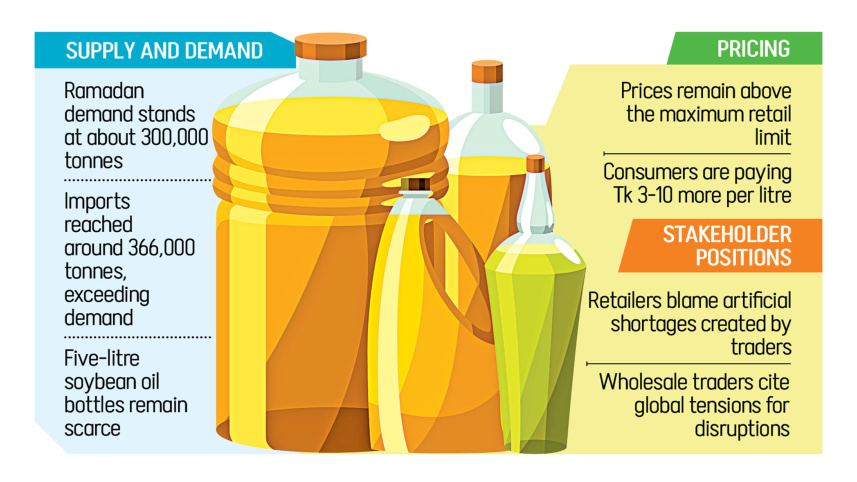
A sudden spike in edible oil prices was observed over the last week, which retailers claim was caused by immoral traders creating an artificial shortage, whereas wholesalers have pointed to the Gulf war situation influencing the global market and consumer behaviour.
The demand for soybean and palm oil in the country during Ramadan is 3 lakh tonnes, whereas importers have brought in 3.66 lakh tonnes in anticipation of the month, according to a Ministry of Commerce document.

Visiting several kitchen markets in Dhaka and Chattogram on Monday, correspondents found that edible oil is being sold above the maximum retail price.
Consumers are paying Tk 3 to Tk 10 more per litre for edible oil in the retail market, according to retailers in different parts of the country.
Five-litre bottles of soybean oil all but vanished from the market in some areas as Ramadan reached the mid-point. Some traders even limit the number of such bottles an individual can buy.
Abul Hashem, a trader at Moulvibazar, a wholesale hub for sugar and edible oil in the capital, said he has been receiving only a single carton of five-litre bottles of soybean oil, whereas the demand is for five cartons.
As a result of this scarcity, demand has shifted to loose soybean oil, raising its price as well, he said.
As per Trading Corporation of Bangladesh (TCB) data, on Monday, loose soybean oil was sold at Tk 185 to Tk 193 per litre, up from Tk 175 to Tk 186 a week ago, a 4.71 percent rise.
Five-litre bottles of soybean oil were sold yesterday at Tk 950 to Tk 955, compared to Tk 920 to Tk 955 a week ago, marking a 1.60 percent increase.
Meanwhile, Super palm oil was sold at Tk 165 to Tk 170 per litre yesterday, up from Tk 162 to Tk 165 a week ago, marking an increase of approximately 2.45 percent.
WHOLESALERS CITE GLOBAL INFLUENCE
Wholesale traders in Chattogram are blaming global uncertainties triggered by the US-Israel war on Iran for a rise in edible oil prices.
According to trading sources and delivery order traders, two weeks ago, palm oil traded at Tk 5,850 per maund, rising to Tk 5,900 to Tk 5,920 after the war began. It now sells at Tk 6,200 per maund.
Soybean oil prices also increased from Tk 7,100 to Tk 7,350 per maund at the wholesale level.
Anwar Hossain, a wholesale trader at Chattogram’s Khatunganj market, said edible oil has seen the sharpest rise out of all kitchen market commodities. Supplies have declined, driving prices upward.
Unless supply improves, prices are unlikely to stabilise, he said.
As per National Board of Revenue (NBR) data, during the first six months of fiscal year 2025-26 (FY26), crude soybean oil imports fell to 3.03 lakh tonnes from 3.63 lakh tonnes, while palm oil imports rose to 8.23 lakh tonnes from 7.11 lakh tonnes.
Taslim Shahriar, deputy general manager of Meghna Group of Industries, which markets the Fresh brand of edible oil, said that recent price hikes in edible oils are largely driven by panic buying.
He also said that traders are reacting to sharp increases in global prices. Soybean oil rose to around $1,260 to $1,270 per tonne, and palm oil climbed to $1,230 to $1,240 per tonne.
On average, soybean oil and palm oil prices have risen by about $100 per tonne. Typically, their prices differ and do not align closely, but at present, they have nearly converged, Shahriar explained.
 For all latest news, follow The Daily Star's Google News channel.
 While import volumes had been sufficient during Ramadan, sudden shifts in consumer behaviour and global market volatility have disrupted the supply and demand balance, pushing prices upward, he added.
On Sunday, March 15, Commerce, Industries, Textiles and Jute Minister Khandaker Abdul Muktadir said at an event that attempts to create artificial shortages in some retail areas may occur, but this does not reflect the overall market situation.
He said that in the event of global conflict, supply pressure and price increases may occur. However, the government will take necessary measures to keep products within consumers’ purchasing power.
Comments