


Bangladesh launches first agrivoltaics pilot to boost green transition
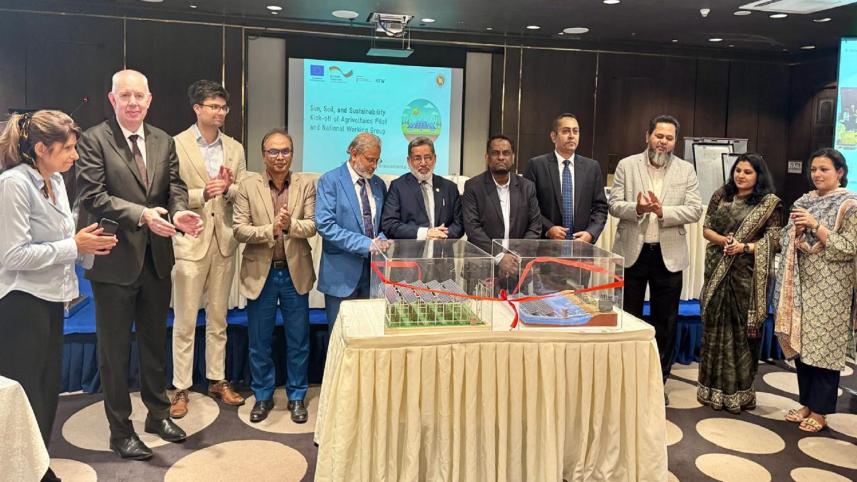
Bangladesh today launched its first structured "Agrivoltaics Pilot Project" and formed a national working group on "Agrivoltaics and Floating Solar", marking a significant step towards promoting renewable energy solutions that maximise the use of limited land resources.
The pilot project aims to assess the technical, agricultural and economic feasibility of agrivoltaic systems in Bangladesh and to help identify pathways for scaling up renewable energy in line with the Renewable Energy Policy 2025, which targets 30 percent renewable energy in the power mix by 2040.

The event, titled "Sun, Soil, and Sustainability: Kick-off of Agrivoltaics Pilot and National Working Group," was jointly organised by the Power Division of the Ministry of Power, Energy and Mineral Resources and the Green Energy Transition-Policy Advisory Partnership (GET-PAP) project, implemented by GIZ Bangladesh.
GET-PAP is co-funded by the European Union and the German Federal Ministry for Economic Cooperation and Development (BMZ).
"We are not just inaugurating a new facility, we are laying the foundation for future generations to thrive. By harnessing the sun not only to grow crops but also to generate clean electricity, we are addressing two of the most pressing challenges of our time --food security for a growing population and accelerating the transition to renewable energy," said Nur Ahmed, additional secretary of the Power Division, while speaking as chief guest.
Edwin Koekkoek, team leader of the Green Inclusive Development Section at the Delegation of the European Union to Bangladesh, said, "Bangladesh is an example in the area of climate adaptation. You have a lot of technologies and expertise that you are sharing."
"We want to contribute to better connecting Europe and Bangladesh in the area of green energy transition," he added.
During the technical sessions, representatives from GIZ, Fraunhofer ISE and IDCOL presented findings on system design, agricultural performance and investment considerations. Participants also discussed lessons from regional experiences, including insights from the Indian Agrivoltaics Alliance.
 For all latest news, follow The Daily Star's Google News channel.
Comments