


Union warns of instability as tannery wage implementation stalls
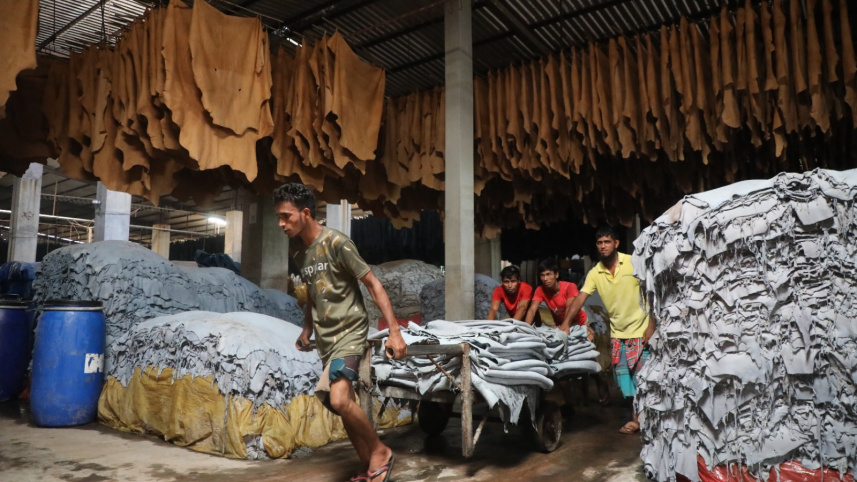
The Tannery Workers Union has alleged that the leather industry is facing growing uncertainty due to employers' delays in implementing the revised minimum wage, ongoing layoffs and the interim government's reported move to transfer Savar leather estate under the Bangladesh Export Processing Zones Authority (Bepza).
Despite a gazette issued on November 21 and the ministry's subsequent announcement, implementation of the revised minimum wage is yet to happen, the union's President Abul Kalam Azad said at an event at The Daily Star Centre today.

"Nearly two years of discussions, tripartite meetings and the ministry's final decision have produced no effective action from employers," he added.
Azad claimed that many long-serving workers were being labelled as "temporary" to deny them the revised wage, which he described as a clear violation of labour law.
Also speaking at the event, the union's General Secretary Abdul Maleque said employers were also delaying the renewal of the bilateral agreement that typically follows a Wage Board decision.
"This delay," he said, "has pushed other worker benefits into uncertainty."
The union is extremely concerned that it has not been informed about the interim government's planned initiative to bring the tannery industry under the Bepza, he added.
A high-level government committee has recently recommended the transfer of the management of the Savar Leather Industrial Estate from the Bangladesh Small and Cottage Industries Corporation to the Bepza in an effort to boost environmental compliance and revive the country's leather export sector, according to media reports.
The committee is expected to submit its recommendations to the Ministry of Industries in a month.
Maleque further alleged that skilled and experienced workers, including machinists, were being laid off and replaced with contract labour without receiving their legal dues. "This is intentionally pushing a formal sector into an informal labour system."
AKM Nasim, country programme director of the Solidarity Center-Bangladesh Office, said employers' reluctance to implement the gazetted minimum wage, coupled with the inactivity of government offices, was alarming.
He noted that the law guarantees equal wages for permanent, temporary and contractual workers, yet implementation remains weak for temporary workers in Dhaka and female workers in Chattogram.
"At the same time, reports of worker dismissals in Chattogram due to union activities are also worrying," he said.
Nasim warned that placing the sector under Bepza could severely restrict workers' freedom of association.
Under the recently amended labour law, a union may be formed within an enterprise cluster by only 20 workers, but the number of unions is capped at five.
This, he said, heightens vulnerabilities for smaller unions and prevents any new union formation once the limit is reached, reducing workers' organising strength.
Ensuring a dignified working environment for workers is a shared responsibility of the state and the employers to restore stability in the industry, he added.
Syed Sultan Uddin Ahmmed, chief of the Labour Reform Commission, said although the tannery industry is an important sector of Bangladesh, it still faces a precarious situation.
"Keeping workers in temporary positions for long periods, delaying the implementation of the announced minimum wage, and creating uncertainty under the pretext of review are weakening the foundation of trust," said Ahmmed, who also heads the Bangladesh Institute of Labour Studies.
"This will ultimately affect the entire industry and the national economy, " he added.
 For all latest news, follow The Daily Star's Google News channel.
 The current crisis in the industry is making it unstable, undermining the trust between workers and employers, and creating uncertainty for the future, he said.
Comments