


The jute is gone, but Adamjee is busier than ever

The first thing that stands out at Adamjee today is what is missing. There is no sign that the establishment at Siddhirganj in Narayanganj was once one of the biggest jute mills in the world. No jute bales piled beside factory floors, no running looms, no smell of raw jute that defined the giant industrial site.
Instead, trucks and covered vans enter the gates with raw materials and leave with finished export products. Workers head into factories making bridal gowns, safety shoes, men’s suits and automobile seat covers.

This was the Adamjee this correspondent saw on August 15, when the Bangladesh Export Processing Zones Authority (BEPZA) invited journalists to mark 20 years since the commissioning of Adamjee Export Processing Zone (AEPZ).
Officials took journalists through four factories: a high-end bridal-wear manufacturer, a safety-shoe maker, a men’s suit factory, and a plant producing automobile seat covers for Japanese vehicle manufacturers.
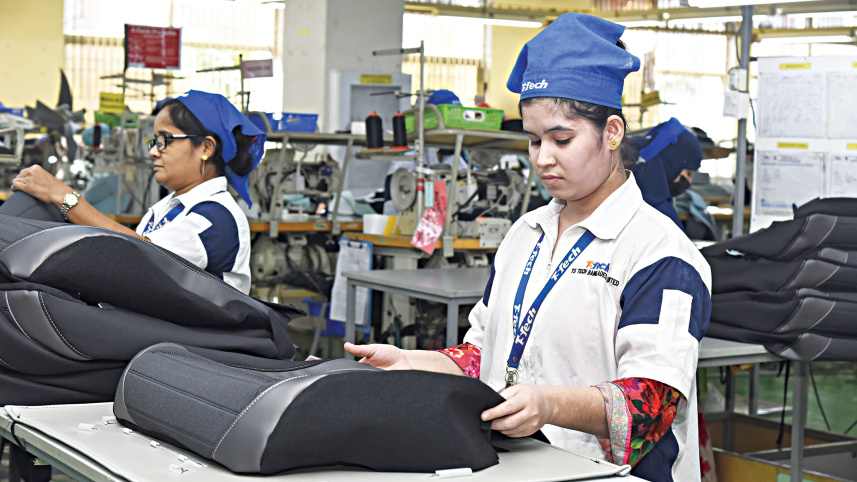
The constant movement of vehicles inside the zone, along with the busy factory floors and workers moving between production units, made the scale of economic activity taking place there immediately visible.
Inside, almost everything was destined for overseas markets. Bridal dresses were being prepared for shipment to Europe, safety shoes were moving through production lines for buyers in dozens of countries, and seat covers were being made for Japanese automotive supply chains.
It was an unlikely collection of industries to find on land once dominated by jute.
This land was once home to Adamjee Jute Mill. Established in 1950 on the bank of the Shitalakhya, it went on to become the centre of a community, with its own workers’ housing, schools and markets that grew into Adamjee Nagar.
That came to an end on June 30, 2002, when the nationalised industry shut down after incurring a huge Tk 13 billion accumulated loss since independence, management problems, technological limitations and labour unrest. An estimated 20,000 to 25,000 workers lost their jobs, and the vast industrial site fell largely silent.
The government handed the land over to BEPZA on December 1, 2004. Some four years later, on March 6, 2006, the then prime minister Khaleda Zia inaugurated the Adamjee Export Processing Zone on the same land.
THE ADAMJEE NOW
More than two decades later, the EPZ now covers 292.62 acres, including 238.55 acres of bonded area, which allows duty-free imports of raw materials and machinery, according to the latest BEPZA data.
The EPZ has 311 industrial plots. Its operational enterprises exported goods worth $1.18 billion in fiscal year 2025-26, while cumulative employment stood at 75,734 as of June 2026.
Adamjee’s transformation is part of a much larger export-processing network operated by BEPZA, the state-owned investment promotion agency that runs specialised economic zones for fully export-oriented factories.
BEPZA currently operates eight EPZs and the BEPZA Economic Zone. As of July 2026, cumulative investment in the zones had reached $7.39 billion, while cumulative exports stood at $128.19 billion.
A total of 565 industrial enterprises are currently under BEPZA, of which 451 are in commercial operation, and 114 are under implementation.
The EPZ authority said in FY26, enterprises in the zones exported goods worth $8.41 billion, up from $8.22 billion in FY25. The zones’ contribution to national exports rose to 17.51 percent, 2.22 percentage points higher than the previous year, despite a 0.58 percent decline in the country’s overall exports.
The scale of the major EPZs puts Adamjee’s position into perspective.
Chattogram EPZ, spread over 453 acres with 501 industrial plots, exported goods worth $2.46 billion in FY26. Cumulative employment there stood at 188,914 as of June 2026.
Dhaka EPZ, covering 356.22 acres and containing 451 industrial plots, exported $1.76 billion during the same fiscal year and had cumulative employment of 90,705.
 For all latest news, follow The Daily Star's Google News channel.
 Adamjee, with exports of $1.18 billion and employment of 75,734, is the third-largest EPZ among the eight government EPZs in terms of export and employment size.
“Once, the area was almost a dead industrial zone. The government wanted to bring it back to life through industrialisation, employment and exports,” said Abdur Rahim Khan Bhuiya, executive director of Adamjee EPZ.
In FY26, the zone attracted $34.45 million in new investment, exported goods worth $1.18 billion and created 2,046 new jobs.
INSIDE STORY: GOING GLOBAL
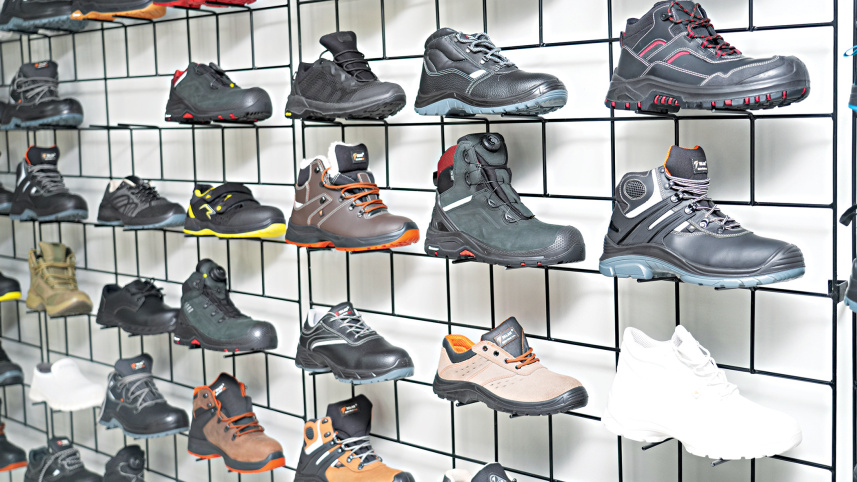
That diversity became clear factory by factory. Super Protective Shoes, a Ukrainian-invested footwear manufacturer, has operated in the zone since 2008.
Lavryk Andrity, the company’s chairman and managing director, said he and his father chose Bangladesh over Vietnam after visiting the country in 2007.
The factory now employs around 1,000 workers and produces 5,000 to 6,000 pairs of safety shoes a day.
Annual exports run at about $25 million, with the company targeting $50 million within two years, and its shoes now reach some 60 to 70 countries.
The company imports raw materials from Brazil, China, India, Pakistan and Europe, while sourcing some leather locally.
Local sourcing accounts for less than five percent of its global sourcing.
Andrity also wants permission to sell some products in Bangladesh, particularly to the construction sector.
He said the company is willing to pay applicable duties and sell up to 10 percent of its production locally.
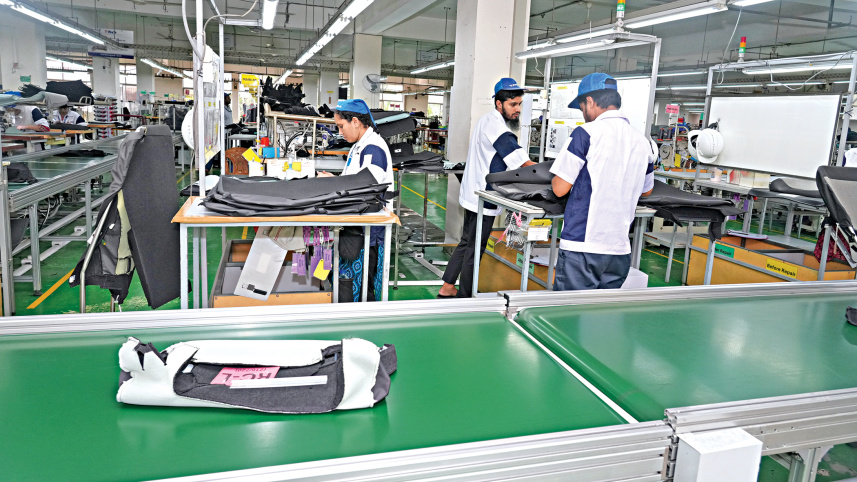
A little further, at TS Tech Bangladesh, a Japanese company, workers make automotive seat-trim covers for vehicle manufacturers including Toyota, Suzuki and Honda.
The company has invested $4.67 million in Bangladesh to date and employs 512 people. In FY26, it exported products worth $14.75 million, shows BEPZA data.
Most of its raw materials come from Japan and China, processed in Bangladesh before being supplied to production facilities in Japan.
Satoru Onishi, the company’s managing director, said the company has been working to improve productivity and automation, including through the use of 3D printing for some internal production activities.
At Universal Menswear Ltd, the products are more familiar to the country’s garment industry, even if the markets it serves remain just as global.
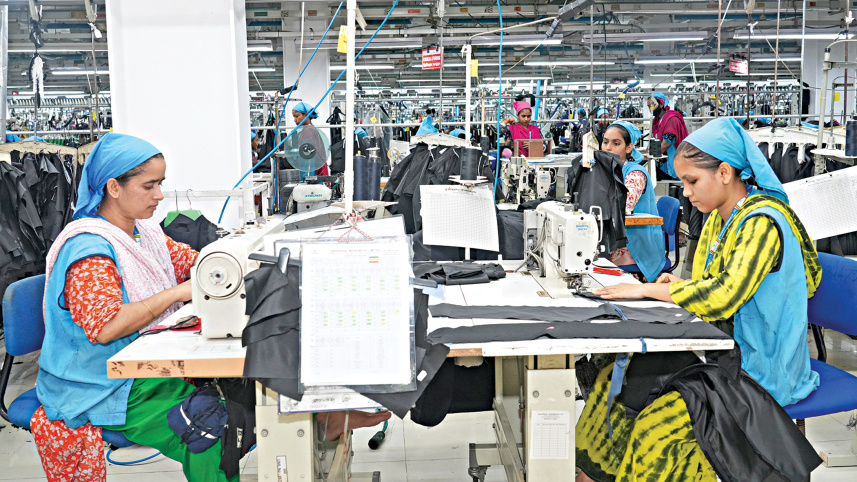
The company is a joint venture between Ananta Group of Bangladesh and Romanian entrepreneur Christopher Long, and production began in 2011 after the business relocated from Romania to Bangladesh.
The factory specialises entirely in two-piece suits, blazers and trousers, mainly for European markets, with buyers including Marks & Spencer, Moss Bros, Primark, Bestseller, C&A, Next and companies under the Inditex group; some of its products also reach the US market indirectly.
According to company officials, the company started with an initial capital investment of about $46 million. Last year, its exports stood at some $98 million.
A typical production line has 130 to 150 workers and can produce roughly 700 to 800 pieces an hour, depending on the style.
Operating inside the EPZ gives the factory more reliable access to electricity, gas and water, as well as greater security, officials said.
It has also installed a 668-kilowatt solar system, supplying about 4 percent of its electricity needs.
There are limits, however. Most major inputs, including fabric, buttons, thread and labels, are imported, leaving relatively little room for local value addition.
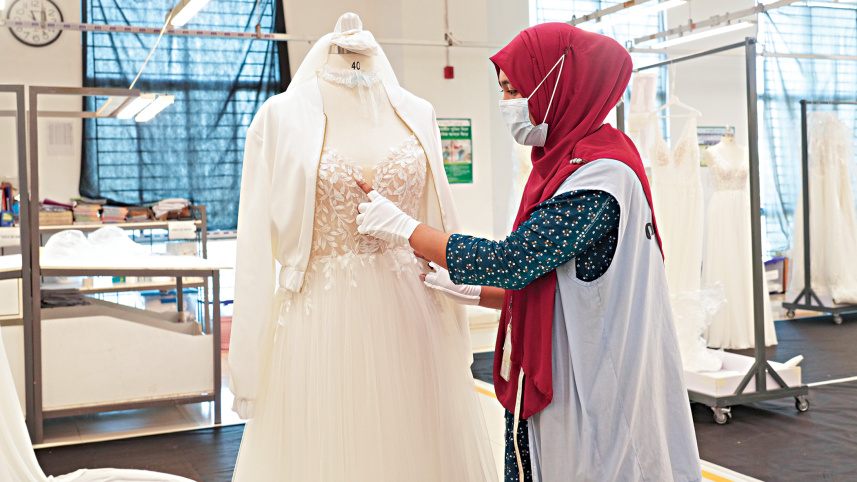
But the most unexpected addition to the zone’s landscape is UBF Bridal Ltd, a German-owned company making high-end bridal wear for international markets.
The business started in Tongi in 1987 and moved to the EPZ after its German owners decided to establish a new facility there. Construction began in 2020, and production started in 2022.
Its Bangladesh-made dresses are sent to a central warehouse in Berlin before being distributed to 37 countries, including the United States, Spain, Italy, France, Brazil and South Africa.
According to Md Robiul Hoque Siddiki, chief operating officer of UBF Bridal, the company is the first of its kind in Bangladesh to manufacture high-end bridal wear.
The factory now employs around 450 people and has eight production lines. It plans eventually to operate 16 lines.
The company initially invested $8 million, rising to more than $10 million. Another $6 million investment is planned for a shoe factory at the same complex, with production to be shifted from the United States.
Exports have grown from about $3.3 million in the first year to $5.2 million last year. This year, exports have already crossed $7 million, against a target of more than $8 million.
Production efficiency has improved from about 30 percent when the factory started to around 60 percent now, with a target of 80 percent.
A ZONE STILL GROWING
None of the four factories at Adamjee is standing still. Super Protective Shoes is installing new machinery to push daily output toward 10,000 pairs of shoes and is targeting a doubling of its exports within two years. UBF Bridal is building a second production line for footwear at the same complex, shifting that work from the United States, and plans to grow from eight garment lines to sixteen. Universal Menswear and TS Tech are both leaning further into automation to keep pace with buyers abroad.
In addition to the existing factories, more enterprises are being built within the export zone and are expected to go into production next year.
BEPZA officials said 10 projects are currently under implementation, involving a proposed investment of $247 million and expected employment for 18,475 people. Of these, six are Bangladeshi-owned, one is a Bangladesh-China joint venture, one is a Bangladesh-UK joint venture and two are Chinese-owned.
The projects include three garment factories, six garment accessories units and one bicycle factory – Evergreen Cycles Ltd, a Bangladesh-UK joint venture, added the officials.
Once the new enterprises are in operation, they expect the zone’s annual exports to exceed $1.5 billion within the next one and a half years.