


Reforms can boost leather, footwear exports to $5b by 2030: Nasim Manzur
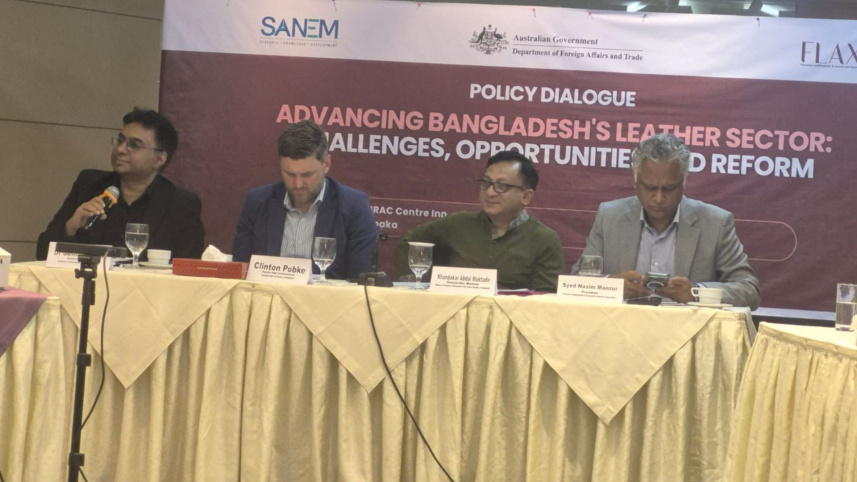
Bangladesh can more than double its exports of footwear and leather goods to $5 billion by 2030, but this will require major policy reforms, better infrastructure and a shift towards higher-value products, said the chief of the Footwear, Leathergoods & Accessories Exporters Association (FLAXA) today.
A lot has been talked about the potential, but somehow that doesn’t live up to expectations, said FLAXA President Syed Nasim Manzur at a policy dialogue on advancing Bangladesh’s leather sector.

The South Asian Network on Economic Modeling (SANEM) and FLAXA organised the event at BRAC Centre Inn.
Nasim said policymakers need to look beyond leather when framing policies for the sector. Non-leather footwear, bags and other products are becoming increasingly important, while new areas such as automotive leather components are also emerging, he added.
Bangladesh currently exports around $1.76 billion worth of footwear and leather goods, despite being the world’s seventh-largest footwear producer. Its products reach more than 105 countries, with the US and India being the two largest markets.
Non-leather footwear already accounts for nearly 31 percent of the sector’s exports and is growing faster than leather footwear, he said.
Bangladesh currently has less than half a percent share of the global non-leather footwear market. Increasing that to 5 percent could generate about $3.5 billion in exports, while a similar expansion in synthetic bags could bring in another $3.4 billion, according to FLAXA estimates.
“This is a huge opportunity. Someone will take it,” Manzur said, citing the rapid growth of countries such as Vietnam and Cambodia in these markets.
He called for separate customs rules and incentives based on specific Harmonised System (HS) codes — the standardised system used to classify internationally traded goods — for leather and non-leather products, saying the present system often creates confusion and arbitrary treatment.
The government should also keep export incentives unchanged for a fixed period to give investors certainty ahead of Bangladesh’s LDC graduation, he said.
He urged the withdrawal of advance income tax on exports, describing it as a tax on revenue rather than income.
The sector also needs urgent action on gas and power supplies, particularly in the Savar tannery estate. The Central Effluent Treatment Plant (CETP) must be made operational, while roads and other infrastructure inside the estate need improvement.
Nasim criticised excessive paperwork, saying exporters currently need 23 certificates and licences involving about 190 documents, compared with only four in Vietnam.
Bangladesh must also move away from exporting semi-finished leather. About 65 percent of the country’s leather is exported as crust leather, he said.
“We need to push towards finished products,” Nasim said, adding that Bangladesh could import raw hides for processing just as it imports cotton for its textile industry.
“A comprehensive strategy and a targeted roadmap can make the $5 billion export target very much doable,” he said.
 For all latest news, follow The Daily Star's Google News channel.
Comments