


Private sector players promising shuttered BJMC mills a new lease on life

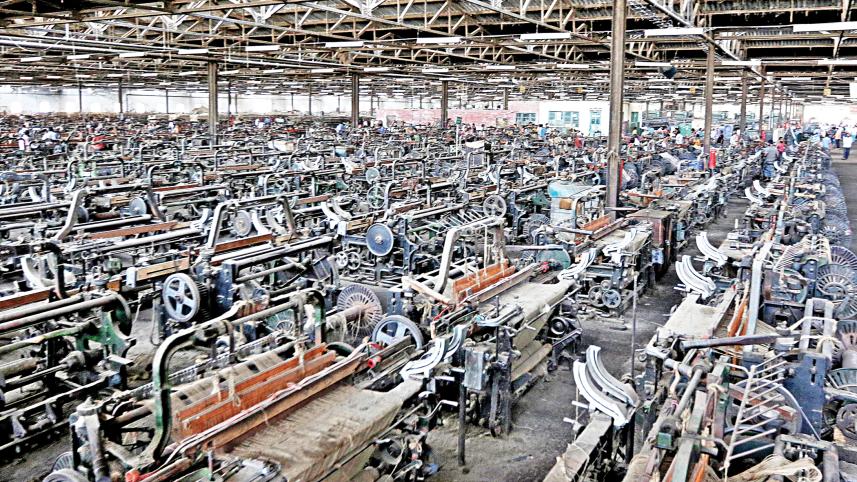
The government is considering giving priority to leasing out state-owned jute mills to the private sector so that production could resume within a short time, according to officials of the textiles and jute ministry and industry stakeholders.
The development comes after the ministry found a greater response from private millers in taking on the 25 mills shuttered last month instead of the other options it had floated, including public-private partnerships (PPP).

Some millers said the PPP process was time-consuming and complex and they lacked the knowledge and experience to operate under the system.
The views came in the first two meetings of the 13-member committee headed by Textiles and Jute Minister Golam Dastagir Gazi held on 23 July and 5 August.
Some participants suggested declaring the machinery to be scrap while some recommended dividing the mills into three categories to be leased out, modernised and brought under the PPP.
Proposals were also placed for handing over some mills to the Bangladesh Investment Development Authority (BIDA) and the Bangladesh Economic Zones Authority, according to minutes of the meetings.
The government formed the panel on 16 July to recommend measures to modernise the production system of jute goods in light of the present and future market prospects and to restart the plants under the Bangladesh Jute Mills Corporation (BJMC).
The panel comprises the executive chairman of BIDA; secretaries to finance, commerce, industries and textiles ministries; a director-general at the Prime Minister's Office; and presidents of the Federation of Bangladesh Chambers of Commerce and Industry, the Bangladesh Jute Mills Association (BJMA) and the Bangladesh Jute Spinners Association.
The government closed down all 25 jute mills that employed 24,886 permanent workers and a large number of casual workers from 1 July to bring an end to continuing losses resulting from the use of decades-old machinery, corruption, mismanagement and operational costs higher than those in the private sector.
Since the closure, the government has been maintaining that it would give the factories, which were nationalised in 1972, a new lease on life either under the PPP, government-to-government initiatives, joint venture or on lease.
Initially, the committee decided not to sell the lands of the closed jute mills for any other purpose, according to minutes of the first meeting.
In its second meeting, the committee decided to "consider leasing out mills as an effective and useful method to restart mills within a short time" by keeping the government's ownership on land and other properties.
It also decided to consider other options based on circumstances.
As per the decision, BJMC also offered scope for interested investors to visit the shuttered plants such that they could see the condition of the factories and other properties.
Some 24 interested investors visited the mills located in Chattogram, Khulna and Dhaka divisions. The deadline for visiting the mills ended on 20 July.
BJMC Chairman Md Abdur Rouf, however, said interested investors would be able to visit factories if they want. On the method of the handover, he declined to comment.
Mohammad Abul Kalam, member secretary of the committee, said leasing those out was an option.
"All the options are on the table. We have not decided on anything yet," he added.
The investors would not be interested in taking rent of the mills for short periods, said Mohammed Mahbubur Rahman Patwari, chairman of BJMA.
As the government says it will not sell the land, no other option will be feasible other than a long-term lease, he said, adding that the government understands that the lease format would be easier to jumpstart production at the mills at the earliest.
 For all latest news, follow The Daily Star's Google News channel.
 He favoured giving out leases for 99 to 100 years as banks will not provide finance to those not on a long-term lease.
As the mills had been established a long time ago, many pieces of machinery had become old and their capacities had eroded, said Patwari, who has visited some of the mills adjacent to Dhaka.
"As the machinery is old, new owners will have to start anew,"
The panel also decided to determine the recovery value of the machinery and divide mills into three categories depending on the condition of the machinery, said Patwari, also a member of the committee.
Aameir Alihussain, managing director of steelmaker BSRM, said they wanted to explore the potential for investment in the state jute mills.
"We are interested subject to due diligence," he said, while urging the authorities for making all the information available, give time and ensure clarity.
Comments