


Plastic industry resilient amid challenges
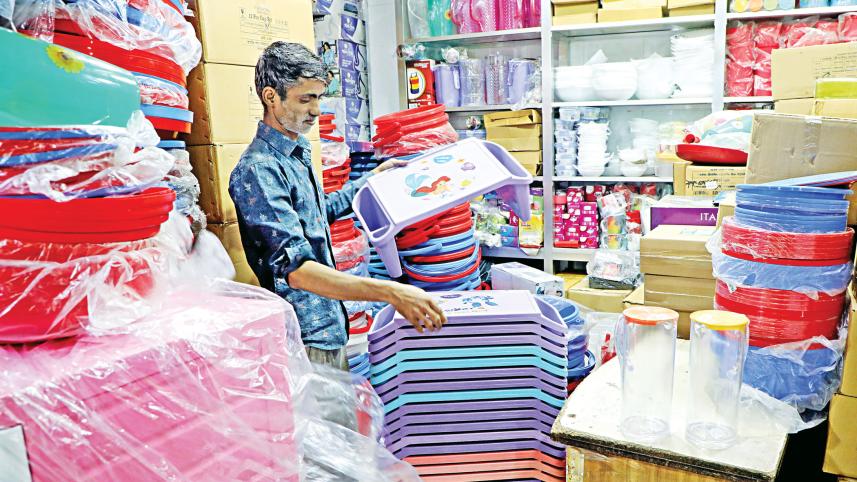
Despite economic challenges, Bangladesh's plastic industry remains resilient and continues to grow steadily, said Shamim Ahmed, president of the Bangladesh Plastic Goods Manufacturers and Exporters Association.
He made the statement at a media briefing yesterday at the association's office in Paltan, marking the 20th anniversary of the International Plastic Fair (IPF).
 For all latest news, follow The Daily Star's Google News channel.
 Ahmed said the plastic industry has changed significantly over the years. "Once limited to household items, the sector now serves as a vital backward linkage for more than 60 industries, including pharmaceuticals, agriculture and engineering," he said.
Recalling the history of the IPF, Ahmed said the first fair was held in 1989 and inaugurated by then-president HM Ershad. After a long gap, the exhibition was relaunched in 2002 and has since grown into one of South Asia's leading platforms for the plastic industry.
The 18th edition of the IPF will be held from January 28 to 31, 2026, at the International Convention City Bashundhara (ICCB). Ahmed said the event is expected to attract strong foreign participation and showcase advanced machinery.
Despite a difficult business environment in 2025, the plastic sector has continued to expand, he said. More than 4,000 plastic-related enterprises are now operating in the country, mostly in the business-to-business segment.
He added that new memberships of the association indicate rising investment, particularly in agricultural plastics, packaging and engineering-grade materials.
Ahmed said direct exports from the plastic industry are nearing $300 million, while indirect exports, mainly through garment accessories and packaging, add an estimated $1.2 billion.
He urged policymakers to include indirect exports in national data. "If indirect exports are recognised, the industry's export figure would be closer to $2 billion," he said.
He also called for government support to ease land acquisition, especially for the long-delayed Plastic Industrial City under the Bangladesh Small and Cottage Industries Corporation.
According to him, current land prices there remain beyond the reach of small entrepreneurs.
On environmental issues, Ahmed said plastic pollution mainly comes from post-consumer waste rather than manufacturing. He pointed to Japan's waste management system as an example Bangladesh could follow.
Responding to questions on diversification, he said the industry now has 29 active sub-sectors, including toys, optics and agricultural products such as greenhouse films and biofloc tanks.
As the IPF 2026 approaches, Ahmed highlighted the fair's role in promoting innovation and collaboration in the sector. "Exhibitions like the IPF are more than trade shows—they are tools for transformation," he said.
Akai Lin, overseas director at Chan Chao International Co Ltd, said the company is supporting Bangladesh's plastic industry in entering global markets. "We are committed to providing world-class equipment, including machinery and manufacturing materials that meet US and EU standards," he added.


Comments