


Breaking the syndicate: AI for fair prices

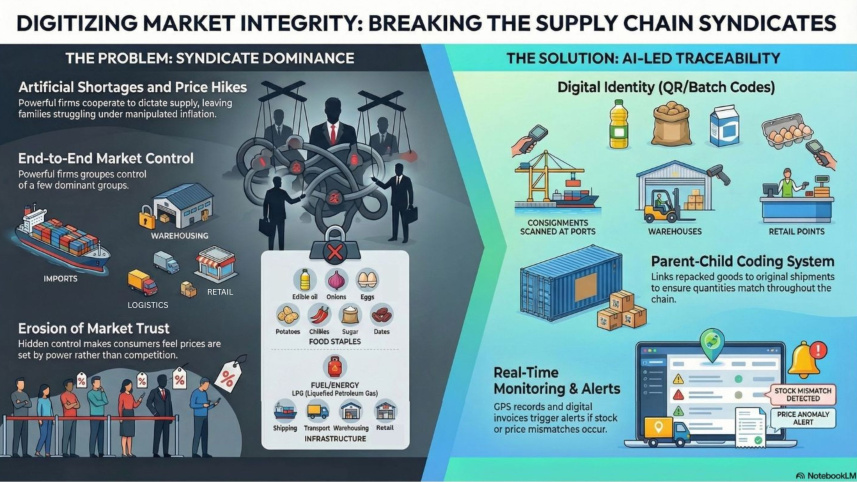
Bangladesh is home to a thriving market for essential goods, and this has a major weakness as well: the overwhelming control of a few powerful companies. Instead of competing, these firms cooperate, allowing them to dictate supply and prices.
The Centre for Policy Dialogue (CPD) brought the issue to light through an article on March 15 this year, based on the findings of Dr. Khandaker Golam Moazzem, research director and economist at the leading think-tank.

The study shows that a small number of large firms and trading groups dominate not only imports of items like edible oil, dates, LPG, onions, eggs, potatoes, and chillies, but also storage, shipping, transport, warehousing, dealership networks, wholesale, and retail distribution.
Such practices create artificial shortages and sudden price hikes, leaving poor and middle-class families—who spend most of their income on food, fuel, and daily necessities—struggling under inflation and worsening daily hardship.
The damage extends beyond consumers—it undermines the economy itself. When prices rise through manipulation rather than real shortages, trust in the market erodes. People begin to feel prices are set not by competition but by a few powerful players.
Most critically, small and medium entrepreneurs are pushed aside. SME traders and importers often lack fair access to finance, storage, transport, or supply channels. With these gateways controlled by large groups, smaller businesses struggle to survive, even if efficient and honest. This destroys competition and stifles new entrepreneurship.
Over time, such dominance breeds crony capitalism. In a healthy economy, success comes from efficiency and innovation; in a crony economy, it comes from influence and control. Thus, the issue is not only high prices—it is about inflation, fairness, business freedom, and economic justice.
How AI-led digital applications can help break the syndicate
If hidden control is the problem, visibility must be the first solution—and AI-led digital tools can help. AI cannot replace strong laws or honest enforcement, but it can make markets more transparent, traceable, and harder to manipulate.
Today, syndicates thrive because much of the supply chain is invisible. Regulators often lack clear data on imports, warehouse stocks, market releases, or delays. Consumers only see the outcome: shortages and high prices. A digital tracking system can reduce this opacity.
Each consignment could carry a digital identity—QR or batch code—scanned at key points: port arrival, trucking, warehousing, repacking, and retail distribution.
Simple mobile apps or scanners would let importers, warehouse staff, transporters, and retailers confirm deliveries, enter stock, upload photos, and record prices. The system should emphasize quick scans over lengthy reports, creating digital footprints with time, place, user, and quantity logged.
For repacked goods like oil, sugar, or dates, a parent-child code system can link smaller lots to the original shipment. Quantity checks are vital: if 100 tonnes are imported, the sum of repacked, dispatched, damaged, and stored goods must match.
Any mismatch would trigger alerts, making manipulation, false labelling, or hidden stockholding far harder.
To strengthen the system, every movement should be recorded in real or near real time. Delivery trucks can be linked with GPS records, warehouses can update stock via mobile apps or terminals, and digital invoices can track who sold what to whom. Repacking centres can print new labels tied to the original batch.
Larger warehouses, ports, and bottling plants may later add smart cameras and digital weighbridges, but advanced tools need not come first. Even a basic setup—smartphones, QR labels, e‑invoices, and cloud dashboards—can bring major improvement at low cost.
Once data flows, AI becomes powerful. It can process vast market information faster than humans, detect unusual price spikes across districts, compare imports with supply, and flag when tax cuts are not passed to consumers. It can also spot suspicious patterns, such as firms raising prices or delaying releases together. While not proof of guilt, these signals give regulators early warnings.
AI can also support small and medium entrepreneurs. SMEs often lack fair access to credit, storage, transport, or supply. A digital platform can level the field by handling finance requests, logistics, and distribution transparently, giving honest businesses a chance to compete.
A public dashboard can further strengthen trust. It could show daily prices, district trends, benchmark rates, and supply updates. Regulators would use a secure dashboard for detailed stock data, suspicious transactions, and AI alerts. Public access reduces rumour, panic buying, and false fear.
Consumers and retailers can join through complaint apps or hotlines to report shortages or overpricing. AI can group these reports by product and location, helping identify manipulation.
Technology alone is not enough. Laws and enforcement must back the system. Reporting should be mandatory for large traders and warehouses, with penalties for false declarations, fake labels, hidden stock, or duplicate codes. Random audits must check digital records against physical stock, and repeated suspicious patterns should trigger investigation and penalties.
 For all latest news, follow The Daily Star's Google News channel.
 In short, AI-led digital tools can bring sunlight into a market long in shadows. They expose hoarding, resist false labelling, reduce manipulation, empower SMEs, and protect consumers from artificial shocks.
They cannot perfect the market overnight, but they make it far harder for cartels to dominate essential goods silently. For fair prices, competition, and justice, smart digital market governance is no longer optional—it is essential.
The writer is a senior banker based in Bangladesh. He can be reached at farhad1168@gmail.com.
Comments