


No licence for travel agencies without full local ownership
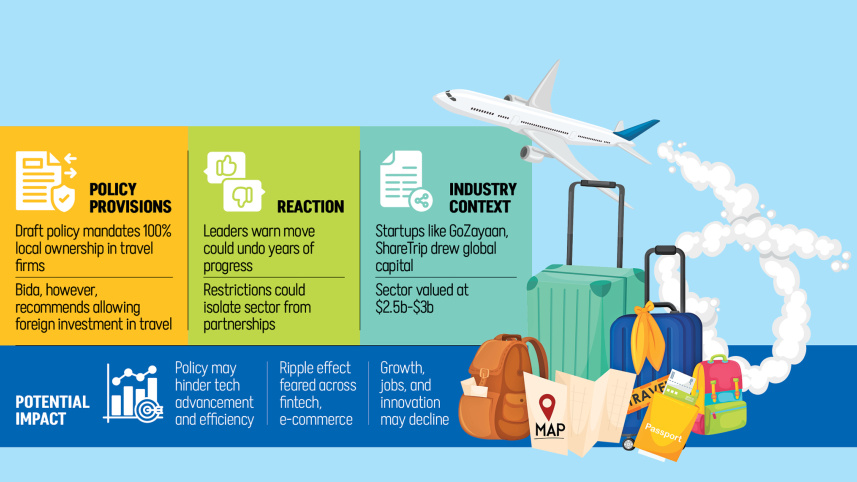

- Draft seeks full local travel agency ownership
- Bida warns restriction deters foreign investment
- Startups argue ban undermines innovation, growth
- Critics say proposal contradicts national goals
The government has proposed that travel agencies must have 100 percent local ownership to get a licence.
The draft amendment to the Bangladesh Travel Agency Registration and Control Ordinance says that the changes are needed "to prevent customer harassment on online and offline platforms" and "to ensure good governance in air travel".
The Ministry of Civil Aviation and Tourism has published the draft online and allowed seven days for public feedback.
The ministry says the proposals have been prepared in line with opinions received at discussions of the relevant committee and by reviewing laws in other countries.
But, the Bangladesh Investment Development Authority (Bida) argued in its recommendation to the draft that "it is difficult to justify the draft" as the existing 2013 law already covers relevant matters.
Under current rules, an applicant for a travel agency licence must be a Bangladeshi citizen.
Bida, which operates under the Chief Adviser's Office, said this Bangladeshi citizen requirement discourages foreign and joint venture investment in the travel industry, which in turn deprives customers of competitive services.
Rather than insisting on full local ownership, it recommended removing the citizenship requirement and replacing it with a condition that the company must be registered in Bangladesh.
Meanwhile, leading travel agencies with foreign investment have also criticised the proposed draft.
"Restricting foreign participation now would roll back progress and dampen innovation across multiple sectors related to tourism," said Ridwan Hafiz, managing director of GoZayaan Ltd, a travel tech firm.
He said startups such as GoZayaan and ShareTrip have attracted more than $20 million in foreign direct investment from Singapore, Japan, the United States and the United Kingdom so far.
This funding brought capital, global expertise, innovation and jobs, he said, adding that foreign investment helped modernise the travel industry and enabled local firms to compete globally.
"Now, if foreign ownership is banned and industries suffer under restrictive rules, can Bangladesh truly expect foreign investment to return, or are we closing the doors to our own future growth?" he questioned.
Sadia Haque, co-founder and chief executive officer of ShareTrip, also opposed the draft, calling it a setback for Bangladesh's vision of a technology-driven and globally competitive economy.
She said the draft goes against national goals to attract investment and support innovation.
"The travel industry is far from a small, cottage sector," she said. "This is a $2.5 billion to $3 billion industry that significantly contributes to national revenue, employment, and global connectivity."
Haque said the sector is not listed as a protected industry under Bangladeshi law and cited Bida recommendation to encourage rather than restrict foreign investment.
 For all latest news, follow The Daily Star's Google News channel.
 She said the amendments could send discouraging signals to both local entrepreneurs and international investors, damage confidence and undermine Bangladesh's reputation as a digital economy.
"Such restrictions could curb growth in the travel and startup sectors," which she said have become major drivers of innovation and economic development.
In the recommendation, Bida also noted that as Bangladesh prepares to graduate from least developed country status in November 2026, sector-specific trade barriers should be lifted and conflicting provisions between local and foreign investment laws should be repealed.
Regarding the draft amendment, The Daily Star approached two senior officials at the tourism ministry. But they did not respond to calls or messages.
Comments