


More time for reform, not more time for delay

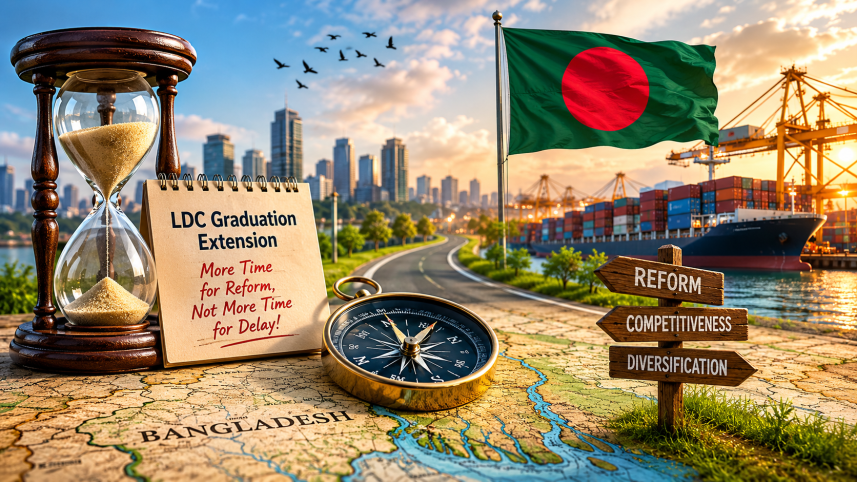
The UN CDP’s recommendation to consider an extension of Bangladesh’s preparatory period for LDC graduation is a highly significant development. It is also consistent with the findings of the Graduation Readiness Assessment, earlier commissioned by UNOHRLLS at the request of the interim government. Overall, these assessments strengthen the case that Bangladesh’s LDC timeline extension request is a justified appeal to manage a complex transition under exceptional circumstances.
The CDP’s assessment confirms two things at once. First, Bangladesh continues to meet the graduation criteria by a wide margin, and its graduation eligibility is not in question. Second, Bangladesh has faced a combination of shocks, including the lingering effects of the pandemic, global economic instability, geopolitical tensions, supply-chain disruptions, and a major domestic political transition, all of which have constrained the implementation of critical preparatory measures. The recommendation therefore gives Bangladesh’s request stronger legitimacy within the UN process.

The next step will be to secure support in the UN General Assembly. Bangladesh should not assume that the CDP recommendation alone will automatically translate into approval. A focused diplomatic drive is now essential. The government will need to engage with UN member states, explain the evidence behind the request, demonstrate that the extension will be used for concrete reform actions, and reassure partners that Bangladesh remains fully committed to graduation.
At the same time, Bangladesh must navigate the process with care. In the current global environment, geopolitical issues have become a serious development risk. While support should be sought from all relevant partners, the LDC graduation extension should not become a bargaining chip in ways that compel Bangladesh to make costly concessions to major powers. Diplomatic engagement should therefore be broad-based, principled, and carefully coordinated, with the extension framed as a development-transition issue rather than a matter of geopolitical alignment.
The CDP recommendation makes the case for an extension considerably stronger. It gives Bangladesh a credible basis for arguing that additional time is warranted on developmental, institutional, and transition-management grounds. However, we must treat this extension as a time-bound window for accelerating long-overdue reforms and strengthening graduation preparedness, not as a pause or a justification for delaying difficult policy decisions. Three years will pass very quickly.
Immediate priorities must include urgently securing post-graduation trading arrangements with the European Union, which absorbs nearly half of Bangladesh’s exports and where the country’s garment sector will face intensifying competitive pressure in the aftermath of the EU’s free trade agreements with Viet Nam and India. Failure to secure favourable market access could significantly erode Bangladesh’s export competitiveness. At the same time, Bangladesh must strengthen export resilience by accelerating diversification beyond traditional products and markets, reducing the longstanding anti-export bias embedded in domestic policies, enhancing productivity and compliance standards, and fast-tracking the implementation of the key measures identified in the Smooth Transition Strategy for LDC graduation.
This is where foreign direct investment becomes central. Bangladesh’s limited progress in non-RMG exports shows that export diversification cannot be achieved through domestic production capacity alone. The missing link has been FDI. While Bangladesh has developed a large and competitive garment sector, its non-RMG sectors have remained weakly connected to global value chains, international buyers, quality-control systems, design networks, and distribution channels. FDI can help close this gap by bringing technology, managerial capability, compliance systems, global sourcing relationships, and access to established markets.
Successful diversifiers have used foreign investors and joint ventures to anchor domestic firms within global production networks. Bangladesh must now treat FDI not as a general investment objective, but as a core instrument of export transformation. This requires a more focused investment strategy. Rather than spreading policy attention thinly across too many economic zones and sectors, a few selected special economic zones should be prioritised and made fully functional for export-oriented investors. These zones should offer reliable power and gas, customs facilitation, serviced land, duty-free input access, compliance infrastructure, labour-skills support, and fast-track regulatory services.
If needed, generous but disciplined incentives should be offered to attract a small number of large foreign multinational export manufacturers. Securing a few credible anchor investors can have a demonstration effect: once global firms begin producing successfully in Bangladesh, suppliers, logistics providers, buyers, and other investors are more likely to follow. As multinational firms seek to reduce excessive dependence on major geopolitical power manufacturing locations, Bangladesh can position itself as a competitive, non-power-aligned production base for global exports. Bangladesh has already demonstrated its ability to produce at scale, supported by abundant labour, an established export culture, and proximity to Asian supply chains. These advantages will count only if Bangladesh presents itself as a reliable, reform-oriented, and export-ready location.
Several long overdue actions require urgent attention. Foremost among them is fixing the Central Effluent Treatment Plant in Savar and ensuring environmental compliance in the leather sector. This would restore credibility and signal seriousness to investors. Other priorities include creating affordable export-support financing for man-made fibre-based apparel, improving product quality and compliance standards in agro-processing and other promising export sectors, reducing logistics and trade-related costs, and preparing for emerging regulatory requirements such as the EU’s Corporate Sustainability Due Diligence Directive and the Carbon Border Adjustment Mechanism.
The issue of export incentives also deserves special consideration. While many broader policy reforms have stalled, the reduction of export incentives appears to have been placed on a much faster track. This sequencing is questionable. The resurgence of industrial policy globally, and recent experience from export success by various economies, suggest that carefully designed support for exports remains important for building supply-side capacity and strengthening competitiveness. With the possibility of an extension of Bangladesh’s graduation timeline, the country must use any available policy space strategically. Export support should not be indiscriminate, but it should be targeted and linked to export expansion, diversification, technology upgrading, compliance, and new market entry. Removing support before alternative competitiveness-enhancing reforms are in place could weaken the very sectors Bangladesh needs to build for the post-LDC period.
More fundamentally, the success of any extended preparatory period will depend on domestic economic management. Tackling inflation, restoring macroeconomic stability, addressing banking-sector weaknesses, and strengthening implementation capacity remain critical. Without progress in these areas, an extension may provide temporary relief but not a stronger transition. The real test, therefore, will be whether Bangladesh can use the additional time to accelerate reforms, deepen productive capacity, attract export-oriented investment, and enter the post-LDC phase with greater confidence and resilience.
The government’s ongoing effort to formulate a new five-year strategic framework presents a timely opportunity to embed LDC graduation preparedness within a broader national development action plan. Rather than treating graduation-related measures as a parallel exercise, the plan should explicitly align its priorities, targets, and implementation mechanisms with the requirements of a successful post-LDC transition.
In this regard, Bangladesh already possesses a valuable foundation in the STS, which contains a comprehensive set of actions covering macroeconomy, export competitiveness and diversification, productive capacity, institutional strengthening, and international partnerships. Many of these measures can be incorporated directly into the forthcoming development framework. The new strategic plan should therefore establish clear priorities, assign institutional responsibilities, define implementation timelines, and allocate the necessary resources to ensure that the most critical graduation-related reforms are carried out within the available window of opportunity.
The author is an economist, who serves as chairman of the Research and Policy Integration for Development (RAPID). He can be reached at m.a.razzaque@gmail.com
 For all latest news, follow The Daily Star's Google News channel.
Comments