


Japanese investors want tax, regulatory reforms
Without policy continuity, long-term investment decisions remain at risk, they say
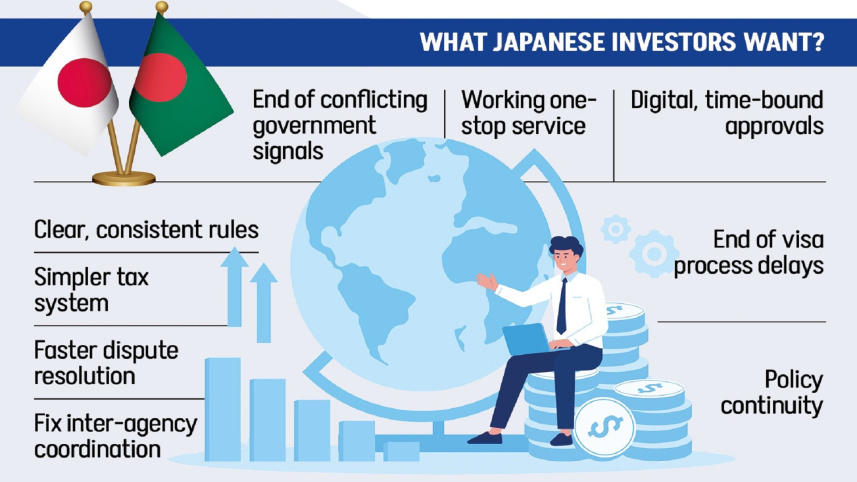
Unpredictable tax practices, weak enforcement, and conflicting regulatory directives continue to raise costs and delay operations for businesses, Japanese investors said today.
Speaking at an event at The Westin Dhaka, marking the Japan Business Day, they argued that without policy continuity, transparent administration, and reliable dispute resolution, long-term investment decisions remain at risk.
 For all latest news, follow The Daily Star's Google News channel.
 The programme was jointly organised by the Embassy of Japan, Bangladesh and Japan External Trade Organisation (Jetro).
“Clear, consistent and fairly applied rules are vital to improve Bangladesh’s investment climate. Uncertainty often outweighs product competitiveness,” said Manabu Sugawara, president of the Japanese Commerce and Industry Association in Dhaka (JCIAD), commonly known as Shoo-Koo-Kai.
He identified tax reform as a priority, calling for simpler procedures, clearer interpretations and reduced discretionary practices, alongside faster services and reliable dispute resolution.
Sugawara highlighted poor coordination among government agencies, saying conflicting directives create delays and raise costs for investors.
He also urged a functional one-stop service with fully digital, streamlined and time-bound approvals, licensing and renewals.
Pointing to persistent visa and permit delays, he said such bottlenecks must be resolved quickly.
Hiroshi Uegaki, country representative of Mitsubishi Corporation, one of Japan’s corporate giants, called for foundational reforms to strengthen Bangladesh’s investment climate for Japanese firms.
He stressed improving data management, business efficiency and digitalisation aligned with international standards to reduce delays.
Uegaki highlighted the importance of economic partnership agreements (EPAs) to ease import-export processes and support smoother operations.
Policy consistency, he added, remains critical to ensure long-term investor confidence and signal a stable, business-friendly environment.
Tareq Rafi Bhuiyan, president of the Japan-Bangladesh Chamber of Commerce and Industry, said the EPA would ensure continued market access to Japan and strengthen investor confidence through a rules-based framework.
The Bangladesh-Japan EPA is being seen as critical to sustaining trade and investment as Bangladesh prepares for LDC graduation, he said.
“Investors value predictability and long-term trust,” he noted, adding that reforms must align with EPA commitments to attract sustained Japanese investment.
Also speaking at the event, Rashed Al Mahmud Titumir, the prime minister’s adviser on finance and planning, pointed out priorities to deepen Bangladesh-Japan economic ties and shift focus from aid to investment-led growth.
He said Bangladesh wants higher Japanese investment to match global averages, with a stronger emphasis on manufacturing to create sustainable jobs.
He also stressed the need for greater technology transfer through joint ventures, enabling long-term industrial capacity and competitiveness.
Titumir added that the government is committed to policy reforms, including deregulation, stronger market-based oversight, and improved contract enforcement to build investor confidence.
Ashik Chowdhury, executive chairman of the Bangladesh Investment Development Authority (Bida), outlined a set of reforms aimed at attracting sustained foreign investment, particularly from Japanese firms.
He said improving the business climate would require making tax administration more transparent and efficient, reducing the burden of unpredictable enforcement. He also stressed the need for stronger coordination among government agencies to avoid conflicting directives that often delay operations.
Chowdhury called for a fully functional “one-stop service” to streamline licensing through digitalisation and ensure visa processing within a predictable timeframe. Policy consistency, he added, remains crucial for long-term corporate planning and boosting investor confidence.
Japanese Ambassador to Bangladesh Shinichi Saida described the recently signed bilateral EPA as a landmark step, urging Bangladesh to view it through a long-term lens rather than immediate gains.
He said the deal offers legal certainty for investors and reinforces a rules-based trade environment at a time of global uncertainty.
Meanwhile, presenting the findings of a survey on business conditions of Japanese firms, Kazuiki Kataoka, country representative of Jetro, said Bangladesh is emerging as a promising frontier for Japanese businesses, with stronger profit expectations and growing interest in expansion.
He noted that 56.9 percent of Japanese firms in Bangladesh plan to expand operations, driven largely by the country’s rising domestic market.
He also pointed to administrative inefficiencies and policy uncertainty as major risks, stressing that improving these areas could unlock greater foreign investment.
Syed Nasim Manzur, managing director of Apex Footwear Limited, said Bangladesh should position itself as a manufacturing hub, exporting to Japan and integrating into global value chains.
Leveraging the EPA, he added, could deepen long-term partnerships and boost trade and services.
M Masrur Reaz, chairman and CEO of the Policy Exchange of Bangladesh (PEB), said Bangladesh’s prospects under the proposed economic partnership with Japan remain promising, but some weaknesses could blunt its gains.
He said weak inter-agency collaboration, fragmented public-private dialogue, and limited private-sector linkages undermine policy execution and investment climate reforms.
Comments