


Institutionalised social dialogue a must to resolve labour-owner disputes
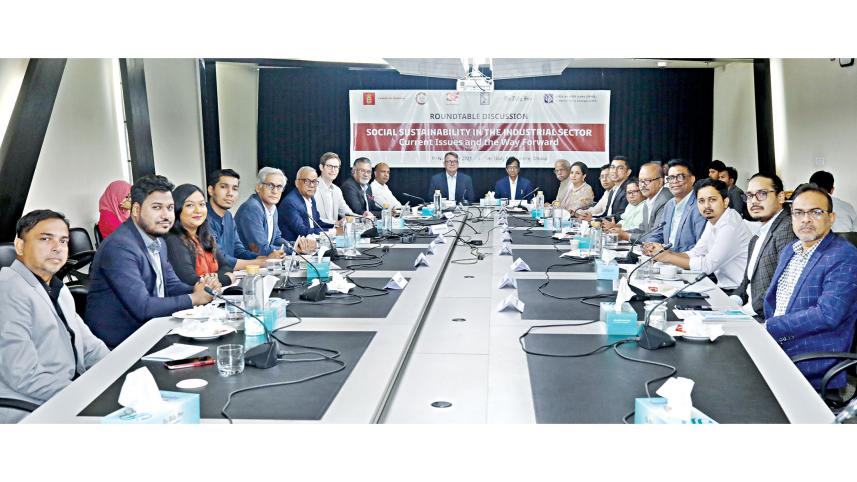
Social dialogue, a widely practised method for resolving industrial disputes, must be institutionalised across all industries so that negotiations can effectively bridge differences such as those surrounding the recently amended labour law, said labour leaders, industry owners and experts yesterday.
A formalised platform for dialogue would allow all parties to discuss and settle disagreements before they escalate, they said at a discussion titled "Social Sustainability in the Industrial Sector: Current Issues and the Way Forward", jointly organised by the Centre for Policy Dialogue (CPD), the Embassy of Denmark and The Daily Star at the newspaper's office in Dhaka.

"The dialogues, however, need to be more transparent, congenial, and coordinated," said Md Abdus Samad Al Azad, joint labour secretary.
Azad noted that Bangladesh has already signed the occupational safety and health-related conventions of the International Labour Organisation (ILO). "Now is the time to create a roadmap for implementing those conventions in the industrial units."
Syed Sultan Uddin Ahmmed, executive director of the Bangladesh Institute of Labour Studies, noted that although the amended labour law acknowledges social dialogue, it must be institutionalised to serve its purpose.
Syed Sultan Uddin Ahmmed, executive director of the Bangladesh Institute of Labour Studies, noted that although the amended labour law acknowledges social dialogue, it must be institutionalised to serve its purpose
For instance, he said job losses triggered by automation could be openly discussed through such platforms to help workers upskill.
The interim government has amended the labour law, gazetted on November 17, revising several provisions, like lowering trade union-registration requirement, expanding definitions and categories, and introducing new safety, hygiene and maternity-related obligations for employers.
One provision that allows a minimum 20-worker trade union, along with redefined labour and workplace categories and employer obligations, has been a point of contention between the labour leaders and factory owners.
While workers welcomed the amendment, factory owners opposed the threshold provision, fearing such a lower number of workers' representation might "affect the stability of factories and allow outsider interference".
Several trade bodies expressed dissatisfaction stating that the decisions of the Tripartite Consultative Council (TCC), the highest platform for labour law amendment, were not incorporated in the amendment.
Meanwhile, speaking from the industry's side, Vidiya Amrit Khan, vice-president of the Bangladesh Garment Manufacturers and Exporters Association (BGMEA), said the garment sector urgently needs a unified code of conduct.
Separate buyers currently demand separate codes, she said, while continuing to offer lower sourcing prices despite the higher compliance costs manufacturers must bear.
Echoing her, Asif Ibrahim, vice-chairman of Newage Group of Industries, said Bangladesh does not need to follow separate codes of conduct for every buyer. "Since Bangladesh is a signatory of the ILO and ratified almost all the required conventions, the country does not need to follow codes of conduct separately."
Neeran Ramjuthan, programme manager at the ILO, called for strengthening alternative dispute resolution mechanisms, especially given the absence of a unified code of conduct.
Workers' representatives highlighted the gaps in the current framework. Shakil Akhter Chowdhury, general secretary of the Bangladesh Labour Federation, emphasised that labour law provisions still fail to adequately address the informal sector, which employs 85 percent of the country's workforce.
"The amended labour law has room for further improvement," he said.
Mentioning Denmark's good practice of social dialogue, Anders Karlsen, deputy head of mission of the Embassy of Denmark in Bangladesh, called for transparency, the right to strike, avoiding political interference and recruiting more labour inspectors.
In his keynote, Ole Rosenborg Justesen, sector adviser at the Embassy of Denmark, stressed that strengthening social dialogue is essential for avoiding a repeat of the Rana Plaza collapse, navigating the graduation from the least developed country category, and meeting emerging global environmental, social and governance expectations.
It also contributes to stability, productivity and the country's reputation, he said.
 For all latest news, follow The Daily Star's Google News channel.
 Voicing concerns from the ground, labour organiser Kalpona Akter, president of the Bangladesh Garment and Industrial Workers Federation, said workers' voices "should also be heard".
She noted that sweater factory workers are losing jobs due to automation and jacquard machines. "Brands and retailers also have responsibilities."
Taslima Akter Lima, president of the Bangladesh Garments Sramik Sanghati, argued that training alone is not sufficient for workers, particularly women. "They also need social protection."
Md Abdul Awal, assistant inspector general (safety) at the Department of Inspection for Factories and Establishments, said officials identified around 140,000 electrical, fire and structural flaws in factories and recommended remediation to strengthen workplace safety.
Industrial accidents beyond the garment sector were also highlighted. Abul Kalam Azad, president of the Tannery Workers Union, pointed to the Hashem Foods fire and recent chemical factory fires, calling the leather and ship-breaking industries among the most hazardous.
Tamim Ahmed, senior research associate at the CPD, said the absence of another Rana Plaza-type disaster in the garment sector can be considered a major success, but workplace safety in transportation, construction and agriculture still lags behind.
"Most of the workers in these areas are suffering from workplace hazards," he said.
Shah Abdul Tarik, additional director of the Department of Labour, said automation is taking place rapidly as multinational companies are investing heavily – billions of dollars – in automated production systems, making worker upskilling essential.
The discussion was also addressed by Avra Bhattacharjee, additional director at the CPD, and moderated by Tanjim Ferdous, in charge of NGOs and Foreign Missions at The Daily Star.
Comments