


Increasing taxes on essentials: adding fuel to Bangladesh’s inflation crisis

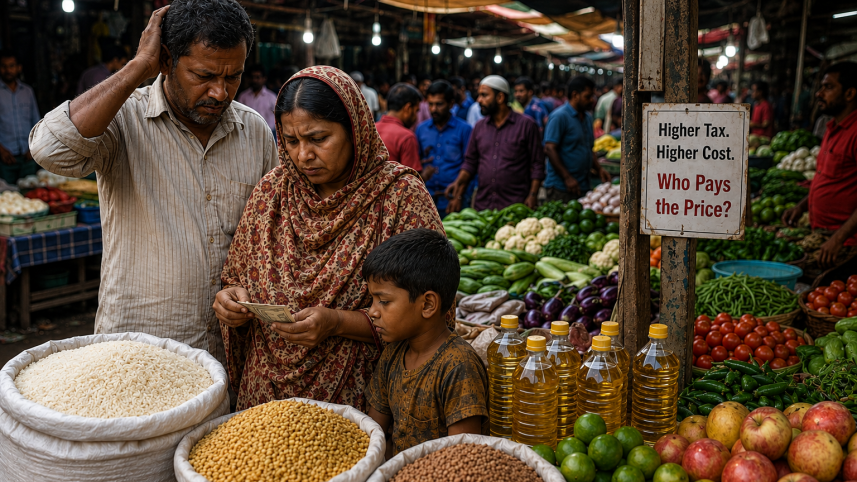
In Bangladesh today, the greatest struggle for ordinary citizens is no longer political uncertainty; it is economic survival. For millions of families, the daily challenge is not debating national issues but simply affording basic necessities. A visit to any local market reveals the reality: middle-income families are cutting back on groceries, while low-income households are struggling to afford even the most essential items.
At such a critical moment, the proposal by the National Board of Revenue (NBR) to increase the source tax on essential commodities from 0.5 percent to 1 percent raises serious concerns. The proposed tax hike would affect key everyday goods such as rice, pulses, edible oil, and fruits. While the increase may appear marginal on paper, its consequences in Bangladesh’s fragile market structure could be far-reaching.

In theory, a 0.5 percent increase may seem insignificant. In practice, however, additional taxation rarely remains confined to importers or wholesalers. Importers pass the extra cost on to wholesalers, wholesalers shift the burden to retailers, and retailers ultimately transfer it to consumers. In economic terms, this is known as cost pass-through, and in Bangladesh, the final burden almost always falls on ordinary citizens — basically, the final consumers.
At a time when inflation continues to erode purchasing power, such a move risks deepening public hardship. Inflation in Bangladesh is no longer an abstract economic indicator; it is a harsh daily reality. Families that once managed their monthly budgets comfortably are now forced to cut spending before the month ends. Many households have reduced their consumption of fish, meat, and fruits, while others are struggling to maintain basic nutrition.
The most troubling aspect of this proposed tax increase is that it targets essential goods — items people cannot simply stop buying. Rice, pulses, and cooking oil are not luxury products; they are necessities. Economists describe these products as having “inelastic demand,” meaning consumers must continue purchasing them even when prices rise. As a result, higher taxes on these items disproportionately hurt lower- and middle-income families.
Such decisions not only create economic pressure but also carry political repercussions because ordinary people determine a large part of their satisfaction or dissatisfaction with the government based on their everyday experiences. When people see that their incomes are not increasing but their daily expenses are rising, questions about the government’s economic management naturally emerge.
History has repeatedly shown that prolonged increases in living costs create widespread social stress and public dissatisfaction. It has been observed in various countries that a prolonged rise in commodity prices creates stress in the daily lives of ordinary people and increases expectations from the government.
In Bangladesh too, people naturally want the government to play an effective role in controlling the market situation and keeping the prices of essential commodities at a tolerable level. Therefore, it is important to consider the purchasing power of the general public and the overall market reality when making such decisions in the current situation. Timely and people-friendly measures can strengthen public trust in the government.
This expectation becomes even more significant considering the government’s repeated commitments to building a just, humane, and prosperous Bangladesh — often referred to as “Bangladesh First” — by reducing poverty, strengthening social protection, and improving living standards. Election promises emphasized lowering the cost of living and creating a more efficient market system. Yet imposing additional taxes on basic necessities appears inconsistent with those commitments.
Certainly, taxation remains essential for any government. Revenue is needed to fund infrastructure, education, healthcare, and social welfare programmes. However, an important question must be asked: should revenue generation come at the expense of ordinary people’s kitchens?
Bangladesh has long faced allegations of large-scale tax evasion, loan defaults, illicit financial outflows, and administrative inefficiencies involving billions of taka. If the government chooses to increase taxes on basic goods without taking stronger action against major tax evaders and financial irregularities, it risks reinforcing public perceptions of inequality and unfairness.
Consumer confidence remains a critical driver of economic growth. When households have less disposable income, demand declines, small businesses suffer, and economic activity slows. While taxing essential goods may generate short-term revenue, it could create long-term economic and political costs.
The responsibility of a government extends far beyond revenue collection; it must also safeguard the welfare and dignity of its citizens. At a time when many families are already struggling with rising living costs, imposing additional financial burdens through higher taxes on essential commodities is both economically questionable and socially insensitive.
Instead, policymakers should prioritize broadening the tax base, curbing wasteful public expenditures, addressing tax evasion, and strengthening market regulation to ensure greater efficiency and fairness in revenue generation.
The success of a government should not be assessed solely through large-scale infrastructure projects or ambitious development agendas. It must also be measured by its ability to reduce the everyday hardships faced by ordinary citizens. The proposed increase in source tax on essential goods is not merely a fiscal measure; it carries significant implications for household affordability, market stability, and public confidence in government policies.
Given Bangladesh’s current economic challenges, the need of the hour is to identify alternative revenue streams and implement meaningful reforms in market governance without placing further pressure on low- and middle-income households. Development, in its truest sense, should improve the quality of life for citizens, not make it more difficult.
The writer is a fellow chartered accountant and a financial sector analyst. He can be reached at faysal.aqc@gmail.com
 For all latest news, follow The Daily Star's Google News channel.
Comments