


How much per capita debt does Bangladesh have?

It is great news for Bangladesh to see its per capita income rising gradually. But have we ever thought about how much per capita debt we currently have, and how much the government is spending per head?
The government has to take a huge amount of loans every year from different sources to cover development and non-development expenditures.

At the beginning of a fiscal year, the government prepares a list of tasks that need to be undertaken to ensure economic growth and development, and to fulfil the promises made to the general public during elections.
Then it begins identifying potential sources of revenue and explores ways to increase tax and non-tax income to finance the planned expenditures—this is known as the annual financial statement or national budget.
Despite collecting lakhs of crores of taka in revenue, the government consistently falls short of funds to finance the entire budget and has to borrow crores of taka from both domestic and foreign sources.
The burden of these loans ultimately falls on the shoulders of the general public, as they are repaid with taxpayers' money.
Bangladesh's total loan stood at Tk 1,006,202 crore at the end of the 2019-20 fiscal year and Tk 1,144,297 crore in the following fiscal year, according to the September 2021 edition of the Debt Bulletin released by the finance ministry.
In 2019-20, Bangladesh's per capita national debt stood at Tk 59,822, based on a population of 16.82 crore, according to data from the Bangladesh Bureau of Statistics.
The next year, per capita debt rose by 14 percent to Tk 68,031.
Now, let's explore where the government sources its loans and how per capita debt compares across other South Asian nations.
Two-thirds of Bangladesh's loan taken in the 2020-21 fiscal year came from local sources, and the rest from foreign countries and global lenders.
The government takes the highest amount of local loans from savings certificates, uses the funds, and in exchange pays interest at varying rates.
Treasury bills, treasury bonds, and Sukuk are other sources of local loans.
The major portion of the foreign loans Bangladesh took in the 2020-21 fiscal year came from the World Bank, the Asian Development Bank, Japan, Russia, China, and India.
It is important to mention that it is easier for the government to repay foreign loans, which come with longer repayment periods and lower interest rates.
On the other hand, the interest the government pays to the public for savings certificates is much higher than the interest paid on foreign loans.

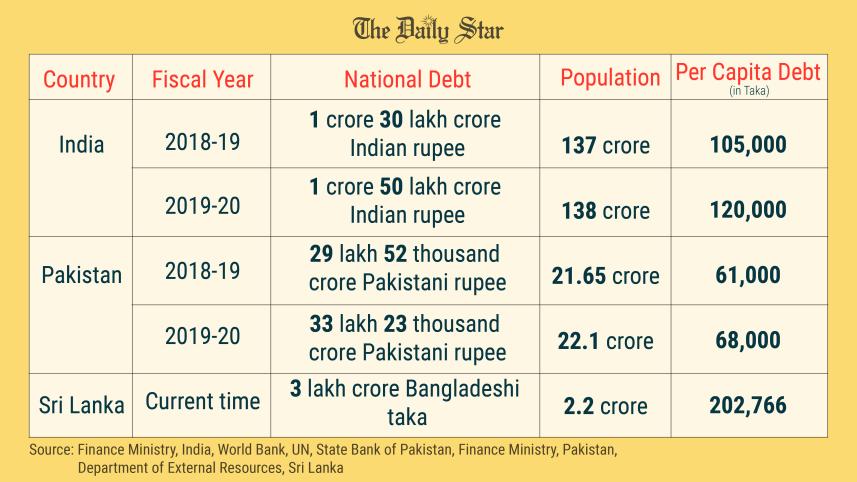
Now let's focus on the per capita debt of the neighbouring countries of Bangladesh.
India, the largest economy in South Asia, had a per capita debt of over Rs 105,000 in 2019, which crossed Rs 120,000 in 2020, according to data from the Indian finance ministry, the World Bank, and the United Nations.
 For all latest news, follow The Daily Star's Google News channel.
 Pakistan's per capita debt was Rs 68,000 at the beginning of the current financial year, up from Rs 61,000 in the previous year, according to data from the State Bank of Pakistan, the Pakistani finance ministry, and the World Bank.
Sri Lanka's per capita debt—which is currently going through a severe economic crisis—exceeds Rs 200,000 if the country's foreign loans alone are taken into consideration, according to the Department of External Resources of Sri Lanka and the World Bank.
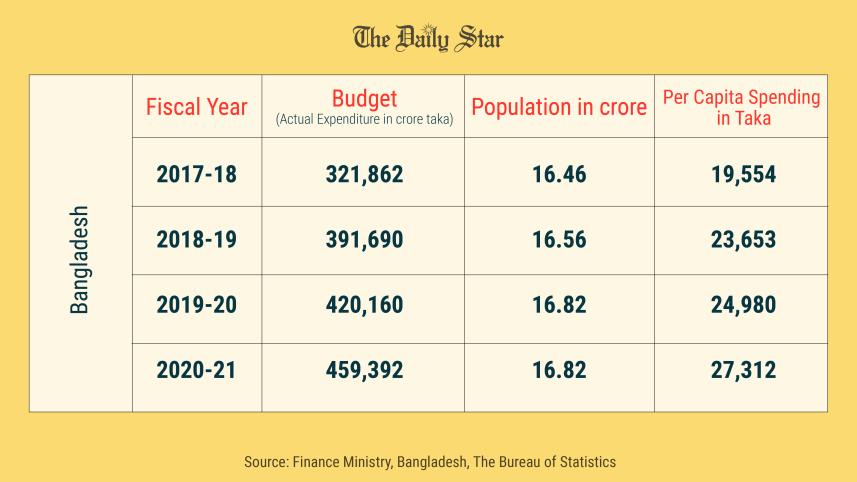
Now the question is: how much did the government of Bangladesh spend per capita in the 2020-21 fiscal year?
The per capita expenditure of the government through the budget has increased every year. In the 2017-18 fiscal year, the government spent Tk 19,554 per capita through the budget.
The very next year, the amount increased by more than 20 percent. In the following two years, spending rose and reached Tk 27,312 in 2020-21.
It is important to note that this per capita debt is calculated based on the total amount of money borrowed by the government so far. The country does not need to repay the loans all at once; every year, the government sets aside a portion of the national budget to pay interest on the loans.
However, it is also worth mentioning that Bangladesh's loan repayment record has always been, and still is, strong.
Moreover, prominent economist Wahiduddin Mahmud, in a recently published article, said the pressure on Bangladesh to repay its loans may have increased due to the coronavirus pandemic and the debts from mega projects.
"But there is nothing to be worried about Bangladesh's debt right now," the economist said.
Comments