


Governor Ahsan H Mansur gets higher rating from Global Finance as reforms take hold

Bangladesh Bank (BB) Governor Ahsan H Mansur has earned a higher score than his predecessor Abdur Rouf Talukder in the central banker report cards by Global Finance, a New York-based magazine and digital platform serving corporates, bankers, and investors worldwide.
Mansur scored C+, higher than the D that Rouf received, owing to his steps to contain elevated inflation and overhaul Bangladesh's crisis-hit financial system.

The current governor, who assumed office in August last year following the ouster of Sheikh Hasina's previous government, scored even better than another predecessor, Atiur Rahman. Global Finance rated Rahman C in 2013.
The publication's annual report cards grade nearly 100 governors worldwide on inflation control, growth, currency stability, interest rate management, and independence, using an A+ to F scale since 1994.
For relatively newly appointed governors, it does not assign any score.
According to the magazine, the Governor of the Central Bank of Sri Lanka, Nandalal Weerasinghe, scored A, the highest among central bankers, followed by the Governor of the State Bank of Pakistan, Jameel Ahmad, in South Asia.
For the Governor of the Reserve Bank of India, Sanjay Malhotra, it said "Too Early To Say" (TETS).
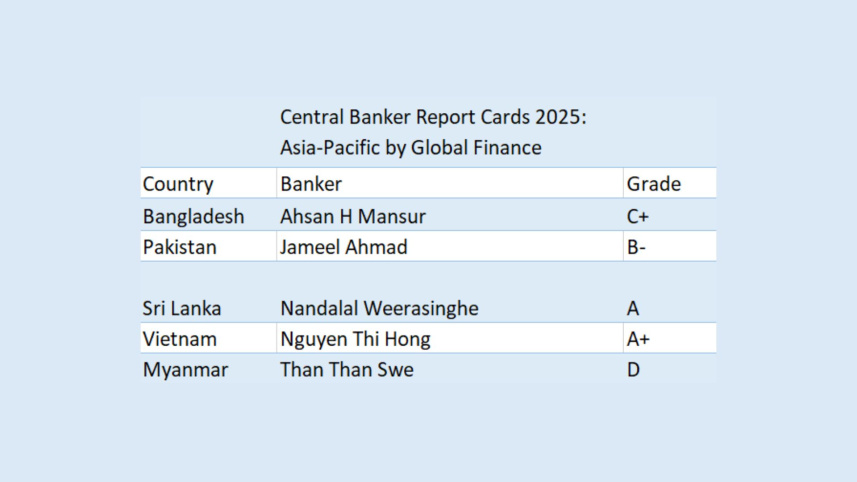
Among the 26 central bankers in the Asia-Pacific, the Governor of the State Bank of Vietnam, Nguyen Thi Hong, received the highest score, A+. Daw Than Than Swe, governor of the Central Bank of Myanmar, received the lowest score, D, in the region, according to Global Finance.
Mansur, a former economist at the International Monetary Fund (IMF), assumed office under the current interim government after Hasina fled to India amid a mass uprising.
"In the interim, he has recognised with clarity the need to restore balance to Bangladeshi financial institutions, spur growth, and tackle rampant inflation—in a bid to stabilise the taka, which has fallen about 4 percent against the US dollar so far this year—as well as the need to restore fundamental faith in the country as an investment proposition," said Global Finance.
His first policy move was a 50-basis-point hike in the overnight repo rate to 9 percent, followed by two further increases that raised the policy rate to 10 percent in October last year.
Inflation, which stood at 10.5 percent at the start of the tightening, eased to 8.55 percent in July. Mansur projects a decline to 5 percent by year-end.
Despite pressure to ease policy to spur growth, he has kept the rate at 10 percent. The Asian Development Bank estimated GDP growth at 3.9 percent for the fiscal year ended in June, far below the 6.4 percent annual average recorded between 2010 and 2020.
"Mansur has grasped the need to overhaul the country's crisis-hit financial system," it said, adding that he has introduced a three-year reform road map under the auspices of the IMF.
"This includes banking system consolidation, non-performing loan resolution, and an overhaul of bankruptcy and restructuring legislation. Perhaps this will help bring the heady days of non-stop growth back to Bangladesh again."
 For all latest news, follow The Daily Star's Google News channel.
Comments